Welcome Email: Examples and a Sequence That Converts
Your welcome email sequence sets the tone for every email that follows. Here are best practices for building a 3 to 5 email welcome series that builds trust and converts new subscribers.
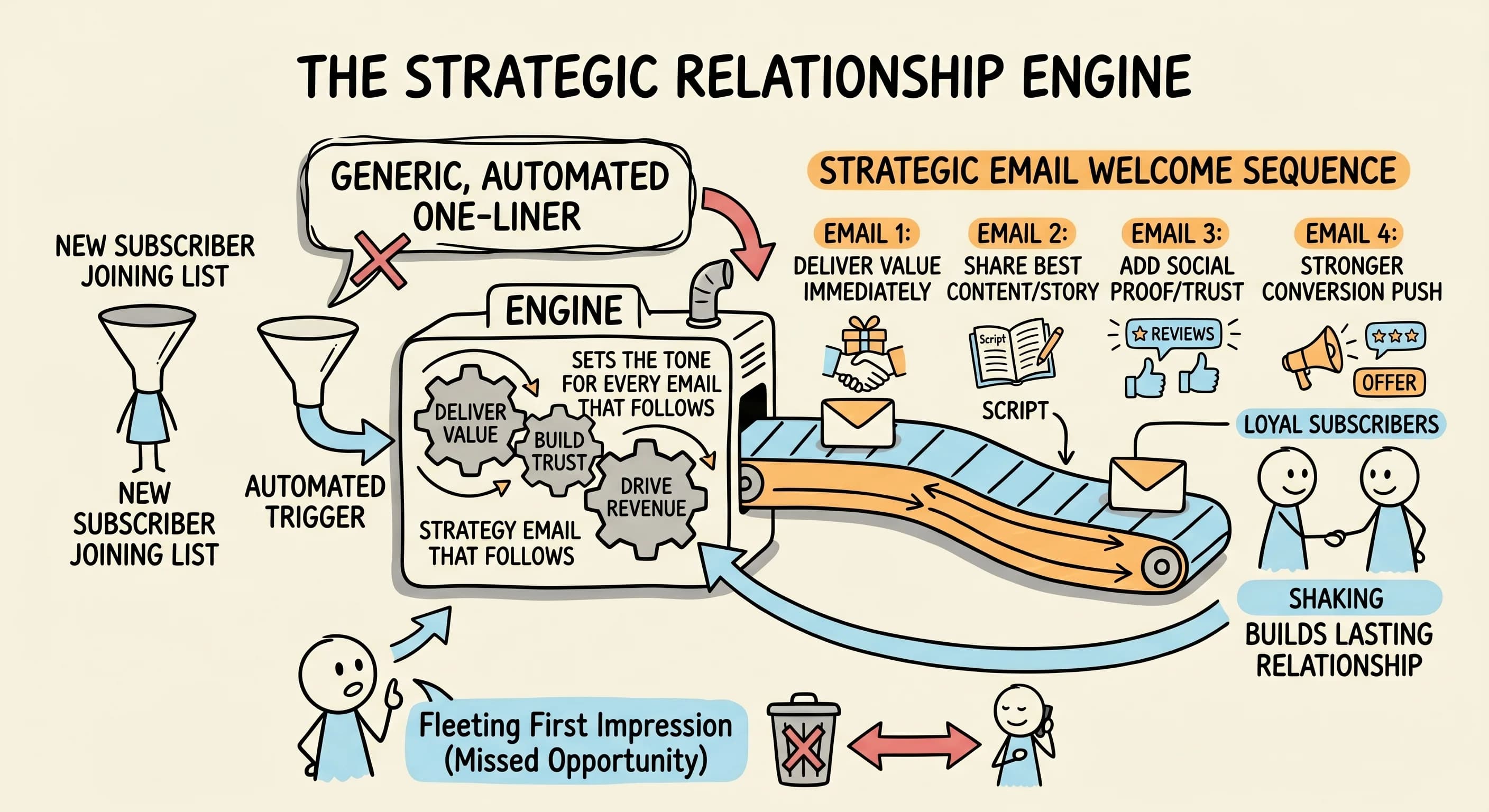
Your welcome email is the single highest open-rate email you will ever send. New subscribers are curious, engaged, and ready to hear from you, so why waste that moment with a generic, automated one-liner? The best welcome emails do far more than say hello. They build trust, drive revenue, and set the tone for every email that follows. Whether you are just starting out or looking to sharpen your email strategy, a well-built welcome series is one of the smartest investments you can make.
What Is a Welcome Email Series?
A welcome email series is a set of multiple emails sent automatically to new subscribers after they join your list. Unlike a one-time welcome message, a series gives you space to introduce yourself, deliver value, build trust, and guide readers toward a meaningful action, all without cramming everything into a single message.
This is different from your regular newsletter or weekly newsletter. Those go to your entire list on an ongoing basis. Your welcome series runs in the background as a welcome automation, triggered the moment someone signs up. Set it up once and it works for every new subscriber who joins from that day forward.
For new customers, an effective welcome experience can be the difference between someone who reads every email you send and someone who unsubscribes after the second one.
Why Not Just Send One Email?
Most creators send one email and move on. That is a missed opportunity. A strategic email welcome sequence turns a fleeting first impression into a lasting relationship. Instead of cramming every introduction, resource, and offer into a single message, a series of emails lets you deliver value gradually without overwhelming your new subscriber.
AWeber recommends a 3 to 5 email sequence spread across the first week because one welcome email simply leaves the relationship-building work unfinished. Beehiiv puts it even more directly: sequences let you drip onboarding details to avoid overwhelming your readers while building suspense around a special offer. Email marketing expert Chase Dimond takes a similar approach, structuring a 4 to 5 email welcome flow that opens with immediate value, then layers in story, social proof, and a final conversion push.
Isn't 4 to 6 emails excessive? Not when you consider that welcome emails consistently outperform every other type of campaign. The open rate for a well-crafted welcome series routinely outpaces that of regular broadcast emails. Readers are most engaged right after signing up, so that is exactly when you want to be showing up in their inbox with something worth reading.
Think of your welcome series as a short email campaign designed specifically to onboard, engage, and convert. Each email in the sequence has one job, and together they create a cohesive journey from stranger to loyal reader. A well-crafted welcome email is the single most important type of email you will send, because it opens the email communication that turns new email subscribers into buyers. Whether you send a welcome email as one message or build various welcome email steps into a strong welcome series, the goal of that first great email is the same: earn the next open.
How Many Emails Should Be in a Welcome Email Series?
One of the most common questions about the welcome series is simply: how many emails should you include in your welcome email series? The honest answer is that 3 to 5 emails is a reliable range for most creators and businesses. Some go up to 6. The right number depends on how much you have to share, what you are selling, and how warm your audience is when they arrive.
If you have multiple lead magnets or freebies, you do not need a different welcome sequence for each one. One well-structured welcome series can acknowledge which freebie brought someone in and still walk every subscriber through the same core onboarding journey. This kind of personalisation is straightforward inside most modern platforms.
Want to learn how to write an email welcome sequence of your own? Start by mapping the journey you want each new subscriber to take, from curious newcomer to confident, engaged reader.
How to Write a Welcome Email Sequence That Converts
Email One: Deliver Value Immediately
 Your first email should feel like a warm handshake. Introduce yourself, explain exactly what subscribers will receive, and set clear expectations. What makes this stand out from other examples? Embed a short personal video greeting.
Seeing your face and hearing your voice builds instant trust, and very few creators are actually doing it. Beehiiv explicitly recommends embedding a video into the body of your welcome email, and Constant Contact describes video welcome emails as a powerful combination of personal connection and exclusive subscriber benefits. This small addition transforms a standard template into a memorable, human moment.
Also include a subscriber-exclusive offer in this first email, whether that is a discount, a free welcome resource, or a bonus session. Chase Dimond's welcome framework opens with exactly this: a discount code or lead magnet delivered immediately in the opening message. This creates an immediate monetisation opportunity while rewarding new subscribers for joining.
When you send an email like this, keep it focused. One clear message, one clear next step. Your email content should reflect the voice and tone your subscribers fell in love with before they signed up.
How to Write a Good Welcome Email Subject Line
Your subject line is the first thing a reader sees before they decide whether to open at all. Keep it clear, warm, and specific to what they signed up for. Strong options include things like "Here's what you signed up for," "Your free resource is inside," or even a direct, curious opener like "What brought you here?" Avoid vague openers that could belong to any sender. Personalisation and specificity win every time.
A great subject line balances curiosity with clarity. You want to spark interest without misleading anyone, because trust is exactly what this first email is supposed to build. Good welcome email subject lines are short, specific, and personal, and they set up the email copy that follows.
Ask for a Reply to Protect Deliverability
Here is a critical best practices move most creators overlook: ask your new subscriber to reply to your email. This signals to email providers that your messages are legitimate and welcome, which keeps you out of spam folders and dramatically improves deliverability over time.
A soft prompt works better than a direct ask. Something like "Hit reply and tell me what you are working on" is far more natural than a transactional request, and it tends to generate more actual replies. AWeber recommends making it easy for subscribers to reach you and encouraging them to recognise your sender address, both of which reinforce the same underlying deliverability principle. Use your welcome series to start that two-way conversation early.
Subsequent Emails in Your Welcome Series
 Once your first email lands, the following messages do the deeper work of building trust and moving toward conversion. Here is a structure that is well-supported across multiple creator-focused platforms:
The second email: Share your best past content, your origin story, or your core mission. AWeber recommends this as the natural follow-up to an initial warm welcome, giving subscribers context for why your newsletter exists and what makes it worth sticking around for.
The third email: Add social proof, answer common questions, and remind subscribers of the exclusive benefit from your opening message. This is where trust compounds. Help your subscribers understand exactly what makes your content different from everything else in their inbox.
 Email 4: Include a stronger conversion push or a deadline around your offer. Chase Dimond's framework uses this email for urgency and a clear call to action.
Email 5 (optional): Send a final reminder, a segmentation prompt, or another reply request. This is also a good place to ask subscribers what topics they care most about, which helps you personalise future emails. By the end of the welcome series, every subscriber should feel oriented, valued, and clear on what comes next.
Space individual emails across several days to maintain engagement without fatigue. Sending too quickly can feel overwhelming. Spacing them too far apart and readers forget who you are.
Welcome Email Examples and Templates That Convert
Want to see what the best welcome email examples look like in practice? The 10 welcome email examples curated by Kit show a range of approaches across different niches and business types. Some lead with a bold personal story. Others open with a freebie or an irresistible offer. What the best welcome email examples and the strongest welcome email templates share is this: they feel personal, they deliver on the promise that earned the signup, and they make it obvious what to do next.
Studying welcome email examples is one of the fastest ways to understand what a great welcome email should feel like at a gut level, from the subject line to the email copy to the call to action. Notice how many avoid a generic opener. Notice how many treat layout and design as a core part of the experience rather than an afterthought. Clean, readable formatting reinforces the sense that you are professional and that your work is worth their time.
Free welcome email templates are available inside most major platforms. They are a useful starting point, but the creators who get results are the ones who customise the welcome email copy and welcome email design to reflect their actual voice and specific audience promise. Whatever type of welcome email you send, the welcome email best practices are the same: one clear message, a personal tone, and an obvious next step for your new users.
Setting Up a Welcome Automation
Setting up a welcome sequence starts with choosing the right email marketing software. Tools like Kit, Beehiiv, AWeber, and MailerLite all handle marketing automation, so your welcome series email flow fires the moment someone fills in your signup form. This welcome email automation means you write the email body once, schedule the delays between them, and the platform handles the rest, sending your welcome to every new subscriber automatically. Set up multiple welcome steps and make your welcome email feel personal even though it's automated. Making this the backbone of your email marketing strategy is one of the highest-ROI moves in all of email marketing.
To make your welcome sequence run smoothly, map out your emails before you start writing. Decide on the number of emails, the spacing, and the goal of each one. Then write each message individually, keeping the focus tight. If you try to create an email that does five things at once, it usually does none of them well.
When you send an email automatically through your platform, every new subscriber gets the same polished experience regardless of when they sign up. This consistency is one of the biggest advantages of automation over sending emails manually one at a time. Whether you use email and SMS together or rely on email-based onboarding alone, the sequence structure stays the same.
How to Transition From Your Welcome Series to Regular Broadcasts
 One of the most practical questions creators ask is how to combine broadcasts and a welcome series without confusing subscribers or sending too many emails at once. The simplest approach is to set a rule inside your platform that pauses broadcast delivery for anyone currently inside the welcome sequence. Once they finish the series, they roll into your regular email cadence automatically.
If you send a weekly newsletter, new subscribers will begin receiving it as soon as they exit the welcome automation. This gives them a contained onboarding experience first and then a smooth transition into your regular email rhythm. It also means you are not sending multiple emails on the same day to someone who just signed up.
Use your welcome series to set expectations about what your regular newsletter covers, how often subscribers receive emails, and what kind of value they will keep getting. The series acts as the bridge between the excitement of signing up and the long-term habit of reading every edition.
What Good Performance Looks Like for a Welcome Series
Curious about what good performance looks like? Welcome emails typically see open rates well above 50 percent, which is significantly higher than the average for standard broadcast campaigns. Click rates also tend to be stronger in the first few emails of a sequence, because subscribers are still in an active decision-making mindset about whether to stay engaged.
If your welcome series is underperforming, the most common culprits are a weak subject line, an unclear value proposition in the first email, or a mismatch between what the signup form promised and what the emails deliver. Fix those three things first before adjusting the length or structure of the series. Test your welcome flow the way you would any email marketing campaigns: change one variable at a time and watch how welcome email performance moves.
Getting More Subscribers Into Your Welcome Series
Wanna get more subscribers on your email list but do not know how? The most reliable paths are a compelling lead magnet, a well-placed signup form, and consistent content that gives people a reason to want more. Once someone subscribes, your welcome series is what converts that initial curiosity into a genuine relationship. Get emails flowing to new subscribers quickly so you capitalise on that early excitement.
How do you get that podcast listener or social media follower to sign up? Offer them something specific and immediately useful, then make sure your welcome series delivers on that promise within minutes of them signing up.
Start Building Your Welcome Sequence Today
Your email list deserves better than a forgettable automated message. A thoughtful welcome series, complete with video, an exclusive offer, and a reply request, is one of the highest-impact moves in email marketing for individual creators. Get your automation live once, and it works for every new subscriber who joins from this point forward.
Excited to write your own welcome email? Start with email one. Keep it simple, personal, and focused on delivering exactly what you promised when they signed up. The rest of the series can follow from there.
The creators who grow loyal, buying audiences are not necessarily sending more emails. They are sending smarter ones, starting from the very first message. Whether you are creating a welcome sequence from scratch or refining an existing one, the goal is the same: make every new subscriber feel like joining your list was exactly the right decision.
Read more about Monetization & Business Models for Content Creators
📚 Complete Guides
- Content Creator Monetization: Proven Revenue Streams
- Content Creator Income Streams: 7 Ways to Build Financial Stability
⚡ Tactics & Strategies
- 30 Daily Outbound Pitches for UGC Deal Generation
- Affiliate Code Negotiation Using Membership Audience Influence
- Age Bracket as Superpower Strategy for Older UGC Creators
- B2B Merchandise Bulk Sales to Industry Professionals- Packaging Products as Client Gifts for Lawyers and Service Providers
- Becoming Your Own Sponsor by Plugging Your Offer Within Episodes
📄 Related Articles
- Online Course Feedback: Use It to Improve Your Course
- UGC Usage Rights Explained: What to Charge and How to License
- Why Content Creators Must Demand Monetary Payment for Influencer Partnerships
- What Is a Good Engagement Rate? Benchmarks by Platform
- The Future of Online Courses: What AI Means for Course Creators
- YouTube CTR: How to Improve Your Click-Through Rate
- YouTube Shorts vs Long-Form Content: Which Fits Your Creator Personality
- YouTube Titles That Get Clicks: Stop Describing, Start Converting
🧮 Calculators
Read more about Systems, Workflows & Operations for Content Creators

Alex Kirillov
One link. Every channel, rate, and piece of work brands need to evaluate you. Built for how creators actually get hired.
Claim your profile
Live creator, content, and marketing roles from real companies, with the pay, market, and context the raw job page never gives you.
Browse jobs