
Why Content Creators Must Demand Monetary Payment for Influencer Partnerships
Learn why content creators must reject product-only deals and demand monetary payment for influencer partnerships. Professional compensation strategies for sustainable creator careers.
Details
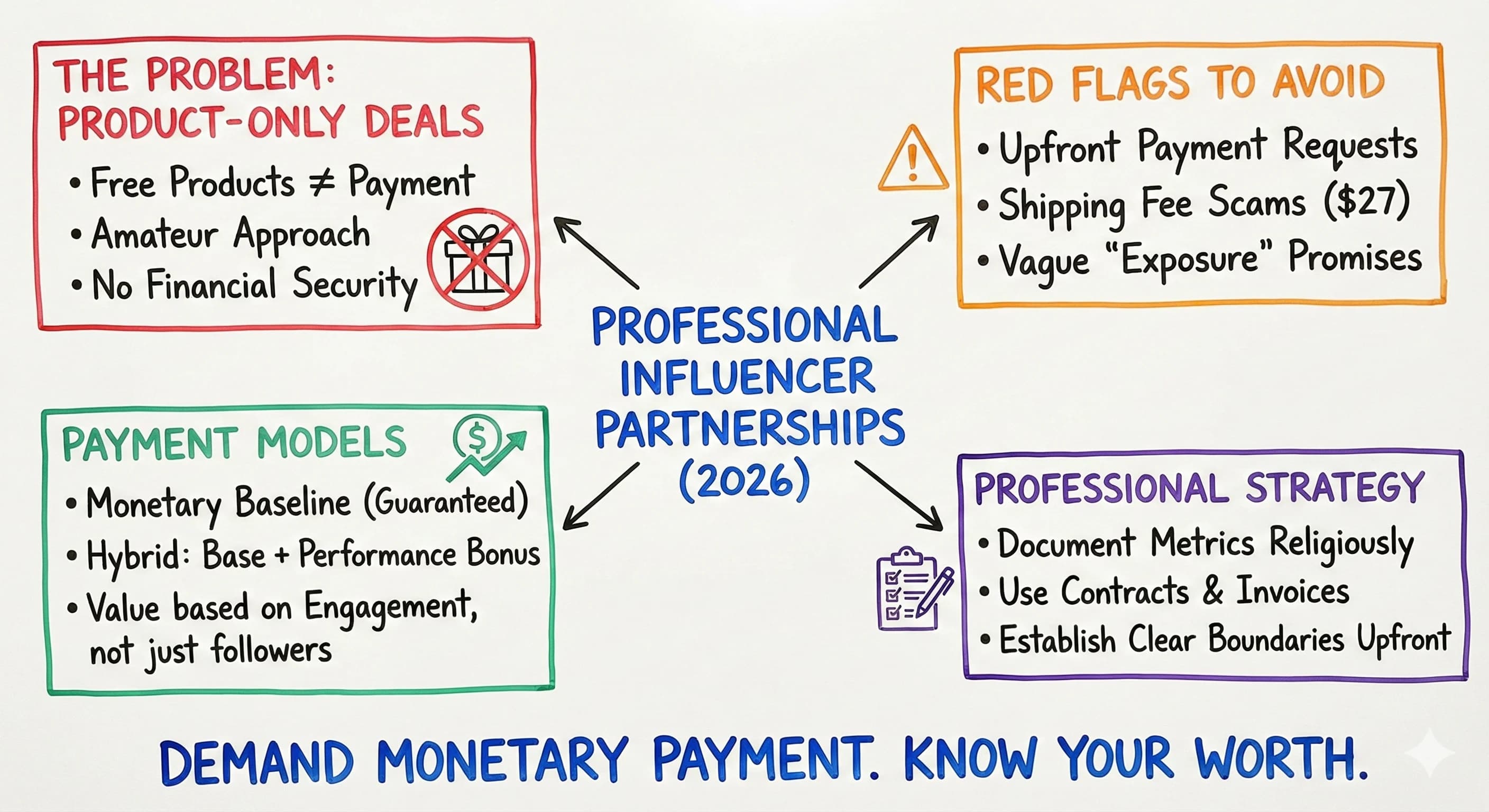
Let's get straight to the point: if a brand offers you free products instead of money, that's your first red flag. We're not living in the early days of influencer marketing anymore. Over 85% of brands actively use influencer marketing now, and they know they need to pay real money for real work.
The Problem with Product-Only Payment Structures
 When brands offer only free products instead of monetary compensation, they're basically telling you they don't understand how professional influencer partnerships work. This isn't about being greedy: it's about recognizing your worth in an industry that's already established clear payment standards.
Here's what the data shows: experienced brands consistently move away from product-only deals once they understand the ROI potential. According to industry payment guides, gifting is primarily reserved for nano influencers who are just building their personal brands, while established creators expect guaranteed monetary payments. This transition isn't accidental: it reflects the professional maturation of the entire industry.
You've probably seen those really shady tactics where brands ask you to pay upfront for products or cover "shipping fees" that somehow cost $27. These aren't legitimate business practices. Professional brands cover all associated costs because they understand you're providing a service, not participating in some weird trade system.
How Much Should Influencers Get Paid for Brand Partnerships?
The compensation landscape varies dramatically based on your platform and engagement metrics, but here's what you need to know: micro influencers on TikTok typically earn $100-500 per post, while established creators command thousands. The key isn't just follower count: it's about demonstrating clear value through engagement rates and audience demographics.
Creators who consistently demand monetary compensation often use hybrid payment models that include a guaranteed base fee plus performance bonuses. This approach gives you financial security while allowing brands to tie additional compensation to measurable results. Some successful creators have built their entire strategy around refusing product-only deals, which actually positions them as more professional and desirable partners.
Calculate your baseline rate using engagement data, audience demographics, and platform-specific benchmarks. This isn't guesswork anymore: there are established industry standards you can reference to justify your rates.
Red Flags: When Brands Cross Professional Boundaries
 Beyond product-only offers, watch for these warning signs that indicate you're dealing with inexperienced or potentially problematic brands:
Upfront payment requests: Legitimate brands never ask creators to pay for products. If they're asking for money from you, run.
Shipping fee schemes: Professional partnerships cover all costs. That $27 shipping fee? It's a scam designed to make you pay for the privilege of creating content.
Unclear payment terms: Established brands provide detailed contracts with specific payment methods and timelines. Vague promises about "exposure" or "future opportunities" don't pay your bills.
The only acceptable exception involves overseas logistics where purchasing readily available products locally makes sense, like buying a Kit Kat from your local store instead of waiting for international shipping. But even in these cases, the brand should pay a separate content fee.
Real Creator Success Stories: The Monetary-First Approach
Several mid-tier creators have documented their success using what industry experts call the "monetary baseline" strategy. These creators establish clear policies: they only accept partnerships with guaranteed monetary base fees, though they might add performance bonuses or affiliate commissions on top.
One beauty creator with 50K Instagram followers shared how rejecting all product-only deals actually increased her booking rate with higher-quality brands. By positioning herself as a professional who works for money, not gifts, she attracted brands with proper budgets and clear campaign goals.
The pattern is consistent: creators who professionalize their approach by demanding monetary compensation tend to build more sustainable, long-term partnerships with brands that understand influencer marketing ROI.
Maximizing Your Influencer Partnership Strategy
To position yourself for monetary compensation and avoid product-only traps:
Document your metrics religiously: Track engagement rates, reach, and any conversion data across all platforms. Brands that pay fair rates want to see clear performance indicators.
Create professional contracts and invoices: Use the same systems that established brands use: detailed contracts, specific payment terms, and professional invoicing. This signals that you're running a business, not a hobby.
Establish clear boundaries upfront: Include your payment requirements in your media kit and initial communications. Don't wait until negotiations to mention that you only work for monetary compensation.
Diversify revenue streams strategically: Combine fixed fees with affiliate marketing opportunities, but always ensure there's a monetary baseline. Performance bonuses should supplement, never replace, guaranteed payment.
Platform-Specific Monetization Approaches
Different platforms offer varying monetization opportunities, but the principle remains the same: demand monetary compensation regardless of where you create content. TikTok creators might combine fixed fees with affiliate links for viral content, while YouTube influencers can leverage longer-form content for comprehensive product reviews with guaranteed payment plus performance bonuses.
The key is understanding what works best for your specific platform while maintaining your monetary payment requirements across all partnerships.
Your Content Has Real Value
 The influencer industry's maturation means you need to professionalize your approach to brand partnerships immediately. Rejecting product-only offers isn't just about your bank account: you're helping establish industry standards that benefit all creators.
Experienced brands already understand this shift. They budget for influencer compensation like any other marketing expense because they've seen the ROI data. When you demand monetary payment, you're not being difficult: you're positioning yourself to work with brands that take influencer marketing seriously.
Focus on building relationships with companies that recognize the true value of authentic content creation. Your expertise in creating engaging content deserves monetary recognition, and there's no excuse for accepting anything less.
Read more about Monetization & Business Models for Content Creators
📚 Complete Guides
- Content Creator Monetization: Proven Revenue Streams
- Content Creator Income Streams: 7 Ways to Build Financial Stability
⚡ Tactics & Strategies
- 30 Daily Outbound Pitches for UGC Deal Generation
- Affiliate Code Negotiation Using Membership Audience Influence
- Age Bracket as Superpower Strategy for Older UGC Creators
- B2B Merchandise Bulk Sales to Industry Professionals- Packaging Products as Client Gifts for Lawyers and Service Providers
- Becoming Your Own Sponsor by Plugging Your Offer Within Episodes
📄 Related Articles
- Best Community Platforms for Course Creators
- How to Retain Clients and Build Recurring Revenue
- How to Find Influencers for Your Brand (Start In-House)
- How to Get Brand Deals as a Creator (Without Pitching)
- How to Get Videography Clients Without Ads
- Get Paid to Use Sounds on TikTok: Music Campaign Strategies
- How Many Followers Do You Need to Make Money? (Start at 500)
- How to Sell Wholesale as a Content Creator
🧮 Calculators
Free: The Creator Payment Playbook
Get the interactive tool, downloadable PDF, and Notion template - all free.
No spam. Unsubscribe anytime.

Alex Kirillov
Details
One link. Every channel, rate, and piece of work brands need to evaluate you. Built for how creators actually get hired.
Claim your profile
Live creator, content, and marketing roles from real companies, with the pay, market, and context the raw job page never gives you.
Browse jobs