
How to Price Creative Services: The Four-Pillar Framework for Freelancers and Designers
Master the four-pillar pricing framework that helps content creators shift from competing on price to demonstrating genuine customer value through strategic positioning.
Details
Understanding Why It's So Hard to Price Creative Work
Is it any wonder that pricing remains a confounding issue and stumbling block for so many professional creatives? You pour real skill, experience, and hours into your creative work, and then someone asks "what's your price?" and your brain goes blank. Whether you're trying to figure out how to price creative services for the first time or you're revisiting a pricing structure that stopped working, most of us have been there.
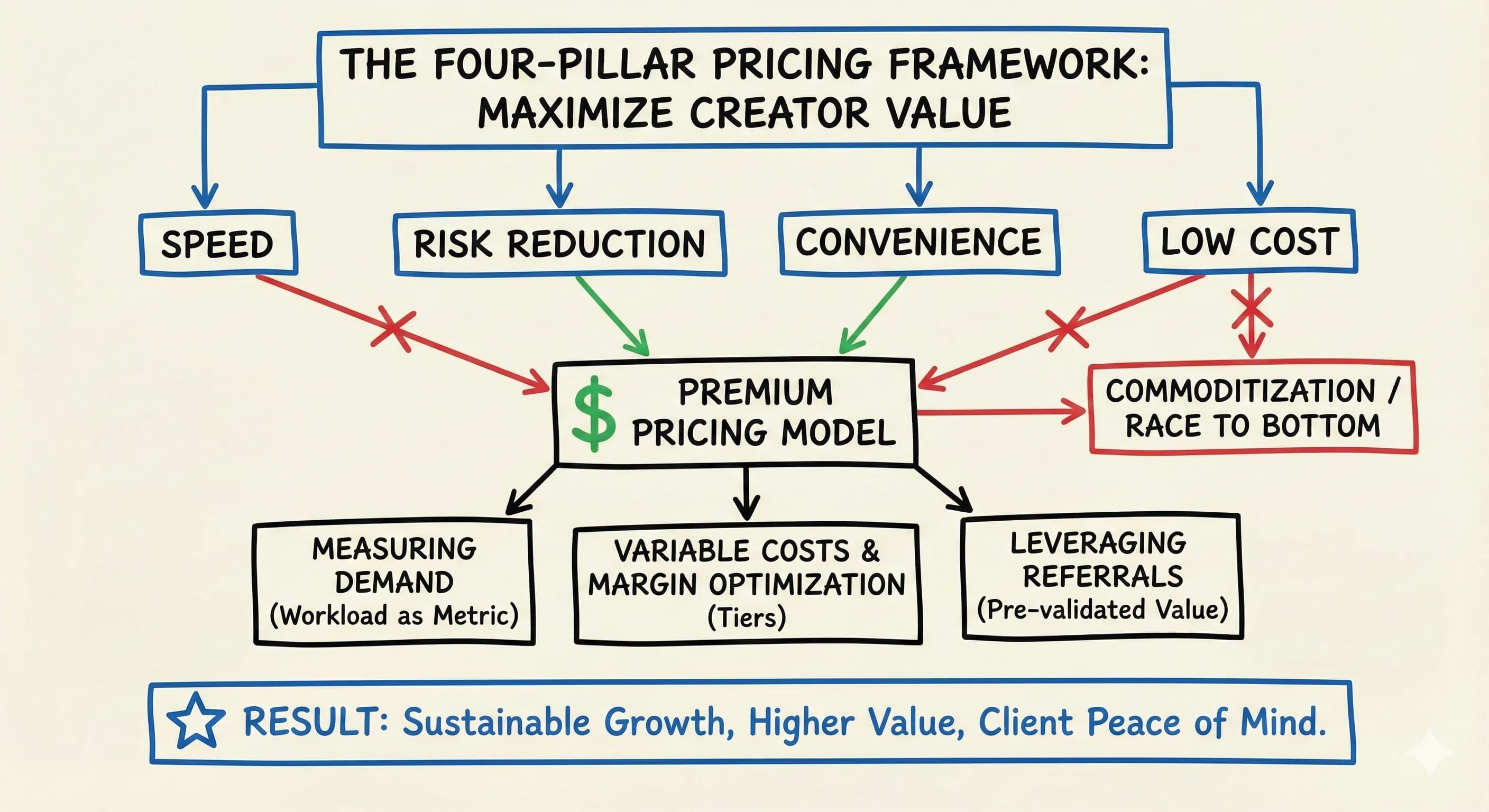
Here's what separates thriving creators from those constantly struggling with money: they understand that pricing isn't about competing on cost. It's about demonstrating genuine value to the client through four distinct pillars.
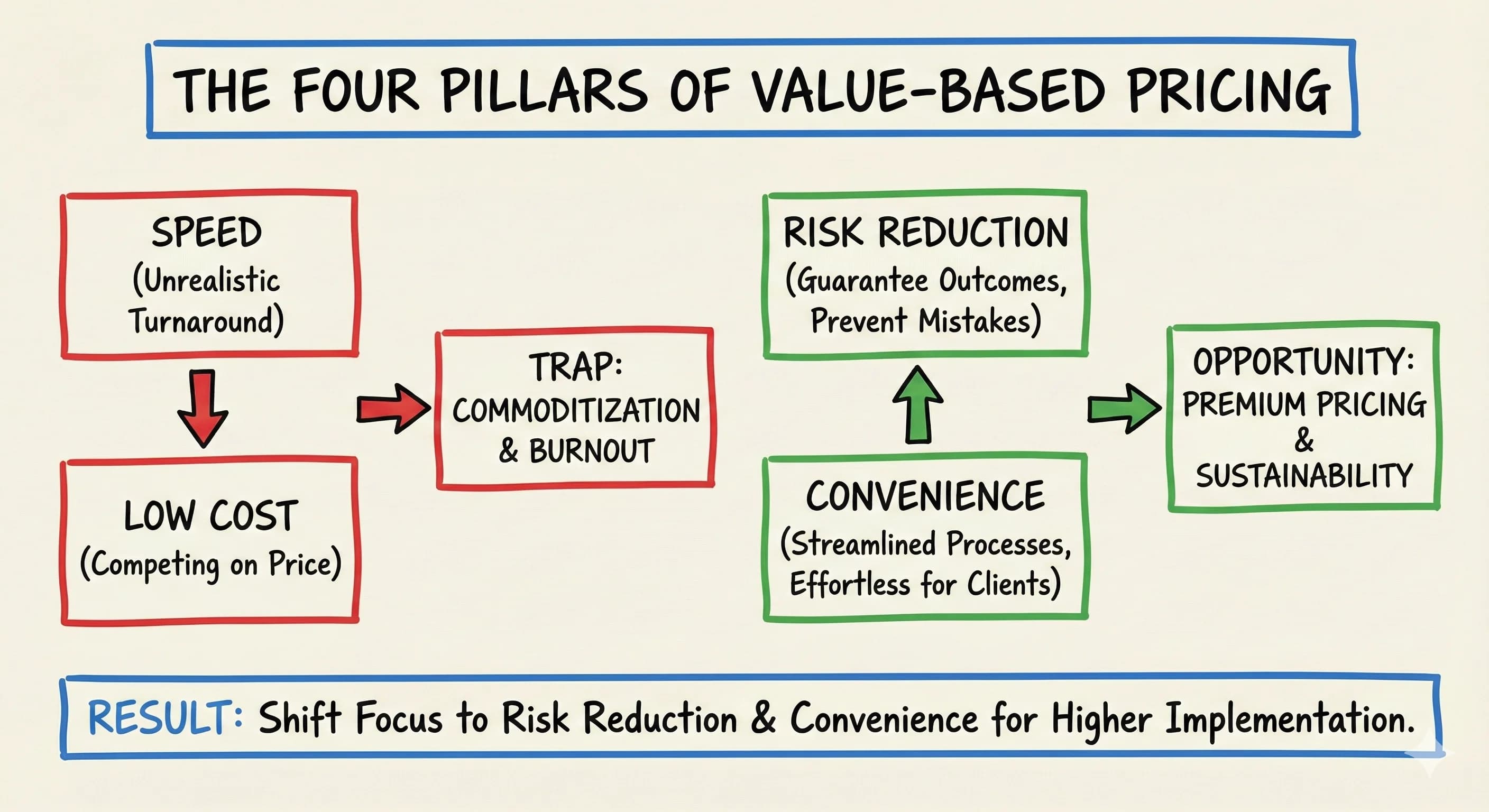
This framework breaks value creation into four clear categories: speed, risk reduction, convenience, and low cost. While all four create customer value, a successful creative freelancer should focus primarily on risk reduction and convenience rather than competing on speed or price. That strategic positioning opens up premium pricing model opportunities that actually stick, and it's the foundation of a sustainable creative business.
Why Graphic Designers and Creative Entrepreneurs Underprice Themselves
Let's be honest about how a lot of us came up with our pricing in the first place. We guessed, or we looked at what someone else was charging and went a little lower to seem competitive. That's not a pricing strategy, that's a race to the bottom.
Creative entrepreneurs and freelance designers especially tend to undervalue their work because creative services feel intangible. A contractor who renovates your kitchen hands you a physical result. A graphic designer who hands you a logo design or a brand identity hands you a file, and it's easy for clients to forget the thinking, the revisions, the expertise, and the hours you need to work behind that file.
Here's a question worth sitting with: when you hire a contractor to do work on your house, do you ask how they arrived at their pricing? Probably not. You trust that their years of experience, their tools, and their process justify the number. The same logic applies when you price your services as a creative professional. Charging enough to stay in business isn't greed. It's professional.
You've probably seen freelance creative workers race to the bottom on price or promise unrealistic turnaround times. Don't fall into that trap. When you position yourself as the safe choice who makes everything effortless for clients, you're setting up premium opportunities that actually hold.
How to Price Your Creative Services: The Four Pillars
So how do you value creative work and turn that value into real numbers? Start with these four pillars and figure out which ones you're actually delivering.
Speed: Can you turn work around faster than anyone else? Speed has value, but competing on it alone is exhausting and it invites clients who want to pay less.
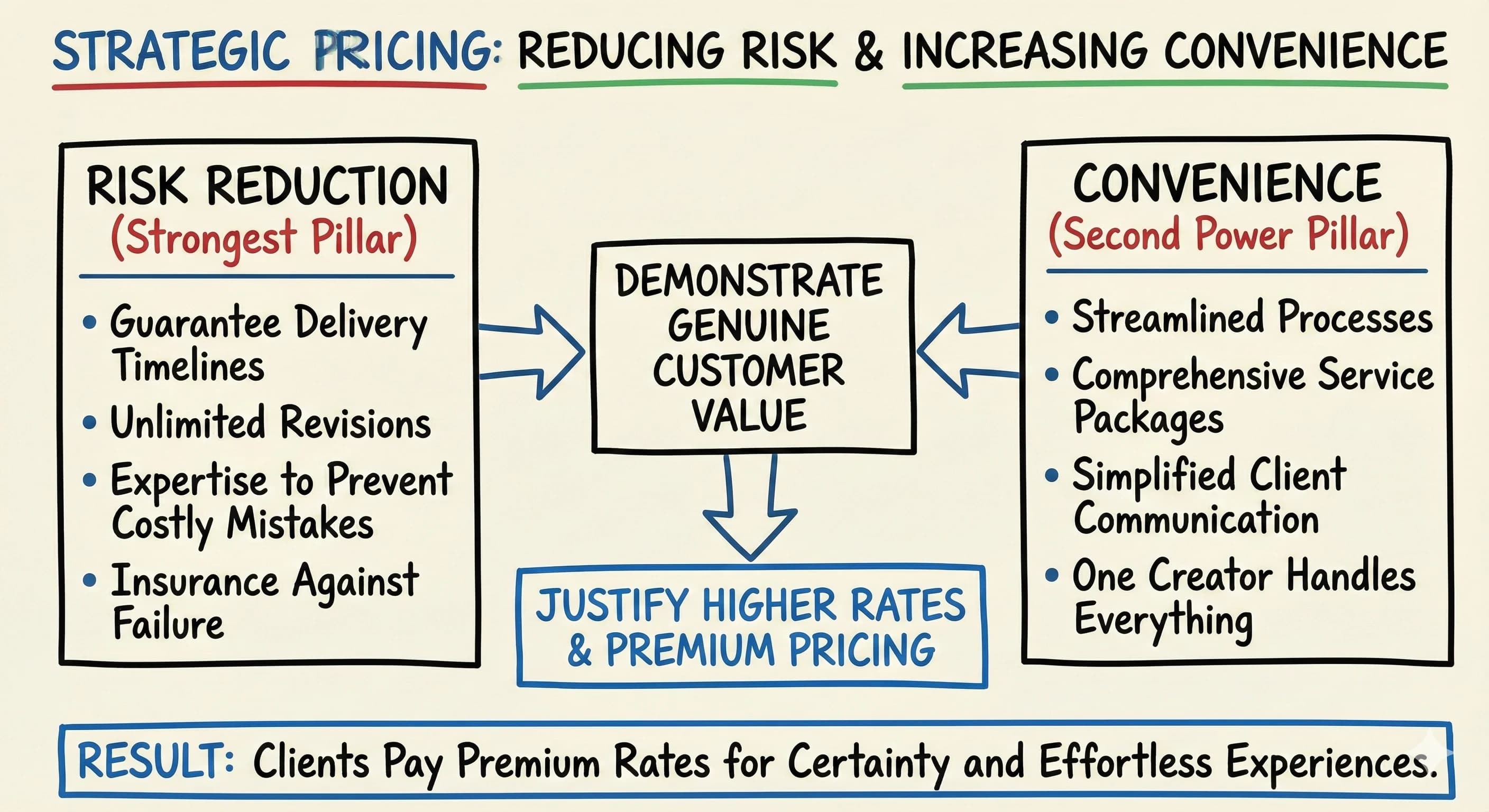
Risk reduction: Do you guarantee outcomes, prevent costly mistakes, or protect the client from things going wrong? This is where premium pricing lives.
Convenience: Does your product or service solve a problem and make the client's life easier? Streamlined processes, clear communication, and comprehensive packages all demonstrate this.
Low cost: Are you the cheapest option? You can be, but it's the hardest pillar to build a healthy creative business on.
The smartest move when you want to price your work well is to lean into risk reduction and convenience, because those are the pillars clients will pay the most to access.
Hourly Pricing vs. Project-Based Pricing: Which One Works?
This is one of the most common questions creatives ask, and the honest answer is: it depends on the work and the client, but both approaches have real trade-offs.
Hourly pricing is straightforward. You set an hourly rate, you track your time, and you invoice based on the number of hours you actually worked. The upside is that you're always getting paid fairly for your time. The downside is that clients sometimes feel anxious watching the clock, and you can end up penalized for being efficient. If you've been doing logo design for ten years and you can produce a great result in two hours, hourly pricing might mean you earn less than a slower, less experienced designer would for the same deliverable. Should you get paid less because it took less time? Should you get paid more because it took more time? These are real questions hourly pricing raises, and they don't always have satisfying answers.
That said, hourly pricing works well when you have no idea how long a project will take, especially for consulting, feedback sessions, or open-ended revisions. It also gives you a foundation for building a project-based estimate later, once you know your average speed.
Project-based pricing means you quote a fixed price for a defined scope of work. The client knows exactly what they're paying, and you know exactly what you're delivering. This model rewards your efficiency and expertise. The risk is scope creep: what if this job goes over, the client asks for what feels like endless revisions, and a quick five-day job turns into ten? That's why your project-based quotes need a clearly defined revision limit and a process for handling work that goes beyond it.
A good starting point: estimate the number of hours the project realistically requires, multiply by your target hourly rate, add a buffer for revisions and communication, and that's your project floor. You can quote above that floor based on the value to the client, the complexity of the brief, and what paying clients in that niche are willing to pay.
How to Calculate Your Hourly Rate as a Creative
If you've ever wondered "how do I arrive at a price" and stared at a blank screen, here's a practical way to think about it when you're starting out or resetting your rates.
Start with what you need to earn annually to cover your expenses and live your life. Add your business costs (software, equipment, taxes, insurance). Divide by the number of realistic billable hours in a year (most freelancers find this is somewhere between 900 and 1,200 hours, not 2,000, because non-billable admin time is real). That gives you a minimum hourly rate.
Then ask: what are design agencies and other freelancers charging in my market? What's the client's budget likely to be? What's the value I'm delivering relative to what they'd pay for a less experienced option? Your rate should sit at or above your minimum, adjusted for market and value.
Remember, your hourly rate isn't just your hourly pricing floor for time-billed work. It's the backbone of every project quote you put together, even when the client never sees it.
Measuring Demand to Know When to Raise Your Rates
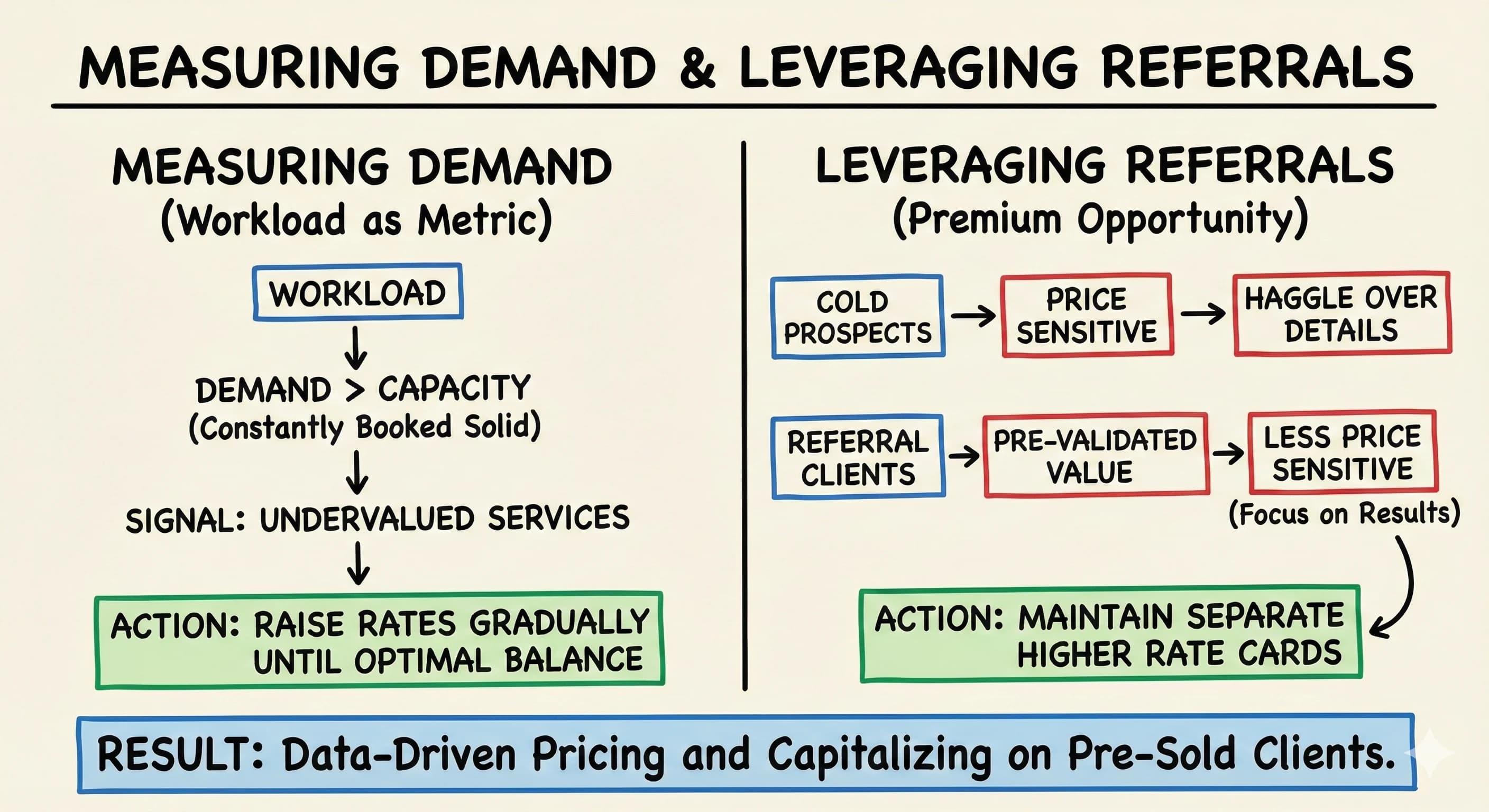
Your workload is the most reliable pricing signal you'll ever find. When demand consistently exceeds your capacity, the market is telling you that you're underpriced. This is one of the clearest ways to know you're not charging enough.
You'll know you're underpriced when you're constantly booked solid but still stressed about money. Effective pricing decisions require watching that signal and adjusting. If you can't take on new clients because you're swamped, raise your prices gradually until you reach a better balance between demand and capacity.
Here's the good news: when you raise rates, you usually don't lose as many clients as you fear. The clients who leave are often the ones who were most price-sensitive and most demanding. The clients who stay, and the new ones who come in at the higher rate, tend to be easier to work with and more respectful of your process. That's a competitive advantage worth building toward.
What a Clear Pricing Structure Actually Looks Like
What would it look like to have a clear pricing structure for your creative services? For most independent designers and creative freelancers, it means having at least two or three defined offerings so that when someone asks how much you charge, you don't have to start from scratch every time.
A simple tiered structure might look like this:
- Essentials tier: Core deliverable, defined scope, fixed price, limited revisions
- Professional tier: Expanded scope, more revisions, faster turnaround
- Premium tier: Full-service experience, risk guarantees, ongoing support or a retainer
A retainer model (where a client pays a recurring monthly fee for ongoing access to your services) is worth considering once you've got reliable relationships. It gives you predictable income and gives the client predictable access, which is a convenience win for both sides. Many creative businesses find that a retainer covering a set number of hours or deliverables per month is easier to manage than negotiating every single project from zero.
The key is that your pricing structure should feel clear to you before you ever present it to a client. If you're guessing every time someone asks how much to charge, you'll consistently underquote.
Referrals, Positioning, and Getting Paid What You're Worth
Referral clients typically expect to pay more than those who find you through cold outreach or discount platforms. They've already heard good things about you, so the risk in their mind is lower. That makes them more willing to pay without pushing back hard on price.
Smart positioning around what makes you the safe, easy choice is one of the most effective ways to support premium rates. Document every way your services reduce client risk and increase convenience. Create examples showing how you've prevented problems, caught errors early, or saved the client time. These stories become your best justification when someone asks why you charge what you charge.
Getting paid on time is also part of the conversation. A clear invoice process with defined payment terms isn't just administrative housekeeping. It signals professionalism and sets the tone for how the working relationship will go. If you started your business without clear payment terms, it's not too late to add them. Most clients won't push back, and the ones who do are telling you something useful about whether they're the right fit.
For services offered online, platforms and portfolio sites make it possible to reach paying clients outside your immediate network. But services as a graphic designer or any creative discipline are ultimately sold on trust, and trust comes from showing your process, your results, and your professionalism, not just your portfolio.
Price Your Services Like You Mean It
The creative entrepreneurs making serious money aren't necessarily the most talented people in the room. They're the ones who understand that clients will pay premium rates for peace of mind and effortless experiences, and they structure their offers accordingly.
Here's what to do next: figure out which of the four pillars you're actually delivering (risk reduction and convenience are your best bets), set an hourly rate you can defend, build at least two tiers of offering so clients have a fair price entry point and a premium option, and treat your workload as the honest signal it is. When you're slammed and still not earning enough, raise your rates.
Knowing how to price creative services is a skill you build over time, not something you figure out once and never revisit. Keep asking what's working, keep watching what the market signals, and don't be afraid to charge what your experience is genuinely worth.
Read more about Monetization & Business Models for Content Creators
📚 Complete Guides
- Content Creator Monetization: Proven Revenue Streams
- Content Creator Income Streams: 7 Ways to Build Financial Stability
⚡ Tactics & Strategies
- 30 Daily Outbound Pitches for UGC Deal Generation
- Affiliate Code Negotiation Using Membership Audience Influence
- Age Bracket as Superpower Strategy for Older UGC Creators
- B2B Merchandise Bulk Sales to Industry Professionals- Packaging Products as Client Gifts for Lawyers and Service Providers
- Becoming Your Own Sponsor by Plugging Your Offer Within Episodes
📄 Related Articles
- Membership Community: Test It Before You Charge
- Affiliate Marketing for Content Creators: The Gift-to-Revenue Pipeline
- Instagram Brand Partnerships: The Flirt and Follow Strategy
- Swipe File: How to Build One With Gmail Labels
- How to Build an Organic Marketing Strategy That Compounds Over Time
- How to Monetize Content Creation: Master One Stream at a Time
- Influencer Contract Template: What to Include (and Why)
- Email Segmentation: The Base Sending Strategy That Works
🧮 Calculators
Free: The Creator Pricing Power Kit
Get the interactive tool, downloadable PDF, and Notion template - all free.
No spam. Unsubscribe anytime.

Alex Kirillov
Details
One link. Every channel, rate, and piece of work brands need to evaluate you. Built for how creators actually get hired.
Claim your profile
Live creator, content, and marketing roles from real companies, with the pay, market, and context the raw job page never gives you.
Browse jobs