
Mastermind Group: What They Are, Cost, and How to Start One
Stop guessing your mastermind group cost. Use this backwards pricing framework to set a membership fee based on your income needs, group size, and cohort structure.
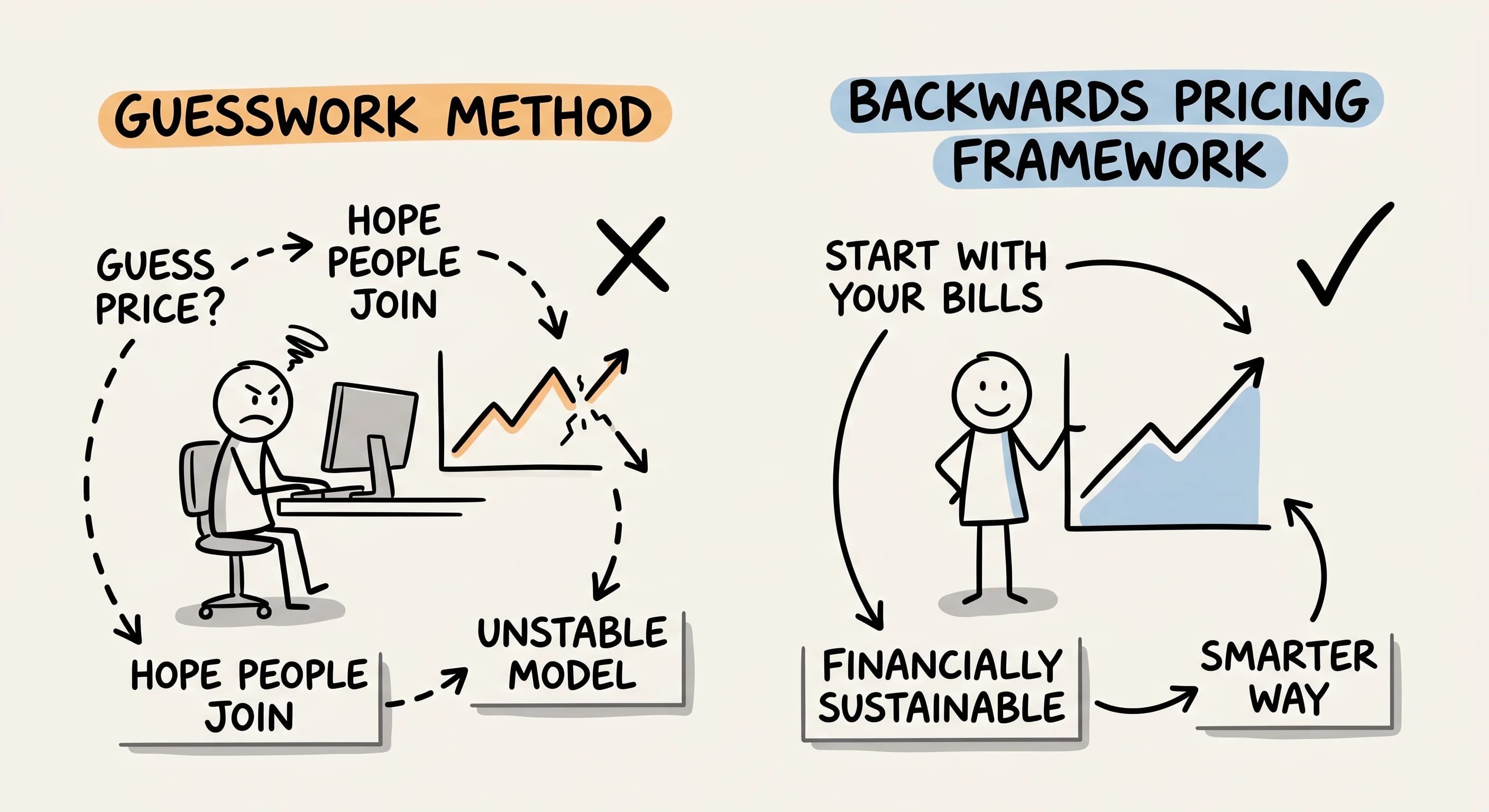
Most entrepreneurs launching a mastermind group make the same mistake: they guess at pricing. They pick a number that sounds reasonable, hope enough people join, and wonder why the model feels unstable. There's a smarter way, and it starts with your bills, not the market.
Understanding Mastermind Groups: What They Are and Why They Work
Understanding mastermind groups starts with a simple idea: small groups of people, typically business owners or ambitious professionals, meet regularly for structured peer collaboration, accountability, and personal and professional growth. Some people call it a "mastermind," others an advisory group or mentoring group, but the core is the same: everyone in the group helps everyone else brainstorm and solve real problems. The concept traces back to Napoleon Hill, who described it in Think and Grow Rich as a "coordination of knowledge and effort" between two or more people working toward a definite purpose. That original idea has since evolved into everything from a free mastermind peer circle to premium business programs charging tens of thousands per year.
Modern programs like Vistage, Strategic Coach, and countless online community offerings have proven that entrepreneurs will pay serious membership fees for the right mastermind. But knowing what to charge remains one of the biggest barriers to starting a mastermind.
The benefits of a mastermind group are well documented. Mastermind members gain outside perspectives on real business challenges, build meaningful relationships, and hold each other accountable to higher standards of execution. Tony Robbins has long advocated for the power of surrounding yourself with the right peer group, and many entrepreneurs credit mastermind participation as a turning point in their business growth. Successful entrepreneurs consistently point to peer accountability and support as one of the most underrated drivers of a successful business.
Every Mastermind Group Is Different: Format, Frequency, and Fit
Every mastermind group is different. Some are intimate virtual accountability circles. Others are structured cohort programs with retreats, curriculum, and curated membership. Mastermind groups typically meet monthly or bi-weekly, though weekly formats exist for intensive programs. The group format, meeting frequency, and level of facilitator involvement all shape what members experience and what the program is worth.
A collective mastermind draws its value from the combined experience in the room. When the group listens carefully to one member's challenge, the diverse perspectives that come back are often worth more than any single expert's advice. This is what separates a well-run mastermind program from a simple networking group.
Group membership can take many forms. Some programs use an open enrollment model. Others run closed cohorts where the same members work together across a fixed term. An effective mastermind usually favors the closed cohort model, because trust deepens over time and members invest more in each other's outcomes.
Is It Worth Paying for a Mastermind Group?
The short answer is: it depends on finding a group that aligns with your stage of business. A poorly structured networking group with no clear agenda delivers little value at any price. The best mastermind, by contrast, can be one of the best investments you make as a business owner, and certainly one of the best investments you make in your professional development.
Author Mike Michalowicz has described mastermind groups as having saved his business, providing critical peer-level problem-solving he could not get anywhere else. When you join a mastermind, you are not just buying access to information. You are buying accountability, honest feedback, and a room full of people who want you to succeed.
Is it a free mastermind group, or is it worth investing in a paid program that provides direct access to experienced professionals? That question matters. Free groups can be valuable, especially early on. But paid groups tend to attract members with more skin in the game, which raises the quality of every session.
So, are mastermind groups worth it? For successful entrepreneurs with the right mastermind match, absolutely. Mastermind groups offer the kind of structured peer support that a coaching program might provide one-to-one, but with the added benefit of collective intelligence. A skilled business coaching engagement might charge similar fees for individual sessions, yet lack the peer diversity that a well-run group delivers. The trick is finding a mastermind group to join that's a good fit for your stage.
How to Find and Join a Mastermind Group
If you want to join a mastermind rather than start one, the process begins with clarity about what you need. Ask yourself what stage your business is at, what specific challenges you are trying to solve, and how much time you can commit to sessions each month.
Finding a group that aligns with your goals is the first real task. Social media groups on platforms like LinkedIn and Facebook are a practical starting point. Many organizers use these communities to recruit members, share program details, and answer questions before enrollment opens. A private mastermind may not advertise publicly at all, so tapping your existing network is often the most direct route.
There are also curated platforms that connect entrepreneurs with vetted programs. GrowthMentor, for example, lists top mastermind groups for entrepreneurs across industries, including options for consumer product entrepreneurs, women entrepreneurs, and early-stage founders looking for structured peer support.
When evaluating options, ask the organizer how often the group meets, what the format looks like, and what the group size is. Smaller groups of four to six members offer more airtime per person. A large group of twenty or more functions differently, closer to a conference or cohort program than a true peer advisory structure.
Also ask what the group offers beyond the regular meeting. Does it include access to an expert facilitator? Does the program include resource libraries or in-person events? What the group offers will vary significantly from one program to the next, so compare carefully before committing.
To find a group that actually moves the needle, look for programs aligned with your industry, your revenue level, and your goals. Mastermind group needs vary from person to person. Members should be peers, not mentors and not students, but people at a similar stage who can give and receive feedback as equals.
Forming Your Own Mastermind Group: Should You Start Instead of Join?
Forming your own mastermind group is often the right move when no existing program fits your specific niche or stage. If you serve consumer product entrepreneurs, for example, or run a community for women entrepreneurs, a tailored program you design yourself will often outperform any generic offering on the market.
The free mastermind model can work well for an initial pilot. Running a free mastermind group for your first cohort lets you test the format, build relationships, and gather testimonials before charging. Just be aware that free group dynamics differ from paid ones. Members who invest financially tend to show up more consistently and engage more deeply.
Should you charge for your mastermind group? Yes, if you are putting serious time and structure into it. Charging signals value. It attracts committed members. It makes costs predictable for everyone involved.
How Much Does a Mastermind Group Cost?
Mastermind group cost varies enormously across the industry. Groups charge anywhere from zero to well over $25,000 per year. The cost depends on format, facilitator reputation, group size, and the level of access provided.
A free group or low-cost peer circle might charge nothing or a nominal fee to cover platform costs. A mid-tier business mastermind group typically runs from a few hundred to a few thousand dollars per cohort. Premium programs with curated membership, in-person retreats, and guest speakers can reach figures in the tens of thousands annually. Business Builder Camp offers a well-known structured program, and Business Builder Camp pricing reflects a clear curriculum and community investment.
When comparing options, look beyond the sticker price. Ask what the group costs relative to the outcomes past members have achieved. A $10,000 annual program that consistently helps members solve problems worth $100,000 to their business has an obvious return on investment. For many participants, a well-matched mastermind is one of the best investments you make in the lifetime of your business.
The question of how fee-setting works changes slightly if your mastermind group sits inside an organization such as a Chamber of Commerce or professional association. In those cases, group membership cost may already be bundled with the parent organization's dues, and the mastermind is offered as an added benefit. That model can work well for building a new group quickly, but it requires clear boundaries around what the mastermind includes versus what general membership provides.
The Backwards Pricing Framework for Starting a Mastermind
Instead of researching cost benchmarks or copying competitors, start with your own financial reality. This is the framework that works when you want to create a mastermind group that is financially sustainable from day one.
Step 1: Define Your Structure
 Decide on program length. Twelve weeks is a proven format that gives group members enough time for real transformation without losing momentum. Research from Circle backs this up. Their mastermind guide recommends 3 to 6 month cycles, specifically because that window is long enough to see meaningful progress but short enough to pivot if something is not working.
For group size, five paying members plus yourself as facilitator is the target. That gives you a group that feels intimate and high-touch without spreading your energy too thin. Both Circle and eCommerceFuel independently recommend 4 to 8 members as the optimal range, with 4 to 5 being the sweet spot for calls that run 60 to 120 minutes.
Step 2: Map Your Sessions
 Give each member two hot seats across the program. That fills ten weeks of content. Add an intro week and a graduation week, and your 12-week mastermind is fully structured. No guesswork, no filler, no awkward sessions where nobody knows what is supposed to happen.
The hot seat format is genuinely the engine that makes group coaching work. eCommerceFuel's mastermind research describes hot seats of 45 to 75 minutes as the core mechanism for deep, meaningful problem-solving inside small groups. When members know their turn is coming, they show up prepared.
Not every member needs to be in the hot seat every single meeting. Rotating the focus ensures that every session has a clear purpose, and members learn as much from watching others work through challenges as they do from their own time in the spotlight. What's the point of a mastermind group unless all members get to give and receive in each meeting? The hot seat model solves that problem by design.
Step 3: Calculate What You Need
 Here is where mastermind work becomes a real business. Take your annual income need, divide it by three cohorts per year, then divide again by five members per cohort. That number is your membership fee.
The math is simple:
Annual income need divided by 3 cohorts divided by 5 members equals price per member.
If you need $90,000 annually, running three cohorts of five members means charging $6,000 per member. No guessing, no hoping, no checking what a competitor charges and splitting the difference.
Should You Charge for Your Mastermind Group?
Use your backwards price as a floor, not a ceiling. If the outcomes your members achieve are genuinely significant, your bills-based price might actually be below what the market would bear. Check it against perceived return on investment. If your $6,000 program regularly helps members solve a problem worth $50,000 to their business, there is room to grow the price.
For more detail on the mechanics of charging, see the related post on whether you can charge for your mastermind group, which covers legal structures, tax considerations, and how to handle sliding-scale pricing for different member tiers.
Variations Worth Testing as You Grow
Once you have run your first cohort using this backwards model, you have real data to work with.
Adjust meeting frequency without changing the income math. If your members are busy executives, bi-weekly sessions across 24 weeks might suit them better than weekly sessions across 12. The pricing formula stays identical.
Test different group sizes within the validated range. Four members at a higher price versus six at a slightly lower price can hit the same annual revenue target. Both fall within the research-validated 4 to 8 member window.
Add a continuity option after the 12-week cohort ends. Many successful mastermind operators run a front-end cohort program that feeds into an ongoing monthly accountability group at a lower monthly rate. That layered model gives you both upfront cohort revenue and a recurring baseline.
The facilitator's role is as important as the structure itself. Circle's mastermind guide emphasizes that a strong facilitator drives accountability, keeps conversations focused, and ensures every member gets value from every session. That is the skill you are bringing. Price it accordingly.
Start a Mastermind Group That Pays Your Bills
Do not wait until you find the right audience size or spend weeks studying every program on the market. Do the math backwards. Structure your group, lock in your cohort calendar, and set a membership fee that makes three cohorts per year equal financial freedom.
Five members. Twelve weeks. Two hot seats each. Three cohorts a year. That is the whole model. The only variable you need to solve for is your annual income need, and you already know that number.
Whether you decide to start by joining a mastermind as a member first or launch your own program immediately, the principles are the same: structure creates value, accountability drives results, and pricing should reflect the genuine transformation you are facilitating.
That is how you build something that lasts.
Read more about Audience Building & Growth for Content Creators
📚 Complete Guides
- How to Build an Audience as a Content Creator
- How to Find Your Target Audience (Start With One Person)
⚡ Tactics & Strategies
- 30 Daily Outbound Pitches for UGC Deal Generation
- 50% Retention Rate Optimization for YouTube Algorithm Success
- Age Bracket as Superpower Strategy for Older UGC Creators
- Audience Consistency Strategy to Avoid Algorithm Penalties
- Audience Psychology Over Algorithm Optimization, Focusing on Human Pain Points and Goals Instead of Platform Tactics
📄 Related Articles
- Online Course Feedback: Use It to Improve Your Course
- UGC Usage Rights Explained: What to Charge and How to License
- Why Content Creators Must Demand Monetary Payment for Influencer Partnerships
- What Is a Good Engagement Rate? Benchmarks by Platform
- The Future of Online Courses: What AI Means for Course Creators
- How to Retain Clients and Build Recurring Revenue
- How to Find Influencers for Your Brand (Start In-House)
- How to Get Brand Deals as a Creator (Without Pitching)
Read more about Monetization & Business Models for Content Creators
📚 Complete Guides
- Content Creator Monetization: Proven Revenue Streams
- Content Creator Income Streams: 7 Ways to Build Financial Stability
⚡ Tactics & Strategies
- 30 Daily Outbound Pitches for UGC Deal Generation
- Affiliate Code Negotiation Using Membership Audience Influence
- Age Bracket as Superpower Strategy for Older UGC Creators
- B2B Merchandise Bulk Sales to Industry Professionals- Packaging Products as Client Gifts for Lawyers and Service Providers
- Becoming Your Own Sponsor by Plugging Your Offer Within Episodes
🧮 Calculators

Alex Kirillov
One link. Every channel, rate, and piece of work brands need to evaluate you. Built for how creators actually get hired.
Claim your profile
Live creator, content, and marketing roles from real companies, with the pay, market, and context the raw job page never gives you.
Browse jobs