
How to Build a Data-Driven Content Strategy (Analytics to Predictions)
Master predictive analytics with regression techniques designed for content creators. Learn when to use linear, gamma, and polynomial regression for accurate content forecasting.
Details
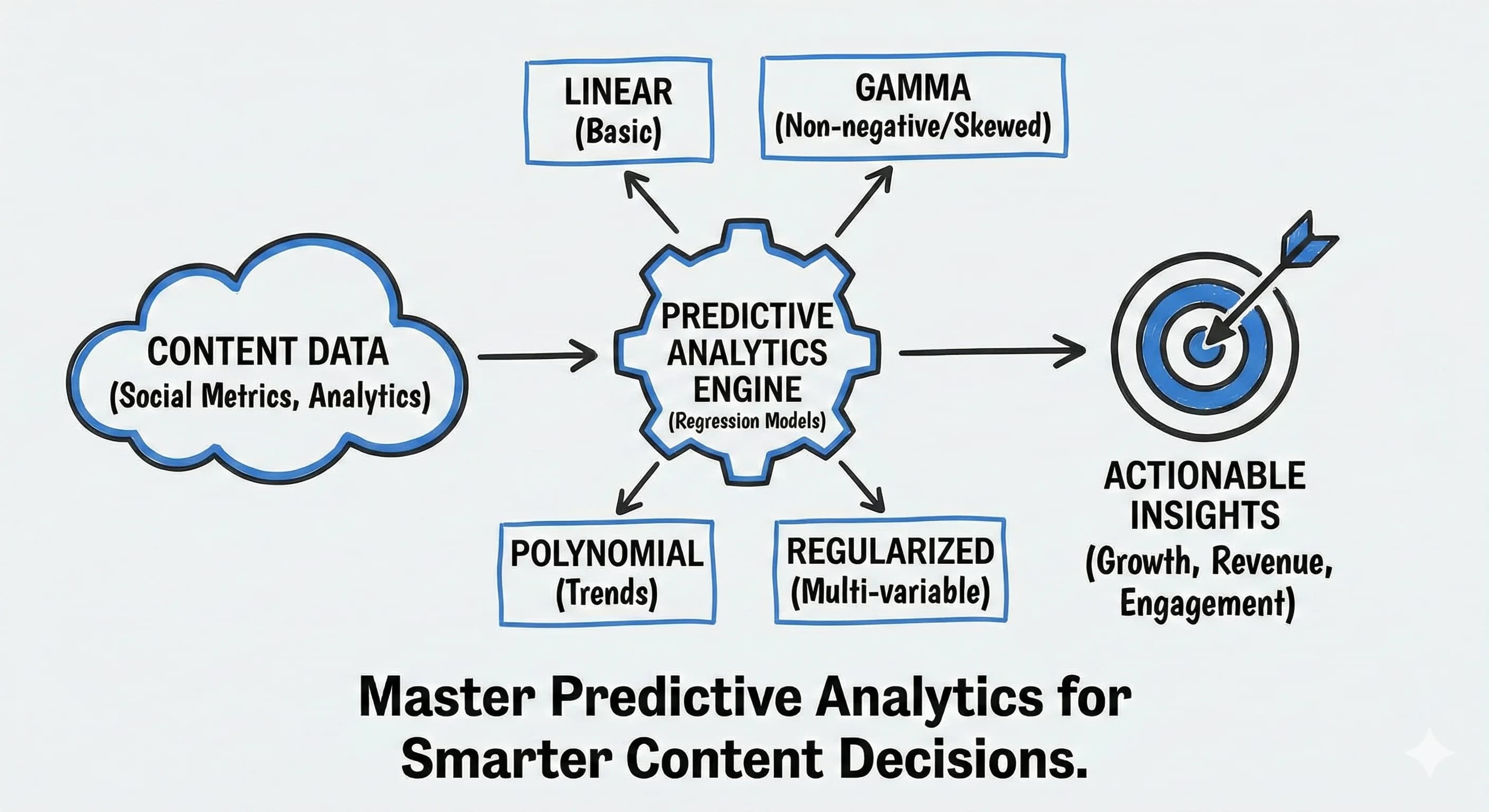
A data-driven content strategy replaces guesswork with evidence. Instead of publishing what you hope will land, you use analytics, audience data, and past content performance to decide what to create, when to post it, and who to target. The result is content that resonates because the data told you it would, not because you got lucky.
You've probably analyzed your content metrics and wondered: "How can I predict which posts will perform best?" or "What's going to happen to my subscriber growth next month?" That instinct is the whole point of a data-driven content strategy: turn the numbers you already collect into insight, then let that insight guide your content creation. This guide covers the strategy end to end, from the data you gather to the advanced predictive analytics that let you forecast performance before you hit publish.
How to Build a Data-Driven Content Strategy
Before any advanced modeling, a data-driven content strategy runs on a simple loop you repeat: collect data, find the insight, create, then measure. Here's how each step works for content creators.
1. Collect the right data. Pull together the numbers you already have: website analytics, social media metrics, engagement rates, and audience demographics. Add keyword research to see what your target audience is actually searching for. This mix of first-party and third-party data is the raw material of every data-driven decision.
2. Turn data into insight. Raw metrics aren't a strategy. Analyze the data to spot patterns: which type of content earns the most engagement, which topics convert, which posting times work. The goal is a handful of clear insights that tell you what your audience wants, not a spreadsheet of vanity numbers.
3. Create targeted content that resonates. Use those insights to guide your content creation. When data shows a topic or format performs, make more of it. This is how data-driven content marketing produces content that resonates and lifts both engagement and conversion, because every piece is informed by evidence rather than a hunch.
4. Personalize where you can. Segment your audience and deliver personalized content to each group. Data-driven marketing consistently shows that targeted, personalized content beats one-size-fits-all messaging on both engagement rates and ROI.
5. Measure and optimize. Track content performance against your goals, then feed the results back into step one. This optimization loop is what separates a real data-driven content strategy from a one-time analytics report.
Master that loop and you're already ahead of most creators. The rest of this guide shows you how to push it further with predictive analytics, so you can forecast performance instead of only measuring it after the fact.
The Metrics That Power a Data-Driven Content Strategy
A data-driven content strategy is only as good as the metrics you choose to watch. Skip the vanity numbers and track the ones that connect content to outcomes:
- Engagement rate: The clearest early signal of content that resonates with your target audience.
- Conversion and ROI: Which content actually drives signups, sales, or leads. Tying content performance to ROI is what turns analytics into a business case for your content marketing.
- Content performance by type and topic: Use website analytics and social data to see which formats and subjects earn their keep, then create more of them.
- Audience data and demographics: Who is engaging, and how that maps to the personas you're trying to reach.
Watch these metrics consistently and the insights compound. Over time you build a picture of exactly what your audience wants, which is the entire promise of a data-driven approach to content.
What is Regression Analysis for Predictive Analysis?
Regression analysis serves as the backbone of predictive modeling, helping you understand relationships between variables and predict future outcomes. Unlike basic data analysis that tells you what happened, predictive analytics uses statistical techniques to forecast trends from historical data.
For content creators, this means transforming raw data from social media metrics, website analytics, and audience demographics into actionable insights that drive engagement and growth. You're not just looking backward, you're building models that help you make smarter content decisions before you hit publish.
The Modern Statistics with R textbook demonstrates this perfectly: when researchers compared ordinary linear regression to regularized regression for predictive tasks, the regularized models consistently showed better predictive accuracy, especially with complex datasets. This isn't just academic theory: it's proven performance improvement you can apply to your content strategy.
Common Predictive Modeling Techniques Every Creator Should Know
Linear Regression: Your Starting Point
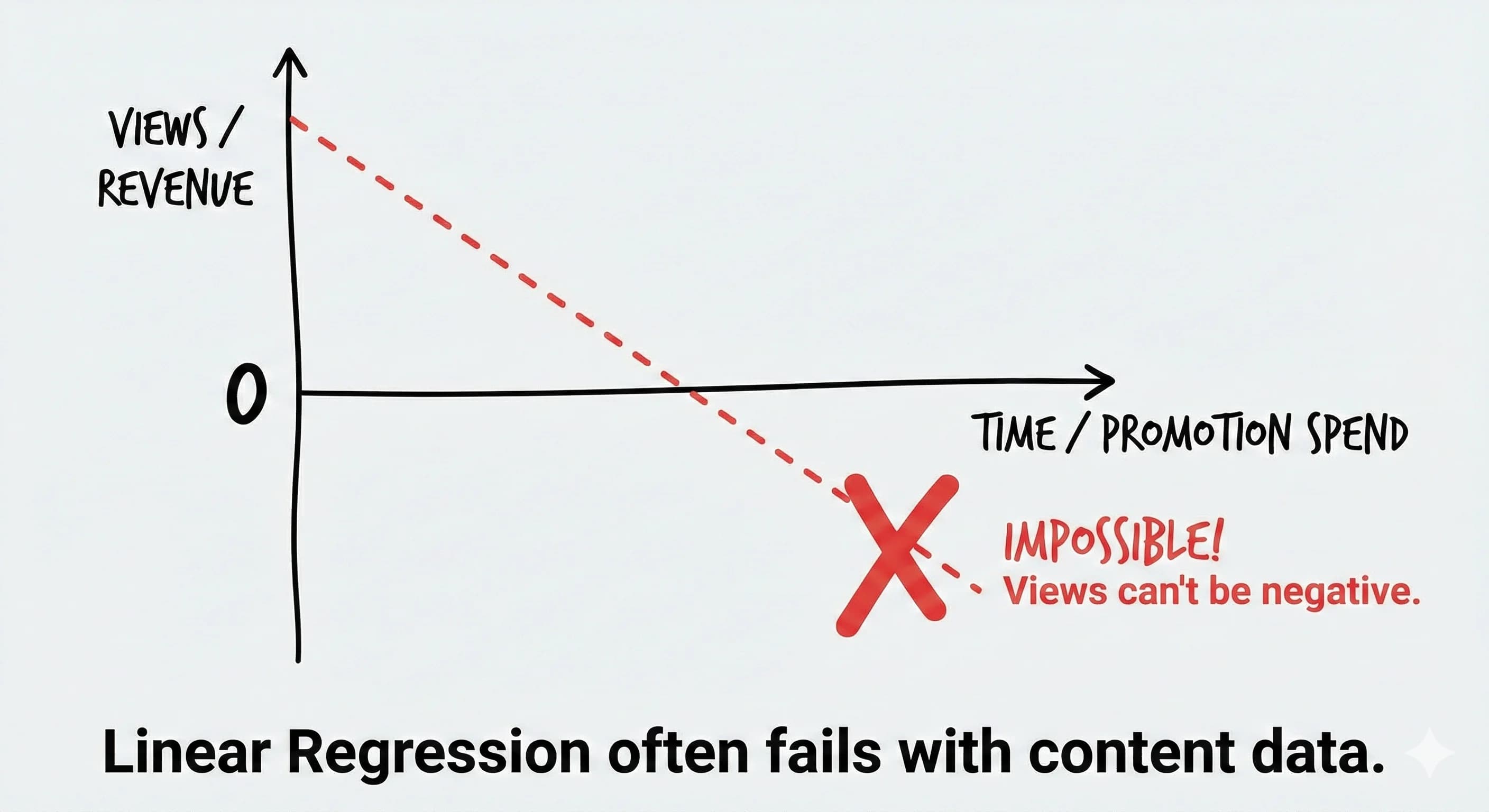
Linear regression remains the most fundamental regression model for beginners. This statistical technique works well when predicting continuous outcomes with normally distributed data. You can use linear regression to predict blog traffic based on promotion spend or estimate video views from upload timing patterns.
But here's where most creators stop, and where you shouldn't.
Beyond Linear: Advanced Regression Models That Match Your Data
Not all content data fits the linear regression mold. Consider this real-world scenario: you're predicting monthly revenue from your content. Revenue can't be negative, and it's often right-skewed (most months you earn modest amounts, with occasional high-earning months).
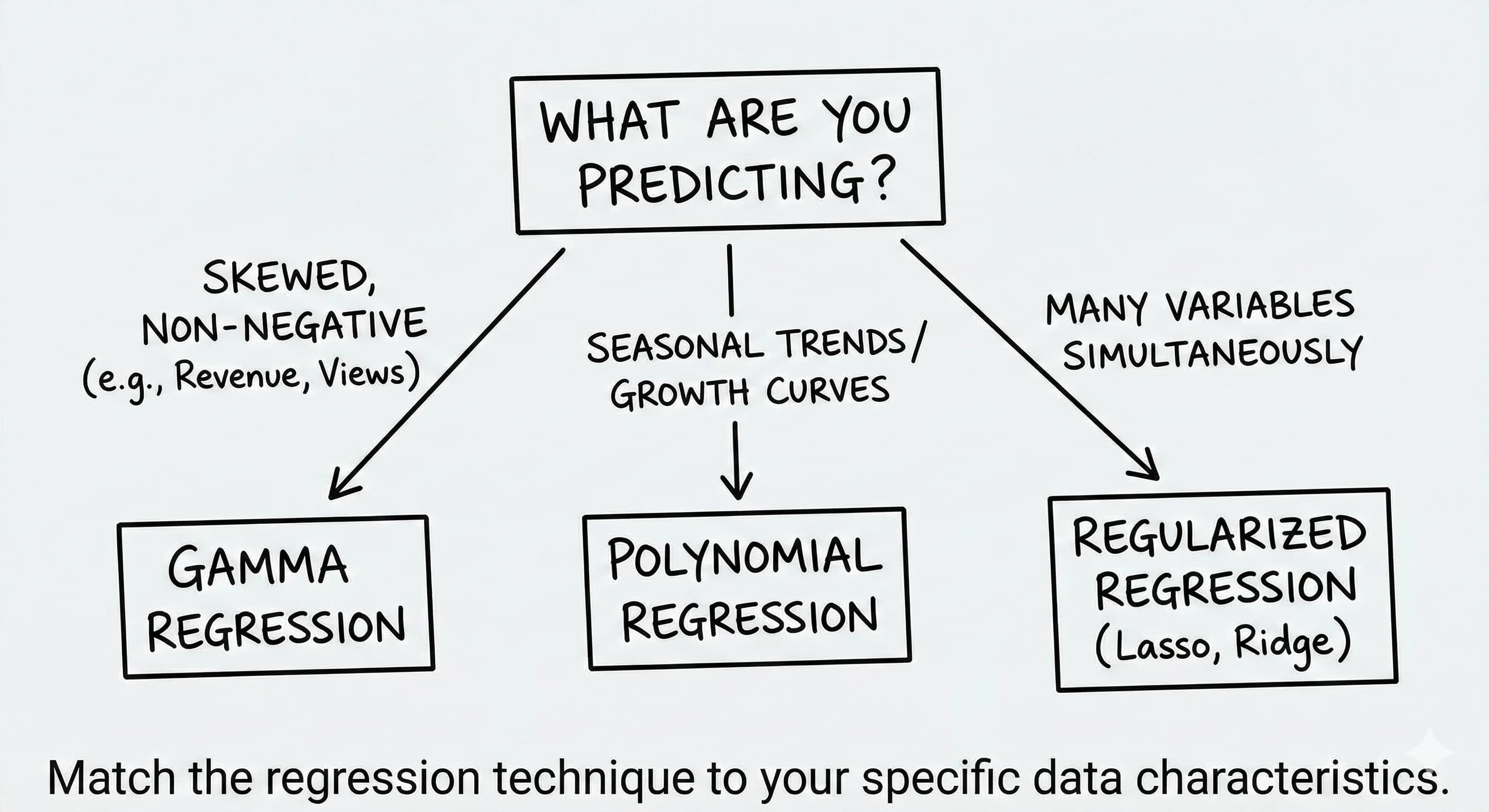
Gamma regression excels with non-negative, skewed data, making it perfect for predicting revenue, view counts, or engagement metrics. The phData consulting team specifically recommends gamma regression for positive, continuous outcomes that show right-skewed distributions, exactly what most content metrics look like.
 Polynomial regression captures non-linear relationships, ideal for seasonal content performance patterns or growth curves that accelerate over time. Regularized regression (lasso, ridge, elastic net) prevents overfitting when working with many variables, crucial when you're analyzing multiple content factors simultaneously.
Take YouTube creator analytics as an example. Research from the journal exploring regression models for YouTube views prediction found that different regression approaches yielded significantly different accuracy levels depending on the specific metrics being predicted. The creators who understood these differences could build more accurate forecasting models.
How to Use Regression Models to Predict Content Success
The predictive modeling process starts with understanding your data characteristics. Ask yourself: Is your target variable continuous or categorical? Can it be negative? Does it follow seasonal patterns?
For content creators, this translates to a systematic approach:
- Identify your prediction goal: Are you forecasting subscriber growth, revenue, or engagement rates?
- Match the regression technique to your data constraints: Use logistic regression for binary outcomes (viral vs. non-viral content), gamma regression for revenue predictions, or polynomial regression for seasonal trends
- Validate with cross-validation: The Modern Statistics with R authors emphasize k-fold cross-validation and bootstrap methods for rigorous out-of-sample evaluation
Here's a practical example: if you're predicting Instagram engagement rates, those values are bounded between 0% and potentially 100%, with most falling in the lower ranges. Linear regression might predict negative engagement rates (impossible) or fail to capture the right-skewed distribution. Gamma regression handles these constraints naturally.
Applications of Predictive Analytics in Content Creation
Data scientists aren't the only ones benefiting from these techniques. Content creators can leverage predictive analytics for:
- Audience growth forecasting using time-series regression to predict subscriber milestones and plan content calendars accordingly
- Content performance prediction through multi-variable analysis incorporating factors like posting time, hashtags, and topic categories
- Revenue optimization with gamma regression models that account for the non-negative, skewed nature of creator earnings
- Platform algorithm adaptation using regularized regression to identify which of dozens of potential factors actually influence reach
Research on predictive analytics in entertainment and media shows that creators who systematically apply these techniques see measurable improvements in content strategy effectiveness. They're not guessing which content will perform, they're using statistical models to make informed predictions.
The Future of Predictive Analytics for Creators
Advanced predictive analytics tools now offer user-friendly interfaces, making complex regression analysis achievable without extensive data science backgrounds. The trend toward automated machine learning (AutoML) means you can experiment with different regression families without manually coding each model.
But here's what won't change: understanding which regression technique matches your specific data constraints gives you a fundamental advantage. When AutoML tools test dozens of models, you'll understand why gamma regression outperformed linear regression for your revenue predictions, or why regularized regression prevented overfitting in your multi-factor engagement model.
Taking Action: Build Your First Predictive Model
Start simple but start smart. Choose one key metric (subscribers, views, or revenue), gather three months of historical data, and think about the data's characteristics before choosing your regression approach.
If you're predicting something that can't be negative (revenue, view counts), don't use linear regression: try gamma regression. If you're analyzing many potential factors simultaneously, use regularized regression to prevent overfitting. If you see seasonal patterns or growth curves, experiment with polynomial terms.
The key is matching your regression family to your data's actual properties, not just defaulting to linear regression because it's familiar. As you build confidence with these techniques, you'll develop intuition for which approaches work best with different types of content metrics.
Whether you stop at the five-step loop or push into predictive modeling, a data-driven content strategy transforms content marketing from guesswork into strategic decision-making. It empowers you to use data to inform every piece of content, predict trends, optimize performance, and build sustainable growth. You're not just creating content, you're using insight to decide what will work before you invest your time and energy.
Read more about Becoming a Content Creator
📚 Complete Guides
- How to Become a Content Creator: Complete Beginner's Guide
- Content Creator Platform Guide: Choose the Right Platform to Start Your Creator Journey
⚡ Tactics & Strategies
- 50% Retention Rate Optimization for YouTube Algorithm Success
- Age Bracket as Superpower Strategy for Older UGC Creators
- AI Workflow Integration for Content Reduction
- Audience Consistency Strategy to Avoid Algorithm Penalties
- Audience Poll on Instagram to Source Q&A Content in Advance of Recording
📄 Related Articles
- AI Content Repurposing: Create Content 70% Faster
- Behind the Scenes Content: Turn Your Work Process Into Viral BTS Ideas
- Thought Leadership: Build It by Writing to Learn
- ChatGPT for Social Media: Prompts That Actually Work
- Content Creation Tools: The Ultimate Directory for Creators
- Emotional Storytelling: Turn Feelings Into Followers
- Relevant Content: A Two-Question Filter for Creators
- Content Inspiration: Where to Find Fresh Ideas Beyond Your Niche
Read more about Systems, Workflows & Operations for Content Creators
Free: The Creator's Predictive Analytics Starter Kit
Get the interactive tool, downloadable PDF, and Notion template - all free.
No spam. Unsubscribe anytime.

Alex Kirillov
Details
One link. Every channel, rate, and piece of work brands need to evaluate you. Built for how creators actually get hired.
Claim your profile
Live creator, content, and marketing roles from real companies, with the pay, market, and context the raw job page never gives you.
Browse jobs