Thought Leadership: Build It by Writing to Learn
You don't need credentials to start a newsletter. Learn how writing to learn builds real expertise faster than waiting until you're ready. The strategy top creators use.
You don't need to be an expert to start. That belief stops more newsletters before they ever launch than any technical barrier ever could. The real strategy, the one that actually works, is to write about what you want to learn, not what you already know. Done consistently, it will build expertise faster than almost any other method available to a content creator today.
What Is Thought Leadership, and How Do You Build It?
Thought leadership is the reputation you earn when your audience sees you as a trusted, go-to expert in your field, a subject matter expert whose insights they actively seek out. It is not a title you claim; it is credibility you build by publishing valuable, original content over time.
Here is the counterintuitive part: you don't need to already be an expert to become a thought leader. The fastest way to build thought leadership is to write publicly about what you want to master. Each piece of thought leadership content forces you to learn, and that visible body of work is what establishes you as an authority. This guide shows how writing to learn turns curiosity into genuine thought leadership.
Writing to Learn: The Thought Leadership Strategy Nobody Expects
Most creators wait until they feel qualified. They want credentials, years of experience, or some official stamp of approval before they dare publish. But that waiting game is a trap. The creators who build the most engaged, loyal audiences don't start as experts. They become experts through the act of writing.
Dan Runcie of Trapital is the clearest example. He didn't launch his newsletter on the business of hip-hop because he already had a PhD in music economics. He became the foremost authority on that subject by committing to study it deeply and write about it publicly, week after week. He picked a narrow, under-covered domain, the business strategy of hip-hop and black media, and each piece forced him to research label deals, catalog sales, streaming economics, and artist brand strategies. The newsletter didn't reflect his expertise. It created it, compounding into a recognized authority, podcast, and paid membership over time.
Ana Lorena Fabrega, creator and former educator, puts it plainly: writing about a subject is how you become an expert in it. The act of publishing forces you to figure out what you actually think. Her own journey, writing and sharing publicly about alternative education before becoming Chief Evangelist at Synthesis, is exactly this principle in action. Your curiosity is an asset, not a liability.
How the Writing Process Actually Builds Thought Leadership
 When you commit to a publishing deadline, whether daily or weekly, something powerful happens. You're forced to draft content that requires genuine understanding. You can't summarize a topic you haven't actually studied. You can't explain a complex idea for your readers without first working through it yourself.
This is the compounding loop that separates long-term newsletter builders from short-term publishers:
- Study a topic deeply to meet your publishing commitment
- Draft your findings in a way your audience can engage with
- Clarify your thinking by putting it into writing
- Summarize what you've learned publicly, week after week
- Repeat for two to three years
The reinforcement effect is real. Every edition you publish deepens your knowledge base. Every question from a reader pushes you further into the subject. Writer Meg Dowell describes the same mechanic for freelance writers who accept assignments outside their expertise: spend more time researching than writing, and over repeated cycles, you build deep, versatile knowledge across domains. The mechanism is identical whether you're a freelancer or a newsletter creator. You grow into expertise because you must learn enough to write accurately and consistently.
Creator and author Ellory Wells describes a similar compounding loop through podcasting and blogging: interview experts, read books, study articles, then synthesize and share publicly. His model is consume expert knowledge, synthesize, publish, repeat. That public body of work signals thought leadership more powerfully than private study ever could, because a recognized thought leader is simply someone whose thinking is visible and consistent.
Writing Helps You Think, Not Just Communicate
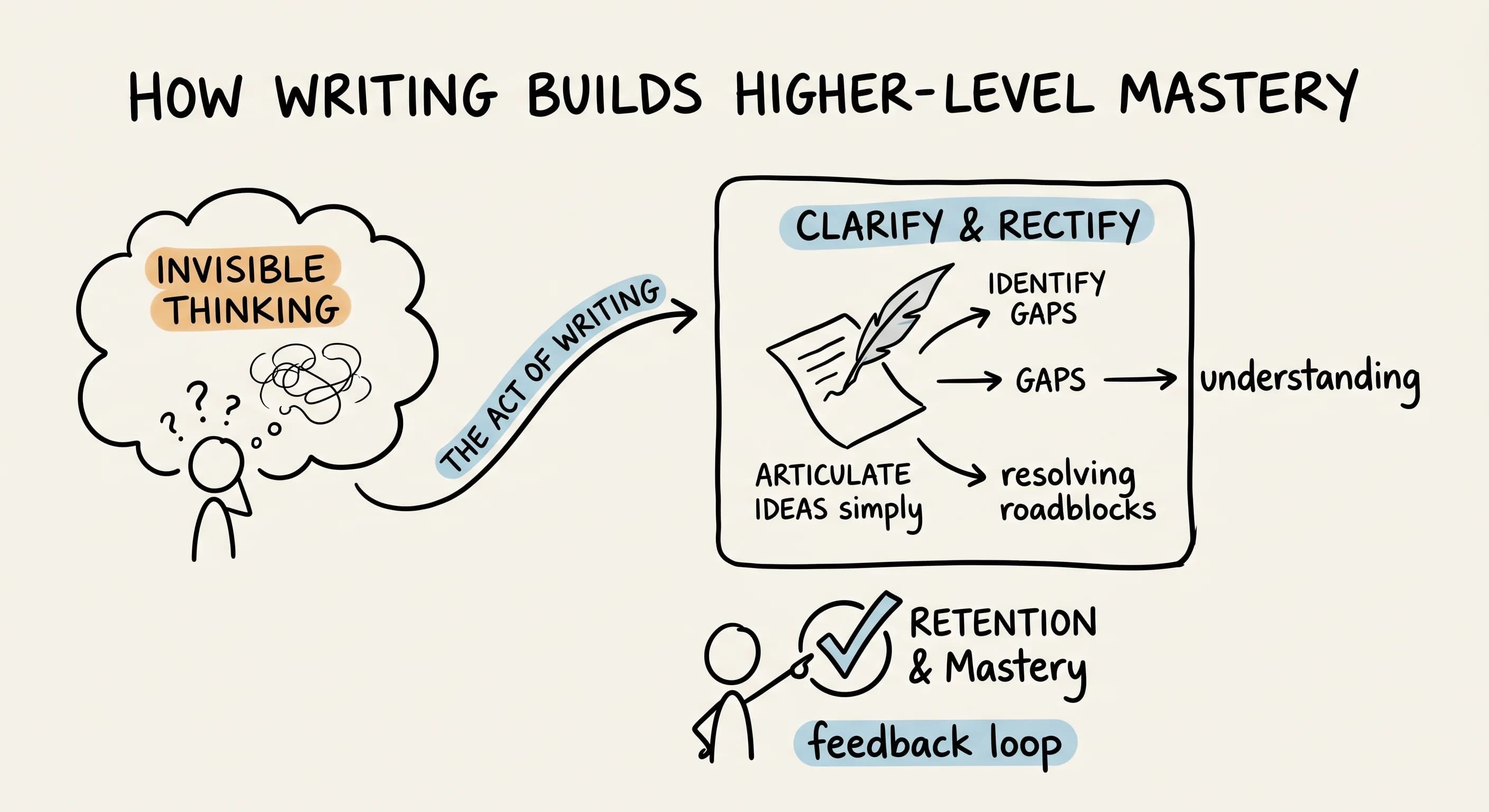
One of the most underrated reasons to use writing as a learning tool is what happens inside your own mind during the writing process itself. Thinking about writing as an act of communication misses half the value. Writing is also an act of cognition.
As you draft, you are forced to ask questions you hadn't thought to ask before. You identify gaps in your logic that invisible thinking never surfaces. This is why writing helps learners at every level, from beginners trying to learn a new subject to advanced practitioners who want to build higher-level mastery in their field. The process of writing forces you to articulate ideas in simple language, and if you can't do that yet, it tells you exactly where to study next.
When you are trying to learn something genuinely difficult, writing consistently about it creates a feedback loop that reading alone cannot replicate. You encounter a roadblock, you write through it, and the act of putting words on the page either resolves the confusion or makes the gap unmistakable. Either outcome moves you forward. Writing also strengthens communication skills in a way that passive consumption never does, because you are constantly making choices about how to express what you know.
A growth mindset is essential here. Approaching each draft as a chance to refine your understanding, rather than a performance of existing knowledge, makes writing a genuinely powerful problem-solving tool. Without writing, many learners stall at the level of vague comprehension. With it, they reach a higher level of clarity and retention.
The Deliberate Practice Connection
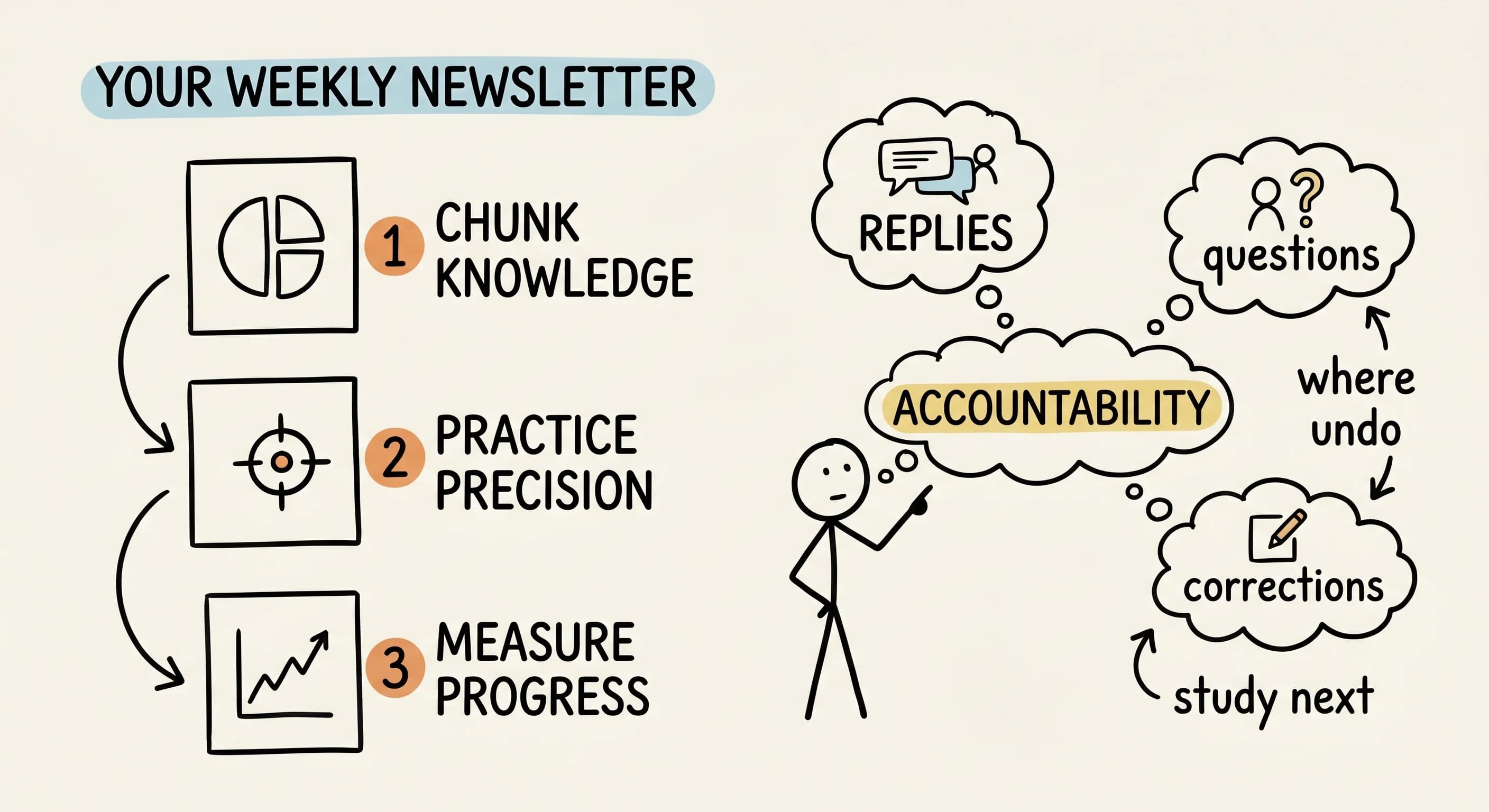
This maps directly onto what researchers understand about how expertise actually develops. Dr. Paula Caproni at the University of Michigan outlines deliberate practice as identifying a meaningful purpose, breaking your goal into smaller, manageable chunks of knowledge, practicing with precision, and measuring progress with specific, time-bound goals.
Your weekly newsletter is exactly that structure in disguise. Each article is a time-bound chunk of focused effort. The public nature of the work creates the accountability and feedback that this approach requires. Reader replies, corrections, and questions are your progress measurement system. They signal where your thinking needs to go deeper and help you identify gaps before they become a real roadblock to authority.
Author Josh Kaufman has argued that roughly 20 focused hours of practice can move you from knowing nothing to being genuinely competent in a subtopic. That translates to about 45 minutes a day for a month. String several of those together with consistent weekly publishing, and your knowledge compounds fast, especially in narrower domains where fewer people are willing to put in sustained effort. Incremental progress, repeated over years, is how mastery is actually built. Consistent practice is what separates people who approach learning seriously from those who stay perpetual beginners.
Building Your Thought Leadership Newsletter
Choose Your Subject Strategically
Identify one subject you're genuinely curious about and want to master. Ask yourself: what could I study obsessively for the next three years? If you want to learn something deeply enough to write about it publicly, that desire is your most reliable compass. Favor a reasonably narrow niche where cumulative research and writing can give you a real edge. The business strategy of hip-hop was narrow enough that consistent publishing gave Runcie a genuine, defensible position. Broad topics don't compound the same way.
Set a Non-Negotiable Publishing Cadence
A weekly newsletter works well for most creators. Treat each deadline as a time-bound, specific commitment, not a loose intention. The deadline creates the accountability that forces learning. Without it, there is nothing pushing you to research, draft, and engage your audience consistently. In the early months, little and often is more sustainable than large, irregular sprints. Writing consistently, even when a draft feels imperfect, builds the habit that makes improvement possible. It is writing consistently over time, not occasional bursts, that produces an integral part of the compounding effect.
Write Publicly as a Learner First
Be transparent with your audience. Dowell's advice adds an important ethical boundary here: don't claim expertise you haven't yet earned. Brand your project as learning in public, especially in the first one to two years. This keeps you honest, invites correction from more experienced practitioners, and actually increases reader trust. Readers engage more deeply with creators who are on an honest learning journey than with those who perform false authority. A coach or mentor in your field can also accelerate this phase by helping you revise your mental models before you publish them.
Pair Your Writing With Deliberate Reading
You can't write your way to expertise without also reading your way there. Pair your publishing cadence with a reading cadence, ideally one substantial source per article. Over time, your reading list becomes part of your public brand. Sharing what you're studying and what you're taking from it adds a layer of transparency that strengthens the relationship with your audience and helps foster genuine trust.
What Are the Best Ways to Build Expertise in Any Field?
 The most reliable path to thought leadership combines three things: structured learning, public output, and critical thinking about both. Reading alone is passive. Taking a course is structured but private. Writing for a public audience forces all three to happen at once, which is exactly why writing is the highest-leverage thought leadership strategy available to a creator. Every true thought leader you admire got there by making their thinking public, consistently, for years.
If you want to build expertise in any domain, use writing as your primary integration tool. Sharpen your ideas by drafting them. Test your understanding by trying to improve their writing quality with each iteration, asking whether you can now explain the concept more precisely than you could last month. That question, asked honestly and regularly, is more useful than any formal assessment. It makes writing an active part of the learning process, not an afterthought.
The question isn't how to write about your existing skills and expertise. It's how to develop thought leadership through writing itself. If you're willing to write about your chosen subject before you feel fully ready, and compound that effort over a few years, you will become one of the most knowledgeable people in the world on that topic, and a genuine thought leader in it. That is how real thought leadership is built: not by claiming the title, but by earning it in public, one piece of thought leadership content at a time. The newsletter is the vehicle. Consistency is the engine. Start now.
Read more about Becoming a Content Creator
📚 Complete Guides
- How to Become a Content Creator: Complete Beginner's Guide
- Content Creator Platform Guide: Choose the Right Platform to Start Your Creator Journey
⚡ Tactics & Strategies
- 50% Retention Rate Optimization for YouTube Algorithm Success
- Age Bracket as Superpower Strategy for Older UGC Creators
- AI Workflow Integration for Content Reduction
- Audience Consistency Strategy to Avoid Algorithm Penalties
- Audience Poll on Instagram to Source Q&A Content in Advance of Recording
📄 Related Articles
- Blog Content Strategy: The Question-Based Method
- Viral Hooks: How to Write Openers That Get Millions of Views
- How to Find Trending Audio on Instagram (The Easy Way)
- Reverse Prompt Engineering: Turn Great ChatGPT Answers Into Reusable Prompts
- How to Optimize Your Newsletter Landing Page to Get More Subscribers
- How to Use the Facebook Ad Library for Brand-Aligned UGC Research
- Growing an Online Community: How to Scale While Preserving the Magic of Micro-Communities
- Original Content Ideas: Break Free from Competitor Crowdsourcing
Read more about Systems, Workflows & Operations for Content Creators

Alex Kirillov
One link. Every channel, rate, and piece of work brands need to evaluate you. Built for how creators actually get hired.
Claim your profile
Live creator, content, and marketing roles from real companies, with the pay, market, and context the raw job page never gives you.
Browse jobs