Relevant Content: A Two-Question Filter for Creators
Most content creators make the same mistake. This two-question framework and content strategy guide helps you create valuable content your target audience actually needs across every channel.
Details
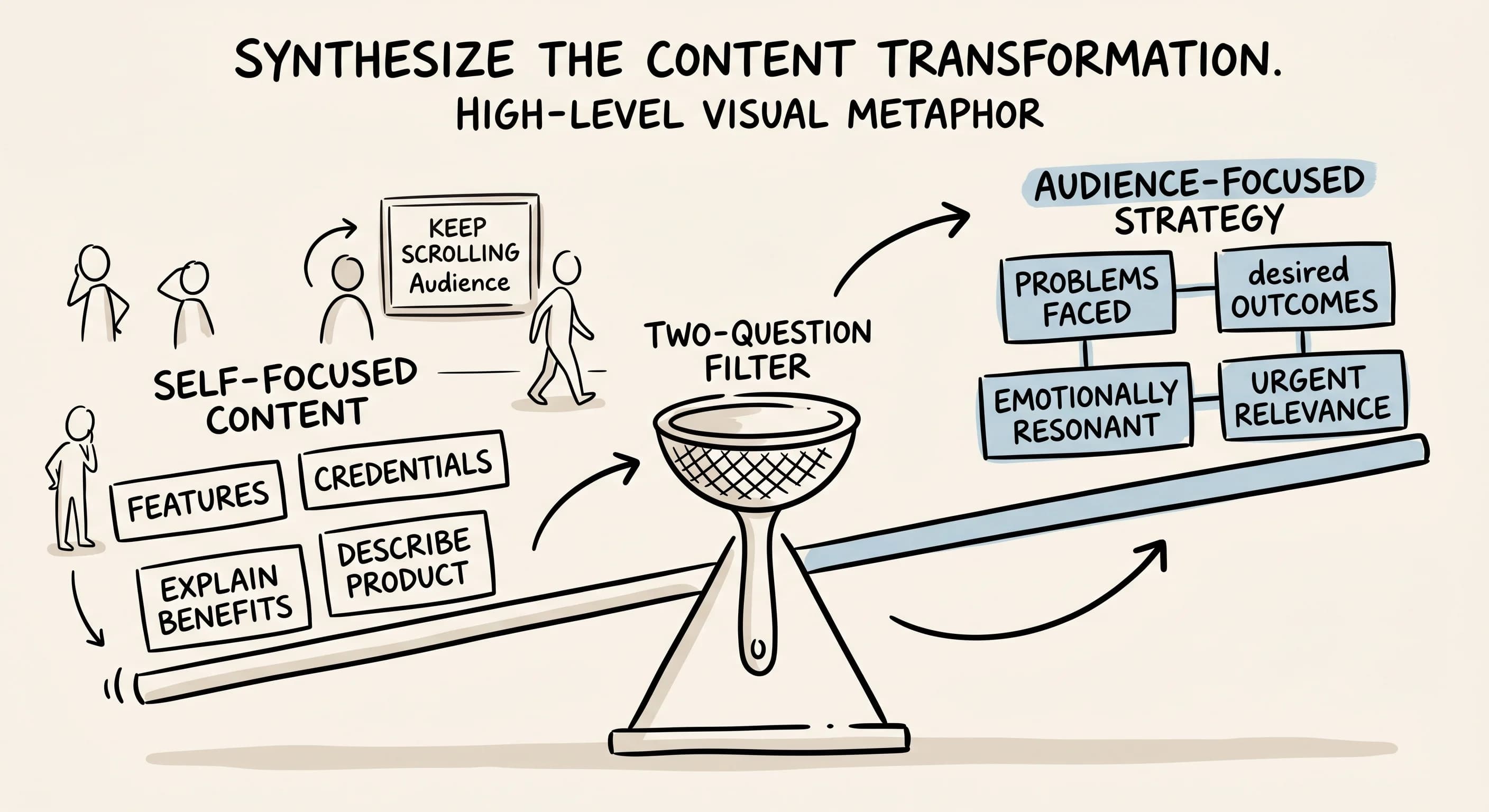
Most content creators make the same mistake: they create content about themselves. They list features, explain benefits, and describe their product in detail, then wonder why their audience keeps scrolling. The problem is not the content format or the keyword strategy. It is that the story is pointed in the wrong direction.
A powerful two-question framework used by top marketers can fix this immediately, and it works across every platform in your marketing stack. But before we get into the framework, it is worth asking a more fundamental question.
What Is Content Creation, and Why Does It Matter?
Content creation is the process of producing and sharing material that informs, entertains, or inspires a specific audience. It can take many forms: blog posts, videos, infographics, email newsletters, or social media posts. Done well, it builds trust, attracts potential customers, and fuels long-term business growth.
But here is the honest truth. What if we told you that email marketing, SEO, AEO, and social media are not the answer on their own? They are channels, not strategies. The real driver is what you actually say inside those channels. That is where content strategy comes in.
A strong content strategy connects the right message to the right audience at the right moment. It is what separates brands that grow with purpose from those that publish constantly but never gain traction. In digital marketing, tools like HubSpot have built entire platforms around helping marketers operationalize this kind of structured, audience-first thinking.
Why is content creation important beyond traffic and visibility? Because it is one of the few marketing efforts that compounds over time. Evergreen content, the kind that remains relevant months or years after publication, keeps working long after you hit publish. An evergreen piece that helps you grow your authority and speak directly to a recurring audience problem can generate leads, build credibility, and reduce your dependence on paid media indefinitely.
What Is the Number One Mistake People Make When Creating Content?
 They make content about themselves. They focus on features, credentials, and processes instead of the specific problems customers face in your industry. The result is content that feels generic, disconnected, and easy to ignore.
If your posts are not landing, ask yourself this: are you just giving advice that people could Google, or are you making people feel something? There is a significant difference between content that is technically accurate and content that is emotionally resonant. The best content does both.
This is also where format matters. Was the content format misaligned with where your audience spends their time and attention? A long-form article might thrive in one context and fail completely in another. Matching format to platform and audience behavior is part of what makes content work.
The Two-Question Filter Every Marketer Needs
 Before you generate content of any kind, write these two questions at the top of the page:
- Why does this matter to your target audience?
- Why does it matter right now?
These questions force you to move beyond feature-listing and into genuine audience-first storytelling. It is the fastest way to create relevant content, content relevant to a real person's real problem, instead of relevant-sounding filler built around a keyword alone. The first question anchors your content creation to real customer relevance. The second, the one most commonly missing from content marketing, adds urgency that actually resonates.
You have probably experienced this yourself. You spend hours crafting what feels like a solid piece of content, hit publish, and hear nothing but crickets. It is not because you are a bad writer. It is because the content did not pass either of those two questions.
Why the Timing Question Is the Missing Piece in Content Creation
The urgency question is not about a sale price or a promotional deadline. It is about your audience's needs and the world around them. It is about making content relevant to what they are experiencing today. Without it, even well-researched content fails to build trust or drive action because it feels disconnected from the reader's reality.
Think about what is happening in your audience's world right now. Are they navigating a platform algorithm change? Dealing with budget cuts? Trying to grow a side project while working a full-time job? That is your moment. When your content can speak directly to that moment, it stops being generic advice and starts feeling like it was written specifically for them.
The Rudolph Framework: Make Your Customer the Hero
 Here is the analogy that makes this framework click: think about Rudolph the Red-Nosed Reindeer. Rudolph's glowing nose is just a feature, until a foggy Christmas Eve makes it exactly what Santa needs to deliver gifts and delight children worldwide. The timing transforms a quirky characteristic into the hero's essential tool.
But notice who the real hero is. It is Santa, the customer. Rudolph's nose simply enables Santa to accomplish his objective. This is how great content works. Your product or service is Rudolph's nose. Your customer is Santa. Your job as a content creator is to position your audience as the hero your content serves.
This principle shows up across the most effective storytelling and positioning frameworks. Donald Miller's StoryBrand methodology, widely used by individual creators and educators, is built on exactly this idea: the customer is the hero, and you are the guide or enabler. Miller consistently argues that marketing fails when it centers the brand instead of the customer, and that the fix is to lead with the customer's specific problem and desired outcome before ever mentioning your product or process.
Going Deep on Your Audience Before You Create Anything
 Before you make content, you need to go deep into understanding who you are actually making it for. This is where the buyer persona becomes essential. Remember that buyer persona you created when you first mapped out your ideal customer? Pull it back out.
A buyer persona is a research-based profile of your ideal audience member. It captures their goals, frustrations, behaviors, and the specific questions your audience is already asking online. It helps you understand what your audience is searching for and allows you to curate topics that actually matter to them instead of guessing.
To build or refine your buyer persona, start by asking:
- What pain points are associated with your industry that you should be talking about but have not addressed yet?
- What is your audience trying to accomplish, and what is standing in the way?
- Where does your audience spends time online, and what formats do they prefer?
When you answer these honestly, you stop creating content for yourself and start creating content that appeals to the people you actually want to reach. That is the shift that changes everything.
How to Build a Strategy and Apply This Framework Across Content Types
Choosing the Right Format to Reach More People
Not everyone consumes content the same way. Format matters enormously, and what format can you create on a consistent basis without burning out? That question is just as important as what you want to say.
Different formats serve different purposes. An infographic can simplify a complex idea and make it shareable in seconds. Short-form videos work when you need to humanize your brand and show personality. A podcast creates intimacy and loyalty over time. GIFs and interactive posts drive quick engagement. Long-form articles and original research establish authority and earn backlinks.
The goal is not to use content on every channel at once. It is to match format to audience behavior, then produce it consistently enough to build a pattern of trust. Tools like Canva make it straightforward to produce visual assets even without a design background, which means shorter pieces and quick social graphics no longer require a full production team.
One practical tool that helps you build a strategy and stay organized is a content calendar. It helps you plan topics in advance, balance different formats, and ensure you are publishing with intention rather than scrambling at the last minute.
What Action Should Your Audience Take Next?
Every piece of content needs a clear call to action: what action should they take next? Should they sign up for your email list? Download a resource? Share the post? Book a call? The call to action connects the content moment to the business outcome, and it is where most creators fall short.
The best calls to action are specific, low-friction, and directly tied to the value the content just delivered. If you wrote a piece about solving a specific problem, the next step should feel like the natural continuation of that solution. A marketer's instinct is often to pack in multiple asks, but one clear next step almost always outperforms a list of options.
For Every Type of Content You Create
In any marketing context, this framework applies whether you are writing blog posts, shooting video, building social captions, or ranking high in search results. Answer both questions before you write a single word. Use those answers as the backbone of your story. Every headline, hook, and call to action should reflect the audience's needs, not your brand agenda.
To create relevant content for your target audience, focus on what your product does for them, not what it is. Then connect it to a real moment in their life: a challenge they are facing, a shift happening in their industry, or a goal they are actively pursuing right now.
A practical way to sharpen Question 1 is to split it into two sub-prompts:
- What specific problem does this relieve for my audience?
- What specific outcome do they get if this works?
This keeps you from staying vague. Saving time becomes cutting your content planning from four hours to forty minutes, so you can actually publish consistently without burning out.
For Question 2, define a real-world trigger instead of manufactured urgency. Ask yourself: what changed recently in your audience's world that makes this more pressing? A platform update, a shift in how audiences engage, a new expectation from their followers? That is your foggy Christmas Eve.
What This Looks Like for Individual Creators
Founders and independent creators who test story angles with real audiences report something consistent: most content ideas do not land, but when one does, you can tell immediately. The audience leans in. Comments increase. Shares happen without prompting. That reaction is your real-time signal that your content passed both questions.
This is why creators who build loyal audiences tend to publish less but resonate more. They are not producing more content for the sake of volume. They are producing original content that has been filtered through relevance and timing before it ever gets written. Sometimes that means creating something from scratch. Other times it means you repurpose a well-performing piece into a new format to extend its reach.
The discipline is not complicated, but it does require you to slow down before you start. It means resisting the urge to create content just to stay consistent, and instead asking whether what you are about to create will actually mean something to your audience today, not just in theory.
Content Creation as a Series of Experiments
What if creating content was like running a series of thoughtful, well-designed experiments? Each post is a hypothesis. Will this type of post resonate? Will this format drive interaction? Are you aiming to go viral, or are you building something slower and more durable?
You will not always get it right. But each time, you are learning what works: what topics resonate, what formats drive interaction, which messages connect with a potential customer and which ones get ignored. That learning compounds, and it is worth the time you invest in it.
AI tools like ChatGPT can help you brainstorm angles, draft how-to outlines, and review your work for clarity before you publish. Used well, they speed up the research and drafting phase so you can spend more energy on the judgment calls that actually require a human perspective.
To make this process sustainable, track metrics like lead generation, engagement, and conversion rather than just traffic or likes. Which pieces generate leads? Which build the most trust? Which make it easiest for someone to take the next step? Use that data to refine your approach over time.
Good content creation best practices also include a mix of original research, curated insights, and practical application. You can curate valuable content from trusted sources, add your own perspective, and create more variations from a single strong idea. When you repurpose and curate thoughtfully, you make content work harder without burning yourself out. Sharing industry insights your audience has not seen elsewhere is one of the fastest ways to build a reputation as a go-to resource in your space.
Content Relevance for SEO: Matching Search Intent
Relevance isn't only about your audience's emotions; it's also how search engines decide what to rank. Content relevance for SEO means your content matches the search intent behind a query, so Google shows it to the right users.
To make your content more relevant to search:
- Do keyword research: find the exact search queries your audience types, then build content around them.
- Match user intent: work out whether the searcher wants to learn, compare, or buy, and answer that intent directly. Content that matches search intent ranks higher than content that just mentions the keyword.
- Build topical relevance: cover a topic thoroughly and link related pages so search engines see authority and relevance, not a thin one-off.
- Handle on-page SEO: put your target keyword in the title, headings, and meta description so both users and search engines instantly grasp what the page is about.
Do this and your content earns relevance on two fronts: it resonates with real people and ranks in search results. That combination is what makes relevant content compound over time.
What Good Is It to Create All This Great Content If No One Sees It?
Distribution is the part most creators underinvest in. You can produce the most valuable content imaginable, but if it does not reach more people who actually need it, it makes no impact. This is where a documented content strategy becomes essential, not optional.
Your strategy should define where your audience is searching, what platforms they use, and how to get your brand's message in front of them consistently. It should align your publishing schedule with your broader goals and account for both short-term wins and long-term evergreen value.
If you were scrolling through your website as a user, what type of content would you want to see? That question is a useful gut check. If the answer is not what you are currently publishing, that gap is where your next experiment begins.
Start Creating Content That Actually Lands
The five C's of great content marketing, clarity, context, consistency, connection, and conversion, all depend on relevance. The two-question filter delivers exactly that.
Stop building content around your brand. Start building it around the moment your audience is living in. That is how you build trust and make every piece of content matter.
Here is your practical starting point. Before your next piece of content, open a blank doc and write these at the top:
- Why does this matter to my specific audience right now?
- What is happening in their world that makes this the right moment to talk about it?
- Who is the hero in this story, and how does my content help them win?
Answer those honestly, and your content creation process changes. Not because you found a magic formula, but because you stopped making content about yourself and started making it about the person on the other side of the screen. That shift is what will help you grow an audience that actually listens.
Read more about Becoming a Content Creator
📚 Complete Guides
- How to Become a Content Creator: Complete Beginner's Guide
- Content Creator Platform Guide: Choose the Right Platform to Start Your Creator Journey
⚡ Tactics & Strategies
- 50% Retention Rate Optimization for YouTube Algorithm Success
- Age Bracket as Superpower Strategy for Older UGC Creators
- AI Workflow Integration for Content Reduction
- Audience Consistency Strategy to Avoid Algorithm Penalties
- Audience Poll on Instagram to Source Q&A Content in Advance of Recording
📄 Related Articles
- Educational YouTube Video Ideas: The Candy vs. Veggies Strategy for Maximum Appeal
- Counter-Positioning: How to Win by Going Against the Grain
- Swipe File: How to Build One With Gmail Labels
- The LinkedIn Hook: Templates and Types to Stop the Scroll
- The P2P Revolution: How Peer to Peer Community Building Is Transforming Influencer Marketing Strategies
- Personal Brand Values: How to Define Them and Filter Every Post
- Content Strategy Framework: The REAL Method
- Viral Content: The Big Idea Formula for Content That Spreads
Read more about Systems, Workflows & Operations for Content Creators

Alex Kirillov
Details
One link. Every channel, rate, and piece of work brands need to evaluate you. Built for how creators actually get hired.
Claim your profile
Live creator, content, and marketing roles from real companies, with the pay, market, and context the raw job page never gives you.
Browse jobs