Educational YouTube Video Ideas: The Candy vs. Veggies Strategy for Maximum Appeal
Learn how successful creators like package educational content using food marketing strategies to maximize YouTube appeal and views.
Details
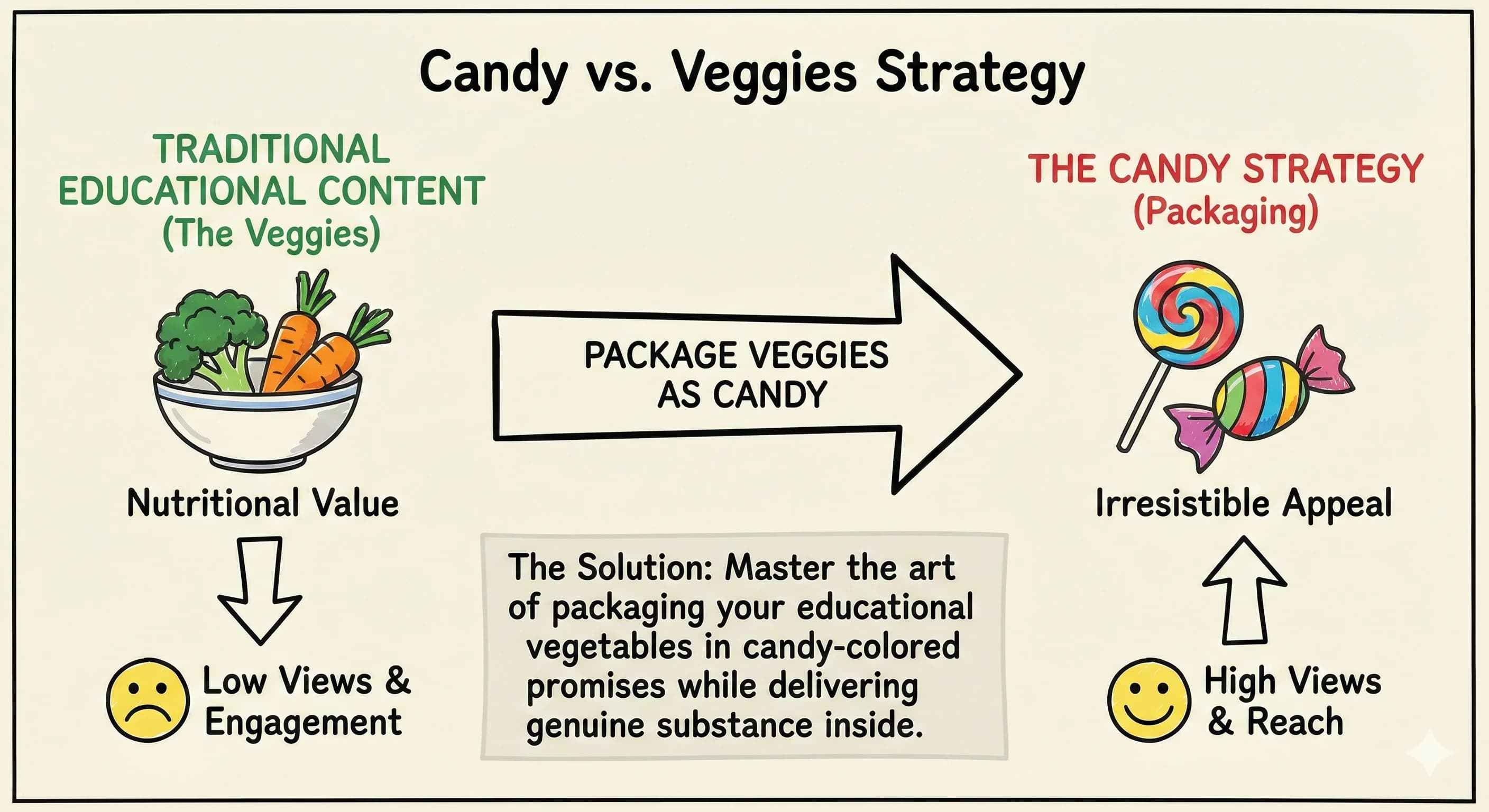
Content creators face a fundamental challenge: educational video content often feels like vegetables when audiences crave candy. You've probably experienced this frustration - you know your content delivers real value, but viewers scroll past because your titles and thumbnails lack that irresistible appeal.
The solution isn't dumbing down your nutritional content. It's mastering the art of packaging your educational vegetables in candy-colored promises while delivering genuine substance inside. Whether you're looking for educational YouTube video ideas that actually get clicks, or you already have great ideas but can't get traction, this packaging strategy is what separates channels with a handful of views from those chasing million views milestones.
Why Your Educational Content Needs a Marketing Makeover
Your channel delivers value, but viewers won't click if your packaging doesn't grab attention. Educational content creators often promote their videos like they're selling vegetables at a candy store - and wonder why nobody's buying.
Derek Muller from Veritasium figured this out years ago. His channel uses extremely sensational titles like "This Battery Breaks Physics" and "World's Longest Field Goal," but inside, he delivers dense scientific explanations. He's openly described optimizing thumbnails and titles first for curiosity and aspirational payoff, then earning watch time by embedding the lesson in compelling stories.
Ali Abdaal takes the same approach with productivity content. He transforms boring topics like note-taking into aspirational packages: "How I Make $1,000,000/Year on YouTube" and "The Only 3 Productivity Apps You Need." Inside, you'll find structured lessons with frameworks and citations - the promised transformation is front-loaded in packaging, while the educational depth appears in the body.
This addresses what food advertisements have known for decades. Research shows that when healthy foods are wrapped in child-appealing packaging with cartoon characters and bright colors, children choose them more often and express higher desire to eat them. The same marketing levers that sell candy can successfully sell vegetables - literally and metaphorically.
Great Ideas for Educational YouTube Video Ideas (Topic Inspiration)
Looking for a video idea that fits the education space? Here are formats and topics that consistently perform well across educational YouTube channels, from beginner-friendly explainers to deep-dive tutorials.
Explainer video formats work brilliantly for abstract concepts. An explainer covering why compound interest works, or a short video breaking down how black holes form, packages complexity into a digestible promise. The School of Life built an entire brand on this: philosophy and psychology made visually compelling and emotionally resonant.
Tutorial content is evergreen. Know a handy keyboard shortcut or two for an application you use every day? Make a video to show your audience exactly how it's done, step by step. Tutorial videos for software, creative skills, and productivity tools regularly rack up millions of views because they solve a real, immediate problem.
Math and science breakdowns are perennially popular. Looking for a quick refresher on a math topic before an exam? Bite-sized explainer videos that tackle one concept at a time - like visualizing fractions or understanding the quadratic formula - serve students and curious adults alike. Channels focused on math consistently grow their subscriber base because demand never dries up.
Crash course style overviews let you cover a subject quickly. A crash course on personal finance, world history, or coding basics promises big value in a short sitting. Crash course content works especially well as a gateway: viewers land for the overview and return for the deeper dives.
Mindfulness and wellbeing is a growing educational niche. Stress management, breathing techniques, and focus strategies packaged as practical how-to videos attract viewers across age groups, from college students to working adults.
Gaming and pop culture hooks are a shortcut into hard topics. There are games coming out on a daily basis, so why not create a short video talking about the game design principles, the history behind the setting, or the math powering the mechanics? It's a natural on-ramp to educational content for audiences who wouldn't otherwise click.
Vlog-style learning journeys - where you document learning a new skill in public - combine entertainment with education. A vlog series on learning a language in 30 days or building a first app from scratch turns your own growth into content that resonates.
If you're a student wondering which topic to make a YouTube channel about, think about the subject you explain most often to friends. That's your niche. Subjects like science, history, personal finance, productivity, and math all support sustainable educational YouTube channels because the audience is large, search demand is steady, and the content stays relevant.
Best YouTube Channels to Study (and What They Do Right)
If you want to find the best educational YouTube channels for inspiration, look at how the top YouTubers package their content, not just what they teach.
The best YouTube education channels share a few habits: they lead with an emotional hook in the thumbnail, they promise a clear outcome in the title, and they deliver on that promise inside the video. Crash Course, Kurzgesagt, and The School of Life are textbook examples. Each uses animation, tight scripting, and a strong visual identity to make complex topics feel accessible.
For younger audiences, the best educational YouTube channels for kids use bright color palettes, friendly characters, and short runtimes. If you're wondering about educational YouTube channels for kids specifically, channels built around songs, stories, and interactive questions tend to hold attention for toddler and early-childhood viewers, where engagement drops off fast if the pacing slows.
Which YouTube channels are recommended by experts for early childhood development? Generally, experts point toward channels that combine repetition, music, and positive reinforcement - the same principles that make educational video games effective. If you're building content in this space, study those structural choices closely.
For middle schoolers, math-focused YouTube channels that use visual proofs and real-world examples consistently outperform text-heavy lecture formats. There are also educational YouTube channels that help with teacher productivity, offering resources, lesson plan walkthroughs, and classroom management tips that save educators hours each week.
The Strategic Food Packaging Framework for Your Video Content
Successful creators understand that marketing strategies must align with viewer psychology. The Super Sprowtz program used cartoon superhero vegetables across banners and videos in school cafeterias, increasing vegetable selection by 2-3x in just four weeks. The food didn't change - only the packaging and story did. Your video content works the same way.
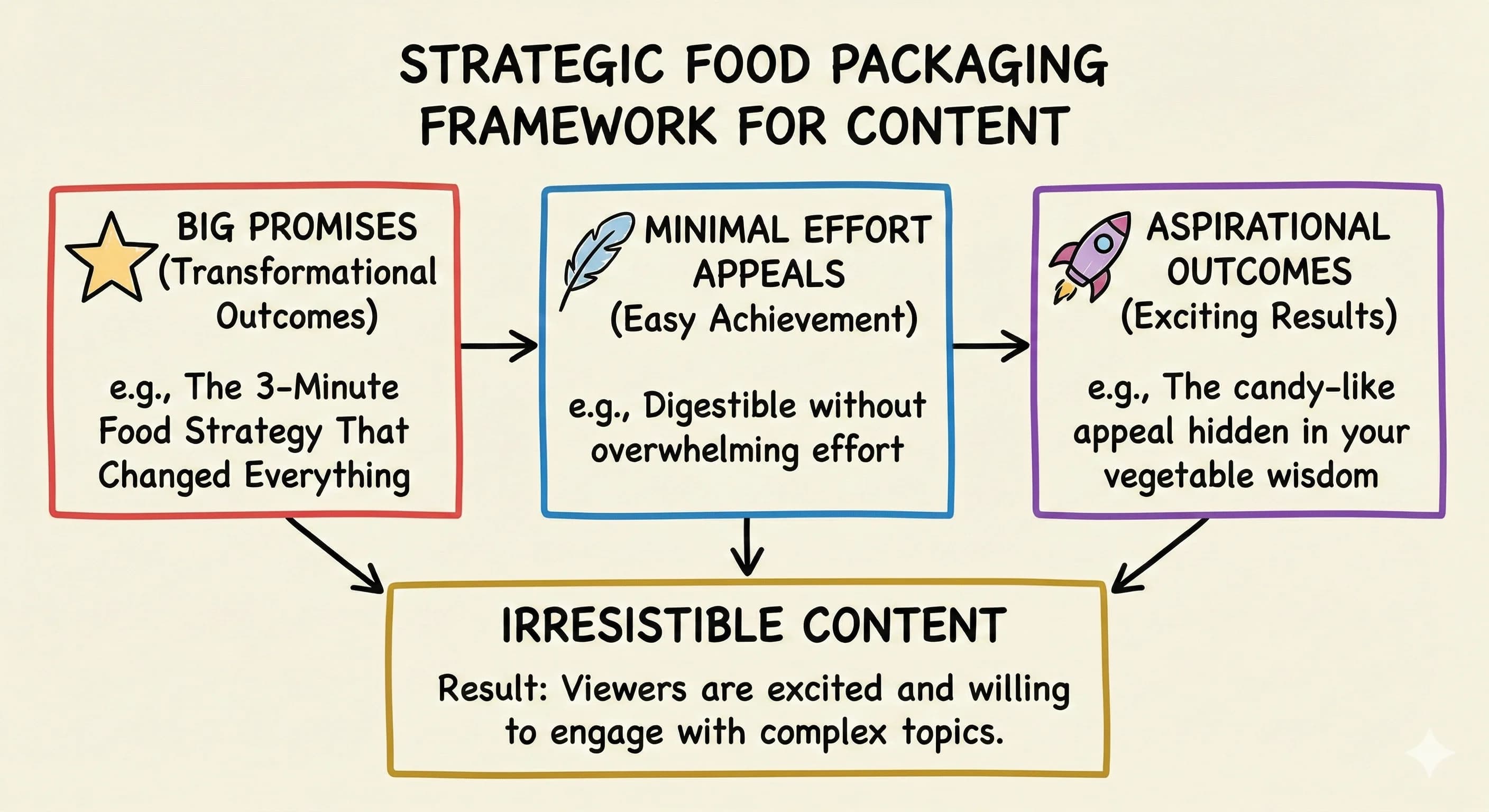
When developing your content package, focus on these core elements:
Big Promises: Promise transformational outcomes that feel achievable. Instead of "Understanding Basic Nutrition," try "The 3-Minute Food Strategy That Changed Everything."
Minimal Effort Appeals: Emphasize easy achievement. Viewers want to believe complex topics can be digestible without overwhelming effort.
Aspirational Outcomes: Highlight the most exciting aspects of your educational content. What's the candy-like appeal hidden in your vegetable wisdom?
Mark Rober exemplifies this approach perfectly. His engineering content uses titles like "I Tested Viral TikTok Science Experiments" but delivers structured concept explorations and experiment walkthroughs. The spectacle gets you in the door; the education is what gets delivered inside.
Video Editing and Production: Make Great Videos Without Overthinking It
You don't need a Hollywood budget to make great videos. Good video production starts with a clear storyboard - even a rough sketch of your opening hook, your main points, and your call to action is enough to keep your video on track.
For video editing, free tools have come a long way. Clipchamp is a browser-based video editor built into Windows and available for education accounts. Students and teachers use Clipchamp to trim video clips, add captions, layer in background music, and export finished videos without installing anything. Is Clipchamp free for education? Yes, Clipchamp offers a free video tier that covers the essentials most school projects and educational creators need. It's a practical starting point before you invest in more advanced software.
If you're starting a school video editing project, a simple workflow helps: shoot or gather your video clips, drop them into your video editor on a timeline, trim the rough edges, add a title card, and export. Online video platforms like YouTube handle the rest. You can make a moving video with these video clips or images, even on a tight budget, as long as your content is clear and your audio is clean.
For creators scaling up, video production quality matters more as your audience grows. Better thumbnails, cleaner audio, and tighter editing all contribute to watch time, which directly affects how YouTube's algorithm distributes your content. Think of video editing as part of your packaging, not an afterthought.
How Food Advertisement Tactics Apply to Educational Channels
Food and beverage companies excel at making unhealthy options irresistible while struggling to promote healthy food effectively. Studies show that bright colors, cartoon characters, playful fonts, and fun claims strongly shift preferences and perceived taste, even when the food is identical.
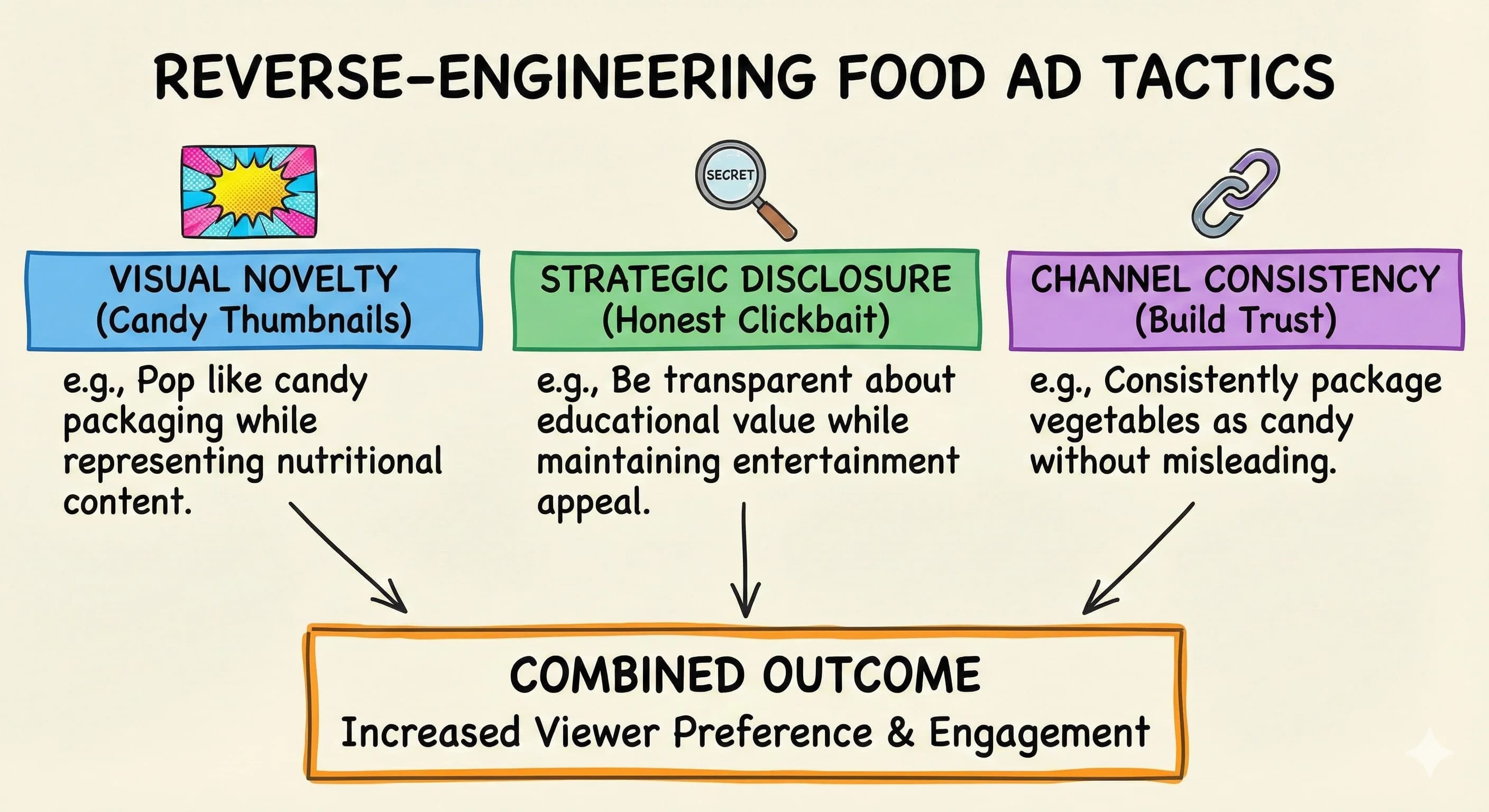
Content creators can reverse-engineer these advertising techniques:
Visual Novelty: Create thumbnails that pop like candy packaging while representing nutritional content. Better Ideas and Matt D'Avella use this strategy with titles like "This One Habit Changed My Life" and "I Tried Waking Up at 4AM for 30 Days." The packaging promises dramatic change and simple rules; the videos cite behavioral science and provide nuanced explanations.
Strategic Disclosure: Be transparent about educational value while maintaining entertainment appeal. Many creators describe this as "honest clickbait" - use attention-grabbing, aspirational promises, but ensure the content truly resolves the curiosity and delivers value.
Channel Consistency: Develop a brand that consistently packages vegetables as candy without misleading your audience.
Implementing the Candy Strategy: Grow Your Channel with Smarter Packaging
To successfully promote healthy educational content through engaging videos, consider how schools use four methods to encourage nutritional choices: visual appeal, peer influence, accessibility, and reward systems. Your YouTube strategy should incorporate similar approaches.
Course creators in the "build in public" space understand this intuitively. They lead with outcome-oriented promises like "Go from Zero to Freelance Developer in 90 Days" and "Land a Data Science Job Without a Degree," then deliver structured curricula covering fundamentals and practice. Behind the scenes, they describe deliberately simplifying the promise on landing pages to be emotionally compelling, then using course content to reset expectations and deliver substantial skill-building.
Want to grow your channel faster? Start with your packaging. Identify the most aspirational element in each video before you film anything. What outcome will make a viewer stop scrolling? How can you present complex information as an easily digestible insight? That framing shapes your title, your thumbnail, and your opening hook.
Monetization on educational channels follows naturally from growth. Once you're consistently pulling views, you can layer in YouTube's Partner Program ad revenue, sponsorships relevant to your niche, digital products, and affiliate links to tools and resources you genuinely recommend. Honest affiliate links - where you only promote things you'd use yourself - fit naturally into educational content because your audience trusts your recommendations.
Your content should inform and educate while maintaining the excitement factor that drives action through emotional appeal rather than logical reasoning alone.
Frequently Asked Questions
What makes a YouTube channel "educational"? An educational video channel teaches the viewer something genuinely useful: a skill, a concept, a perspective, or a process. It doesn't have to be formal or academic. Practical how-to content, explainer series, and even well-researched opinion videos all qualify as educational if the viewer walks away knowing something they didn't before.
How long should educational videos be? It depends on the topic and the format. A tutorial on a keyboard shortcut might be two minutes. A crash course on economics might run twenty. The right length is the shortest runtime that covers the topic completely without cutting anything the viewer actually needs. Bite-sized videos under ten minutes tend to have higher completion rates, which helps with algorithmic distribution.
How do I get more views for educational videos? Start with packaging: your title and thumbnail do most of the early work. Then focus on watch time by hooking viewers in the first thirty seconds. Sharing your videos in relevant communities, optimizing your descriptions with the terms people actually search, and posting consistently all compound over time. To find the best growth levers for your specific channel, study the top performers in your niche and reverse-engineer their structure.
How do I get educational YouTube video ideas fast? Check the comments on your existing videos for questions you haven't answered yet. Browse the "People also ask" section in Google for your main topic. Look at what the best-performing videos in your niche cover, then ask what angle they missed. Your own subscriber questions are one of the richest sources of video ideas you'll ever have.
How much can you earn from an educational YouTube channel? It varies widely based on niche, audience size, and revenue streams. Ad rates in education and finance niches tend to be higher than average. Beyond ads, educational channels often layer in online courses, digital downloads, coaching, and affiliate links. The creators who make the most treat YouTube as a top-of-funnel platform that drives revenue through multiple channels, not just ad monetization alone.
Is Clipchamp free for education? Yes. Clipchamp offers a free video editing tier that works well for school projects, classroom content, and early-stage creators. It's browser-based, which means no installation, and it supports basic video production needs including trimming, captions, and export.
Which idea for educational video would you like to try first? If you're not sure where to start, pick the topic you get asked about most often and make a video to show your answer in the clearest, most visual way you can. That's a tutorial. It's evergreen, it's searchable, and it's a natural first step into the educational YouTube video ideas space.
Transform Your Educational Content Today
The candy vs. vegetables approach doesn't compromise your content quality - it amplifies your reach. Meta-analyses show that children rate foods with cartoon characters as tasting better and are more likely to choose them compared with identical foods in plain packaging. Public health experts explicitly recommend repurposing these "junk food" marketing tactics to promote healthier foods.
This is precisely what successful educational creators do. They understand that attention and emotional engagement are prerequisites for learning. Fun or curiosity-driven framing increases initial attention and persistence, allowing deeper material to be absorbed.
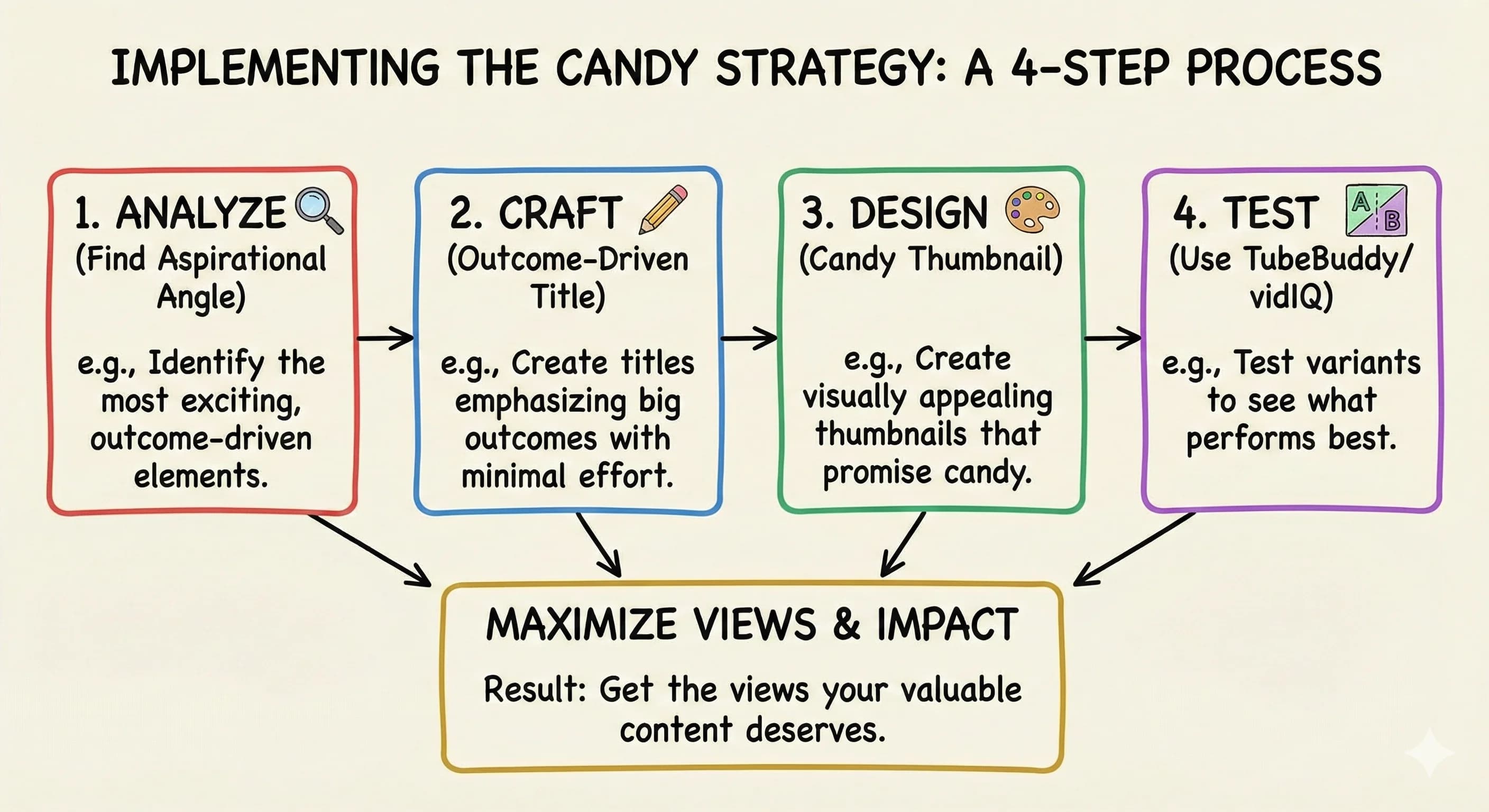
Start implementing this framework immediately: analyze your upcoming content for aspirational angles, craft titles emphasizing big outcomes with minimal effort, and design thumbnails that promise candy while delivering vegetables. Tools like TubeBuddy and vidIQ let you test different title and thumbnail variants, often showing that sensational, outcome-driven versions outperform dry descriptive titles.
Your audience will thank you for making learning irresistibly appealing - and you'll finally get the views your valuable educational content deserves.
Read more about Becoming a Content Creator
📚 Complete Guides
- How to Become a Content Creator: Complete Beginner's Guide
- Content Creator Platform Guide: Choose the Right Platform to Start Your Creator Journey
⚡ Tactics & Strategies
- 50% Retention Rate Optimization for YouTube Algorithm Success
- Age Bracket as Superpower Strategy for Older UGC Creators
- AI Workflow Integration for Content Reduction
- Audience Consistency Strategy to Avoid Algorithm Penalties
- Audience Poll on Instagram to Source Q&A Content in Advance of Recording
📄 Related Articles
- How to Become a Successful Twitch Content Creator: Twitch Streamer Growth Guide
- Media Kit Examples: How to Create One That Lands Brand Deals
- Blog Content Strategy: The Question-Based Method
- Viral Hooks: How to Write Openers That Get Millions of Views
- How to Find Trending Audio on Instagram (The Easy Way)
- Brand Pitch Email Template: The 30-Pitch Strategy That Hit $10K
- Reverse Prompt Engineering: Turn Great ChatGPT Answers Into Reusable Prompts
- How to Grow Email List with Instagram: The Commenter Spotlight Strategy
Read more about Systems, Workflows & Operations for Content Creators
Read more YouTube Resources for Content Creators
📚 Complete Guides
⚡ Tactics & Strategies
- 50% Retention Rate Optimization for YouTube Algorithm Success
- Candy vs Vegetables Packaging Strategy for Educational Content
- Click-Through Rate Optimization as YouTube's Primary Success Metric
- Creating Viral Content Through Polarizing and Educational Hooks
- Doubling Production Effort Per Video to Exponentially Increase Views
🧮 Calculators
Free: The YouTube Content Packaging Toolkit
Get the interactive tool, downloadable PDF, and Notion template - all free.
No spam. Unsubscribe anytime.

Alex Kirillov
Details
One link. Every channel, rate, and piece of work brands need to evaluate you. Built for how creators actually get hired.
Claim your profile
Live creator, content, and marketing roles from real companies, with the pay, market, and context the raw job page never gives you.
Browse jobs