
Deep Research Prompts: A Framework and 5 Templates for Content Creators
Learn how to use AI deep research tools like ChatGPT for content discovery and audience building. Discover proven workflows that successful creators use to find content opportunities.
Details
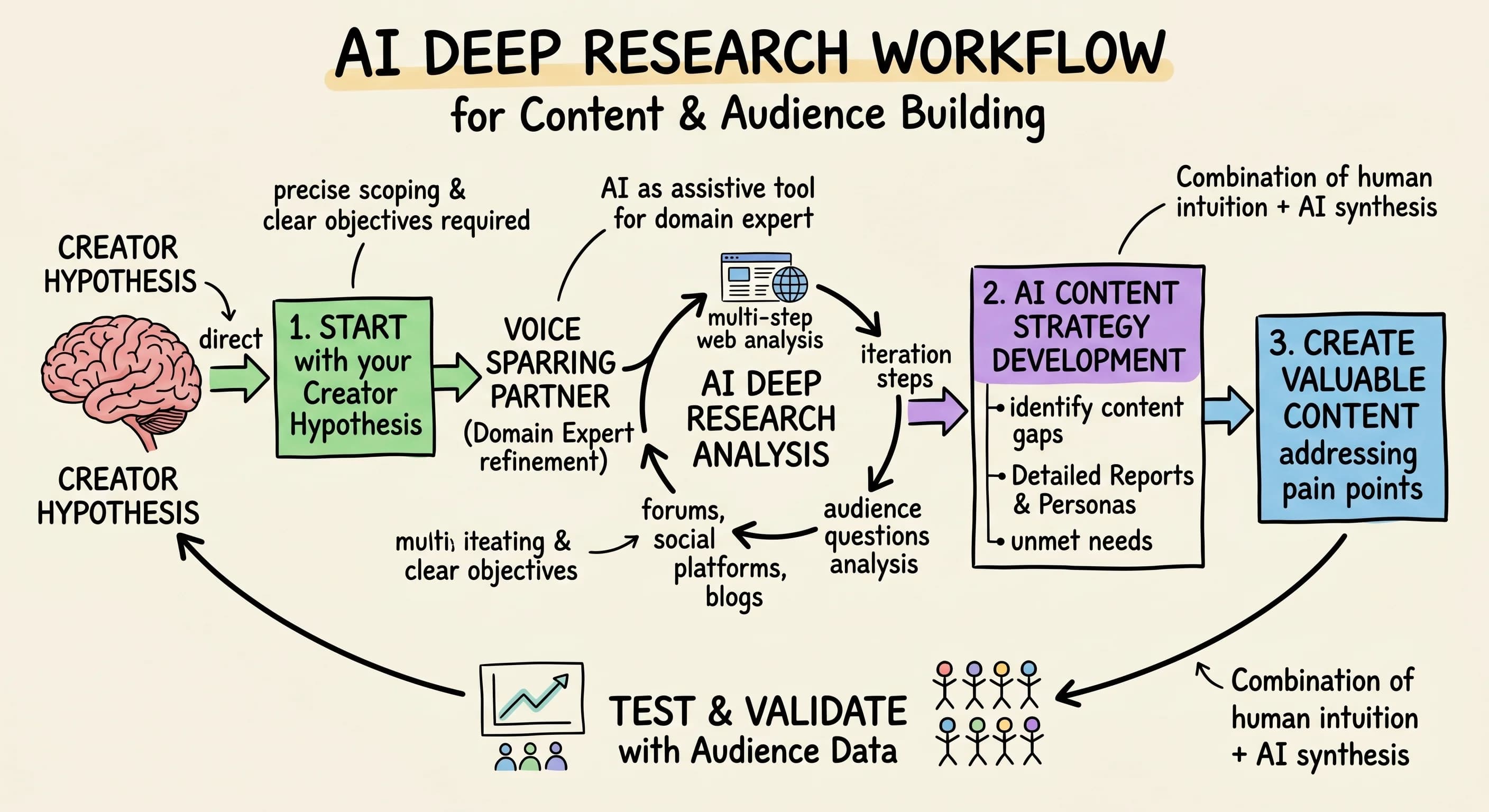
You're sitting there staring at your analytics, wondering what content to create next. Sound familiar? While most creators throw content at the wall hoping something sticks, there's a smarter way to discover what your audience actually wants using AI deep research tools. The catch is that these tools are only as good as the prompt you give them. This guide walks through the workflow, then hands you a framework for writing better deep research prompts and five ready-to-use research prompts you can copy today.
Start With Your Creator Hypothesis
 Before you dive into AI content creation, take a step back and build a hypothesis about what your audience wants. If you're already creating content successfully, you've got valuable data right in front of you. Look at your top-performing content, dig into comment patterns, and review what people are DMing you about.
This isn't just busywork. Your existing engagement data provides crucial hints about your audience's real pain points. Which formats generate the highest engagement? What topics consistently drive comments and shares? Most successful creators already have these insights buried in their analytics.
The key is being systematic about it. Don't just scroll through comments randomly. Actually analyze which posts get the most DMs, what questions show up repeatedly, and which content formats your audience engages with most. This becomes your starting hypothesis for AI-powered research.
The AI-Powered Content Discovery Workflow
 Here's where AI deep research gets interesting. Marketing experts are finding that tools like ChatGPT's Deep Research can conduct 30-40 minute iterative analyses to uncover audience pain points from forums, social platforms, and blogs, outperforming quick searches.
Step 1: Voice Conversation with AI
Start by having a 20-minute voice conversation with ChatGPT about your audience hypothesis. Use the voice feature on web or mobile and just talk through everything in your brain about your audience. Ask the AI to "grill you with questions" to crystallize your thinking and refine your understanding.
This isn't about getting AI to do the work for you. It's about using it as a sparring partner to identify gaps in your thinking before you dive deeper.
Step 2: Deep Research Analysis
After your conversation, prompt ChatGPT to use its deep research capabilities. The tool excels at multi-step web analysis and can extract pain points from online discussions that would take you hours to find manually. Request comprehensive outputs including:
- Detailed user personas
- Market sizing data
- Content opportunity analysis
- Audience pain point mapping
Experts note that these tools work best when you provide precise scoping and clear objectives. The more specific your prompts, the more valuable the output.
Step 3: AI Content Strategy Development
Use your AI-generated content insights to streamline your content planning. One marketer reported using Deep Research for "audience questions analysis," which revealed frequent questions, pain points, and content gaps faster than manual review could achieve.
The research will reveal content gaps and opportunities you might have missed through manual analysis alone. But remember, you're looking for insights to build on, not content to copy.
Which AI Model is Best for Content Creation?
While ChatGPT's deep research feature excels at audience analysis, different AI tools serve various purposes. OpenAI's Deep Research shows 26.6% accuracy on complex benchmarks and generates structured reports for market sizing and trend analysis, though it's limited to Pro users for full iteration.
Perplexity works well for real-time market research and contextual insights. Google's deep research tools offer comparable trend analysis capabilities to OpenAI for audience insights.
The key isn't picking the "best" tool. It's using AI to streamline your workflow rather than replace your creative judgment. Each tool has strengths, so experiment to see which fits your specific content discovery process.
What Makes a Good Deep Research Prompt
A vague request produces a vague report. Deep research rewards a well-structured prompt the way a good brief rewards a freelancer. Whatever tool you use, build every deep research prompt around five parts:
- Objective: State the one question the research must answer. "Identify the top unmet needs of first-year freelance designers" beats "research freelancers."
- Scope: Specify the audience, timeframe, and data sources (forums, Reddit, YouTube comments, competitor blogs) so the agent knows where to look.
- Output format: Ask for a specific structure, an executive summary, key findings, personas, and next steps, so the report is usable instead of a wall of text.
- Evaluation criteria: Tell the model how to prioritize, for example "rank pain points by how often they appear and how emotionally charged the language is."
- Expected outcome: Name what you'll do with it ("a list of 10 content ideas mapped to each pain point") so the AI frames insights for action.
This is the whole of prompt engineering for deep research: be specific about the objective, the scope, and the output. The more precisely you specify each part, the better results you get.
5 Deep Research Prompts to Steal
Use these deep research prompts as templates. Paste one into ChatGPT deep research, Perplexity, or Gemini, swap in your niche, and refine from there.
- Audience pain points: "Act as a market researcher. Analyze forums, Reddit, and YouTube comments about [topic]. Identify the 10 most frequent and most emotionally charged pain points my target audience of [audience] expresses. For each, include a representative quote and a suggested content angle. Output as a table with an executive summary."
- Content gap analysis: "Research the top 20 pieces of content ranking for [topic]. Summarize what they all cover, then identify the questions and subtopics none of them answer well. Rank these content gaps by likely search demand."
- Audience questions: "Identify the most frequently asked questions [audience] asks about [topic] across Quora, Reddit, and Google's People Also Ask. Group them into themes and flag which ones have the weakest existing answers online."
- Persona builder: "Build three detailed personas for [audience] interested in [topic], including goals, frustrations, the language they use, and the platforms they spend time on. Cite the sources behind each trait."
- Trend and market sizing: "Analyze how interest in [topic] has changed over the last 24 months and where it's heading. Include market sizing data, key players, and three emerging sub-trends a creator could get ahead of. Provide a well-structured research report with sources."
Each of these works best when you add your own scope and custom instructions. Treat them as a starting framework, not a finished answer.
Implementing AI Customer Discovery
 For effective AI customer discovery, you'll want to combine multiple data sources. Upload your audience demographics, top comments, and engagement metrics to AI tools. Ask specific questions about patterns, trends, and opportunities.
But here's what most creators miss: the AI-powered analysis will generate insights that would take hours of manual research to uncover, but you still need to validate these insights with your actual audience data.
Prompts like "Identify the most frequently asked questions your target audience is asking about your topic of expertise" can generate detailed reports on customer pain points and unmet needs. However, experts emphasize that these outputs require human interpretation due to their complexity.
Beyond Simple AI Frameworks
While some follow rigid AI frameworks, successful content creators adapt AI tools to their specific needs. The research shows that deep research works best as an assistive tool for domain experts who can refine hypotheses through precise prompts and iteration.
You want to avoid "AI rabbit holes" by maintaining human direction throughout the process. Spend time understanding your AI-generated content insights, then apply your unique perspective and expertise to create authentic, valuable content.
Consider using a hybrid approach: combine AI synthesis with human validation. Use AI to identify patterns in your analytics, then test these insights with your actual audience through polls, comments, or direct feedback.
Taking Action on AI Insights
Once you have AI-generated audience research, create content that directly addresses the discovered pain points. But don't stop there. Test different formats and topics based on your AI content creation strategy, then monitor performance carefully.
Feed your results back into your AI workflow for continuous improvement. This creates a feedback loop where your AI tools get better at understanding your specific audience over time.
The most effective creators use AI deep research as a starting point for deeper audience connection, not as a replacement for genuine audience engagement. Use the insights to ask better questions, create more targeted content, and build stronger relationships with your community.
Remember, the future of content discovery lies in combining human intuition with AI-powered research capabilities. You're not trying to automate creativity, you're trying to make your creative decisions more informed and strategic.
Read more about Audience Building & Growth for Content Creators
📚 Complete Guides
- How to Build an Audience as a Content Creator
- How to Find Your Target Audience (Start With One Person)
⚡ Tactics & Strategies
- 30 Daily Outbound Pitches for UGC Deal Generation
- 50% Retention Rate Optimization for YouTube Algorithm Success
- Age Bracket as Superpower Strategy for Older UGC Creators
- Audience Consistency Strategy to Avoid Algorithm Penalties
- Audience Psychology Over Algorithm Optimization, Focusing on Human Pain Points and Goals Instead of Platform Tactics
📄 Related Articles
- Professional Branding for Creators: Build a Career Asset
- Buyer Persona Examples (and How to Create One With AI)
- How to Grow on Twitter (X) as a Content Creator
- Views to Subscriber Ratio YouTube: How to Find Undervalued Creators Using Stock Market Strategies
- How to Market on Reddit Without Getting Banned
- How to Use the Facebook Ad Library for Brand-Aligned UGC Research
- Google Alerts Marketing: How to Land High-Profile Guests with Strategic Timing
- Facebook Retargeting Strategy: How to Use UGC to Convert Warm Buyers

Alex Kirillov
Details
One link. Every channel, rate, and piece of work brands need to evaluate you. Built for how creators actually get hired.
Claim your profile
Live creator, content, and marketing roles from real companies, with the pay, market, and context the raw job page never gives you.
Browse jobs