
Facebook Retargeting Strategy: How to Use UGC to Convert Warm Buyers
Learn how to use UGC in retargeting ads to build trust and drive bottom-of-funnel conversions. A practical framework for Facebook retargeting with real customer content.
Details
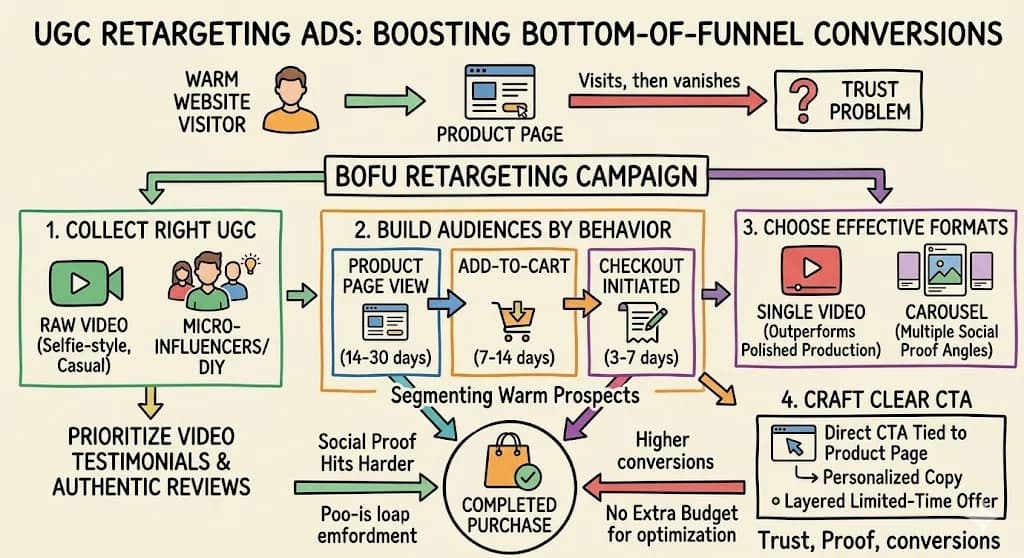
 You've spent real money driving traffic to your product page. Visitors browse, maybe even add to cart, and then they vanish. That's not a traffic problem. That's a trust problem. And this is exactly where a smart UGC retargeting strategy does the heavy lifting for you.
When someone visits your website and leaves without buying, they haven't rejected you. They just weren't quite convinced yet. A well-placed UGC ad in your Facebook retargeting campaign can be the difference between a lost visitor and a completed purchase. This guide covers the full Facebook retargeting strategy, how the Meta pixel and custom audiences work, and why user-generated content is the creative that makes it convert.
How Facebook Retargeting Works: Pixel, Audiences, and Ad Types
Before the creative matters, the plumbing has to be in place. Facebook retargeting (also called Facebook remarketing) runs on three pieces:
- The Meta pixel. Install the Facebook pixel on your website and it tracks every website visitor and the action they take, whether they viewed a product page, added to cart, or started checkout. Without the pixel, there is no retargeting.
- Custom audiences. In Facebook Ads Manager, you build custom audiences from those pixel events. A custom audience of past website visitors who didn't buy is the core of any Facebook retargeting campaign.
- Ad types. You can serve standard image or video ads, or use dynamic product ads (catalog ads) that automatically show each shopper the exact product they viewed. Dynamic product ads are the highest-intent format in the retargeting funnel.
Layer these into a retargeting funnel by recency, and you have the skeleton of an effective retargeting strategy. What you put inside those ads is where UGC comes in.
Why UGC Ads Outperform Traditional Creative in Retargeting Campaigns
Warm audiences don't need more brand messaging. They've already seen your product. What they need is proof from someone who looks like them.
A polished brand creative feels like an ad. A real customer talking casually about your product on their phone feels like a recommendation from a friend. That distinction matters more than most marketers realize. Authentic, testimonial-style UGC ads mirror the peer recommendations people already trust, which is exactly why they perform so well in Facebook ads and Instagram reels.
Cometly's research into UGC ad strategies confirms this: BOFU retargeting creatives that combine real user testimonials with social proof consistently outperform generic product-focused assets for warm audiences. The content feels native to the feed, not forced into it.
Best Version Media puts it plainly: adding user-generated content to retargeting ads "can increase brand confidence and trust," especially when that content is aligned with what the user actually viewed on your site.
Understanding the Bottom-of-Funnel Opportunity
 UGC retargeting lives in the most valuable part of your funnel. These aren't cold strangers. They're warm prospects who already signaled interest by visiting your product page, adding to cart, or starting checkout. They just didn't finish.
When a website visitor sees a real customer talking about your product in a casual, relatable format, something shifts. It answers the quiet question they're carrying: does this actually work for someone like me?
Straight North's funnel-stage framework is useful here. For bottom-of-funnel audiences specifically, they recommend testimonials and before-and-after content that directly reinforces a purchase decision, not content that educates or entertains. BOFU UGC should be short, proof-oriented, and focused on converting someone who already understands your offer.
That's the opportunity. You're not starting from zero with these people. You just need to give them one more reason to trust you enough to click.
How to Use UGC Effectively in Your Facebook Retargeting Ads
Here's a practical framework built around what actually works for real campaigns:
1. Collect the Right UGC
Source content from real customers, micro-influencers, or DIY methods. Prioritize video testimonials and authentic product reviews over anything that looks scripted or produced. A short reel of someone genuinely using your product filmed on their phone is ideal creative for this strategy.
Keep it raw. Cometly's guidance is clear on this: structure your UGC ads like native social content, meaning selfie-style video, casual environment, real voice. Minimal editing. The moment it starts looking like a commercial, the trust factor drops.
2. Build Your Retargeting Audience by Behavior
 This is where a Facebook retargeting strategy earns its conversion rate. In Facebook Ads Manager, build custom audiences based on specific pixel actions, not just general website visits. Stackmatix and Common Thread Collective both recommend segmenting your Facebook retargeting audiences into layers, each with its own UGC creative:
- Product page viewers (14 to 30 days): Show UGC where someone demonstrates the specific product and explains what problem it solved.
- Add-to-cart (7 to 14 days): Use UGC that handles objections directly. Price, quality, fit, whatever the hesitation might be. The angle that works here is "I almost didn't buy this, but here's why I did."
- Checkout initiated (3 to 7 days): These are your hottest prospects. Short, high-trust testimonials paired with reassurances like easy returns or fast shipping close the loop fast.
Matching your UGC creative to the specific behavior is what separates a decent retargeting campaign from a great one.
3. Choose Your Ad Format Wisely
Effective UGC ad formats for retargeting include single video, carousel, and story placements. A carousel featuring multiple real customer testimonials or use cases can be especially powerful, showcasing different angles of social proof in one message. If you're retargeting cart abandoners specifically, a before-and-after UGC format works well for products with visible results, think fitness, skincare, or anything where transformation is part of the value.
For creators and personal brands working with limited budgets, a single authentic video testimonial will almost always outperform a polished multi-asset production. Don't let perfect be the enemy of done here.
4. Craft a Clear CTA That Matches the Moment
Your UGC retargeting ad should end with a direct CTA tied to the specific product page they visited. Personalized copy like "Still thinking about it?" paired with authentic user content creates urgency without pressure.
Cometly also suggests layering in a limited-time offer or practical incentive alongside the UGC itself. Something like a real customer video paired with "free shipping ends tonight" hits both the emotional trust signal and the rational motivation at the same time. That combination works.
The Micro-Segment Advantage Most Creators Miss
 Most people running UGC retargeting campaigns treat their entire warm audience as one group. They're not. A visitor who watched your product video three weeks ago needs a different message than someone who got to the checkout page yesterday.
Serving the same UGC creative to your entire retargeting audience is leaving conversions on the table. When you match the content to where someone is in their decision process, the social proof hits harder because it feels relevant, not random.
This is one of the simplest optimizations you can make, and it doesn't require extra budget. It just requires building out a few additional ad sets with intentional creative decisions behind each one.
Final Thoughts: Let Real Customers Close the Sale
Stop trying to convince warm audiences with brand messaging alone. They've already seen your brand. What moves them now is proof from someone who's been where they are.
When you use UGC strategically at the bottom of the funnel, you're not just running Facebook retargeting ads. You're building trust at scale with the exact people who were close enough to buy but needed one more push. Get the Meta pixel firing, build your custom audiences by behavior, and let real customers do the convincing, and your Facebook retargeting campaign turns warm website visitors into conversions instead of lost traffic.
Start collecting authentic customer content today, map it to your retargeting segments, and watch what happens to your ad performance. The content is already out there. You just need to put it in front of the right people at the right moment.
Read more about Audience Building & Growth for Content Creators
📚 Complete Guides
- How to Build an Audience as a Content Creator
- How to Find Your Target Audience (Start With One Person)
⚡ Tactics & Strategies
- 30 Daily Outbound Pitches for UGC Deal Generation
- 50% Retention Rate Optimization for YouTube Algorithm Success
- Age Bracket as Superpower Strategy for Older UGC Creators
- Audience Consistency Strategy to Avoid Algorithm Penalties
- Audience Psychology Over Algorithm Optimization, Focusing on Human Pain Points and Goals Instead of Platform Tactics
📄 Related Articles
- Mastermind Group: What They Are, Cost, and How to Start One
- Podcast Promotion: Grow Your Show With Swap Deals
- Social Media SEO: How UGC Creators Get Found by Brands
- How to Get More Instagram Story Views: The STD Strategy
- Questions to Ask Your Audience on Social Media (That Get Replies)
- Membership Community: Test It Before You Charge
- Instagram Engagement Strategy: The 5-10 Minute Rule
- Cold Email Outreach: A 90-Day System for Creators

Alex Kirillov
Details
One link. Every channel, rate, and piece of work brands need to evaluate you. Built for how creators actually get hired.
Claim your profile
Live creator, content, and marketing roles from real companies, with the pay, market, and context the raw job page never gives you.
Browse jobs