How to Choose a Social Media Platform for Your Content Strategy
Stop trying to be everything on every social media platform. Learn how to choose the right social media platform for influencing vs. content creation and build your audience without the burnout.
Details
How to Choose a Social Media Platform for Your Content Strategy
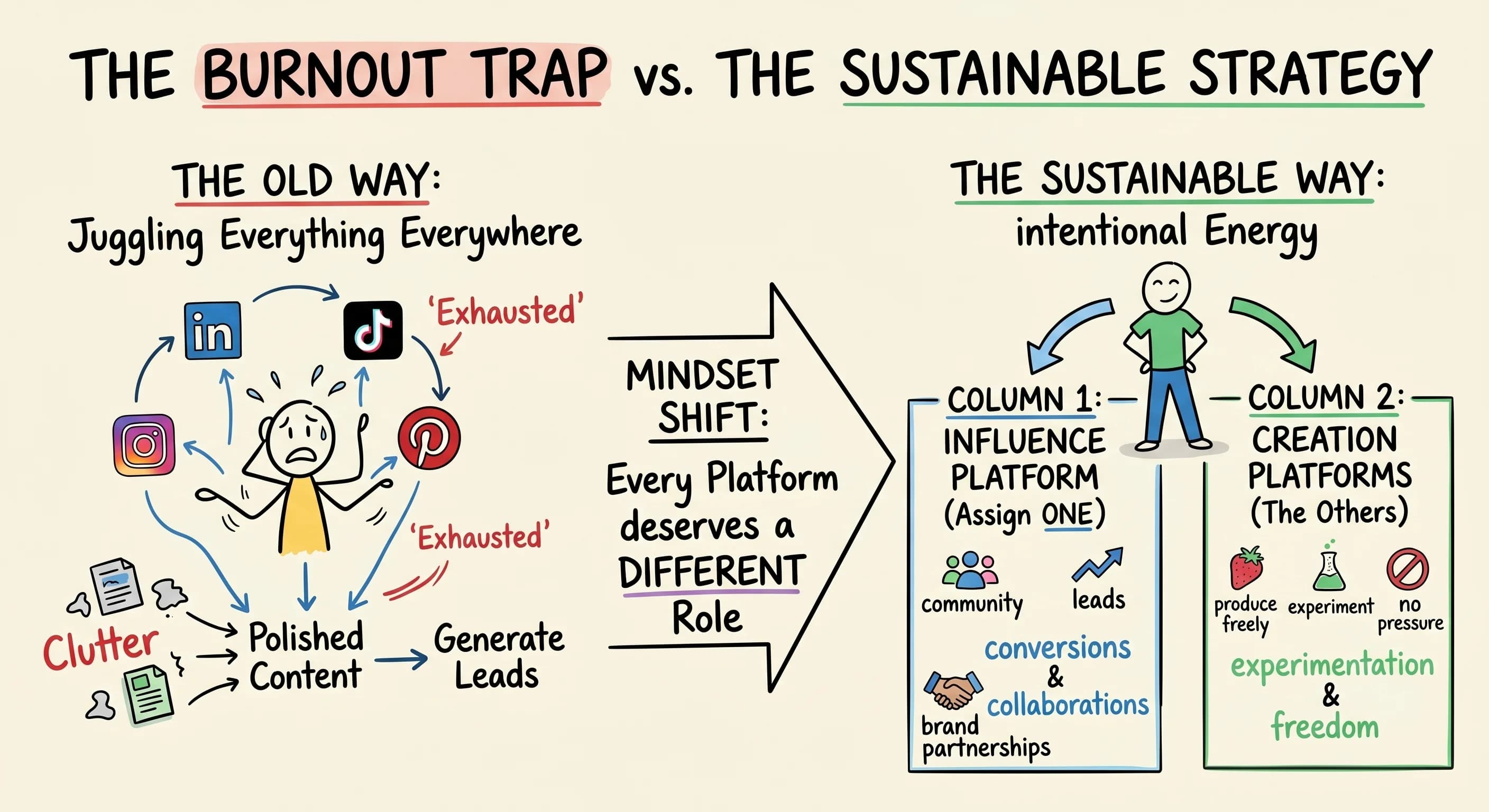
Most content creators burn out because they're trying to be everything everywhere all at once. You're posting on Instagram, LinkedIn, TikTok, and Pinterest simultaneously, trying to build brand awareness, generate leads, and produce polished video content across every channel. It's exhausting, and it's also completely unnecessary.
So, which social media platforms should I use? And do you need to be on every social media platform at once? The short answer is no. There's a smarter way to approach things, and it starts with one simple mindset shift: not every social media platform deserves the same role in your life as a creator.
Do You Need to Be on Every Social Media Platform?
 Research on multi-platform creators consistently shows that effective creators don't replicate the same strategy across every social media channel. A study of 21 cross-platform creators found they actively negotiate different platform demands in distinct ways, adapting their creative practices to what each platform actually rewards rather than forcing one unified approach everywhere.
This makes complete sense when you think about it. LinkedIn operates very differently from Instagram, TikTok, or Pinterest. Each platform attracts different demographics, rewards a different type of content, and drives different user behavior. Sprout Social data consistently shows that B2B audiences engage deeply on LinkedIn, while short-form video and visual content dominates Instagram and TikTok. Recognizing these differences is the foundation of good social media marketing, and it's the reason trying to show up the same way across every social media platform is a recipe for burnout.
For business owners especially, this is the unlock. The big brands that small business owners hope to emulate, the ones putting out great social media content on Facebook, Twitter, Instagram, and Pinterest, aren't actually doing the same thing on each one. They're playing to each platform's strengths.
Which Social Media Platforms Should I Use for My Business?
 Before you can choose the best social media platform for your goals, you need to answer a few honest questions.
What are my objectives from social media marketing? Are you focused on brand awareness, driving website traffic, generating leads, or boosting sales? Is it to increase brand awareness in a crowded niche, or to generate leads and drive sales for a specific offer? Your business targets shape everything else.
Who is my target audience? Who are your customers? Where do they already spend time online? Gen Z gravitates toward TikTok and Instagram Reels. Professionals and B2B buyers are most active on LinkedIn. Older demographics still use Facebook heavily, and Facebook offers some of the most sophisticated ad targeting available to reach your audience across age groups.
What kind of social media content do you enjoy creating? Do you like posting a variety of types of content, and want a place to link back to your weekly blog posts? Or do you prefer talking to a camera? What type of content is most effective for brand interaction in your niche? The platform you choose should match both your audience's preferences and your own creative strengths, because you'll be showing up there consistently.
How much time do you have? Managing multiple social media networks is a real commitment. For most creators and business owners starting out, platforms to focus on should number two or three at most.
What's your brand's tone of voice? Certain platforms reward polish and professionalism (LinkedIn). Others reward raw authenticity and speed (TikTok). A good platform fits your voice naturally, so you're not performing a version of yourself that doesn't feel real.
Once you've answered these, you're in a much better position to choose the right social media platform for each role, rather than defaulting to whichever popular social media app everyone else seems to be using.
How to Choose the Right Social Media Platform for Each Role
 Here's the framework that changes everything: designate each of your active social media channels as either an influence platform or a creation platform, not both.
- Influence platforms are where your community naturally rallies around you, making them ideal for brand partnerships, generating leads, and conversion-focused collaborations.
- Creation platforms are where you produce content freely, without the pressure of performing for brand deals.
Research on creator labor and platform control shows that creators who align their work with what a platform structurally rewards, rather than fighting the platform's nature, experience significantly less friction and role conflict. In other words, following the platform's logic instead of working against it is exactly what high-performing creators already do, even if they don't have a name for it.
Use this simple audit to assign roles and choose the best social media fit for your situation:
- List every platform you're currently active on.
- Review your analytics and identify where engagement feels natural and community-driven rather than forced.
- Identify pressure points by asking yourself which platforms create stress around content creation or performance.
- Designate each social platform as either influence or creation based on where you show up most authentically.
- Only pursue brand partnerships on platforms where you've assigned the influence role.
Choosing the platform to use for influencer work means following your ease, not just your follower count. A study on platform specialization confirms this isn't just an intuitive preference: specialization is a rational performance strategy that reduces cognitive load and role conflict, making it sustainable long-term.
Let's Explore Some Social Media Platforms
Different platforms perform best for different goals. Here's a quick look at what the most popular platforms actually reward, so you can match them honestly to your business goals.
LinkedIn is the oldest social platform still in active growth, and it remains the best social media platform for professional networking, B2B marketing, and thought leadership content. If you run a B2B business or sell services to other professionals, use LinkedIn as your primary influence platform. Its user base skews professional, its algorithm rewards substantive long-form posts, and the community-driven nature of the platform makes brand partnerships feel organic rather than transactional. LinkedIn is genuinely the platform for building authority in professional spaces.
Facebook remains one of the largest social media networks by active users. Use Facebook if your audience skews 30-plus or if you want access to its powerful paid ad ecosystem. Facebook offers precise targeting by interest, location, and behavior, making it especially useful for local businesses and e-commerce.
Instagram is a visual-first social media platform where aesthetics drive discovery. It works well for lifestyle brands, product photography, and creators comfortable with a more curated presence. Hashtags still play a role in organic discovery here, so a smart hashtag strategy is worth building into your workflow. That said, its perfection-driven culture can trigger performance anxiety, which is a legitimate reason to assign it a creation role rather than an influence role.
TikTok is currently the dominant platform for short-form video, and its algorithm is one of the most powerful discovery engines in digital marketing today, functioning almost like a search engine for video content. Gen Z lives here, and it's the platform to use if reach and rapid audience growth are your primary goals.
Pinterest acts more like a visual search engine than a traditional social network, which means content has a much longer shelf life there. It's ideal for creators in food, home, fashion, DIY, and lifestyle niches who want to reach your audience through evergreen content.
So, which platforms do you think you'll enjoy putting real effort into? That question matters as much as the data does.
LinkedIn vs. Instagram: A Real-World Example
One creator described her approach directly: she influences exclusively on LinkedIn and treats all other platforms like Instagram as creation spaces. Instagram remains open for future opportunities, but the inherent pressure to appear perfect on a visually-driven platform makes it unsuitable for authentic influencer work right now. So she protects that boundary completely.
This isn't a limitation. It's a strategy. Research on creator self-representation shows that creators who tell different professional stories across social networks, presenting as a community leader in one space and a content producer in another, are already practicing this kind of role separation naturally. The difference is doing it deliberately.
Platform-specific influencer marketing research supports the same conclusion: partnership behavior is only effective on platforms where the audience relationship and platform norms make it feel authentic. Pursuing brand deals on a platform where you feel pressured and inauthentic isn't just uncomfortable, it's also less likely to convert.
Does It Matter Which Platform You Choose?
Absolutely. The media platform for your business isn't just a distribution channel, it's the environment that shapes how your audience perceives you, how the algorithm amplifies (or suppresses) your content, and whether your work is right for your business goals long-term.
Different platforms have genuinely different cultures. Platforms like LinkedIn and Pinterest reward patience and depth. Platforms like TikTok and Instagram reward speed and frequency. Neither approach is wrong, but mixing them up by treating every platform the same way is where most creators and business owners lose momentum.
And what platforms do you think can be the next big thing? It's worth paying attention to emerging social media networks, but the same principle applies: don't try to colonize a new platform until you've decided what role it would actually play. (As for the Vine, Musically, TikTok pipeline, yes, that pattern absolutely repeats, and it will again.)
Build Your Audience Without the Burnout
You don't need to use social media the same way everywhere. The most sustainable audience-building strategy isn't about being louder across more channels. It's about being more intentional about which platforms deserve which version of your energy.
Assign one platform the influence role, and protect it. Let the others be your creation space where you experiment, produce content freely, and show up without the weight of brand performance expectations. That separation protects your creativity, sharpens your focus, and lets you show up more powerfully where it actually counts.
Your target audience is already on specific platforms waiting for the version of you that isn't burned out. Give them that version by choosing the right social media platform for each role, and committing to it.
So, which social media platforms do you think you'll focus on first? Drop it in the comments.
Read more about Systems, Workflows & Operations for Content Creators
📚 Complete Guides
⚡ Tactics & Strategies
- 30 Daily Outbound Pitches for UGC Deal Generation
- 50% Retention Rate Optimization for YouTube Algorithm Success
- AI Workflow Integration for Content Reduction
- Audience Consistency Strategy to Avoid Algorithm Penalties
- Audience Poll on Instagram to Source Q&A Content in Advance of Recording
📄 Related Articles
- Media Kit for Content Creators: What to Include (and Auto-Update)
- Storytelling in Marketing: How to Adapt It for Every Audience
- Curated Newsletter: How to Make Yours Feel Prestigious
- Blog Content Strategy: The Question-Based Method
- How to Find Trending Audio on Instagram (The Easy Way)
- Brand Pitch Email Template: The 30-Pitch Strategy That Hit $10K
- Reverse Prompt Engineering: Turn Great ChatGPT Answers Into Reusable Prompts
- How to Grow Email List with Instagram: The Commenter Spotlight Strategy
Read more Instagram Resources for Content Creators
📚 Complete Guides
⚡ Tactics & Strategies
- Audience Poll on Instagram to Source Q&A Content in Advance of Recording
- Community-First Creator Sourcing to Maximize Small Influencer Budgets
- Consistent Aesthetic Elements Strategy
- Creating Viral Content Through Polarizing and Educational Hooks
- Earning Influence Through Trust Rather Than Attention Spikes
🧮 Calculators
Read more LinkedIn Resources for Content Creators
📚 Complete Guides
⚡ Tactics & Strategies
- Finding and Supporting Small Creator Communities
- Platform-Specific Role Assignment- Separating Influencing from Content Creation by Channel
- Starting a B2B Influencer Program Direct Outreach to 1-3 Known Creators Without an Agency
- Street Interview Content Strategy for Viral LinkedIn Growth
- First Three Lines Hook Strategy for LinkedIn Posts

Alex Kirillov
Details
One link. Every channel, rate, and piece of work brands need to evaluate you. Built for how creators actually get hired.
Claim your profile
Live creator, content, and marketing roles from real companies, with the pay, market, and context the raw job page never gives you.
Browse jobs