

Triple Whale
Triple Whale is a complete ecommerce intelligence platform that unifies data, attribution, and AI-powered insights to help brands make faster, more confident marketing decisions.
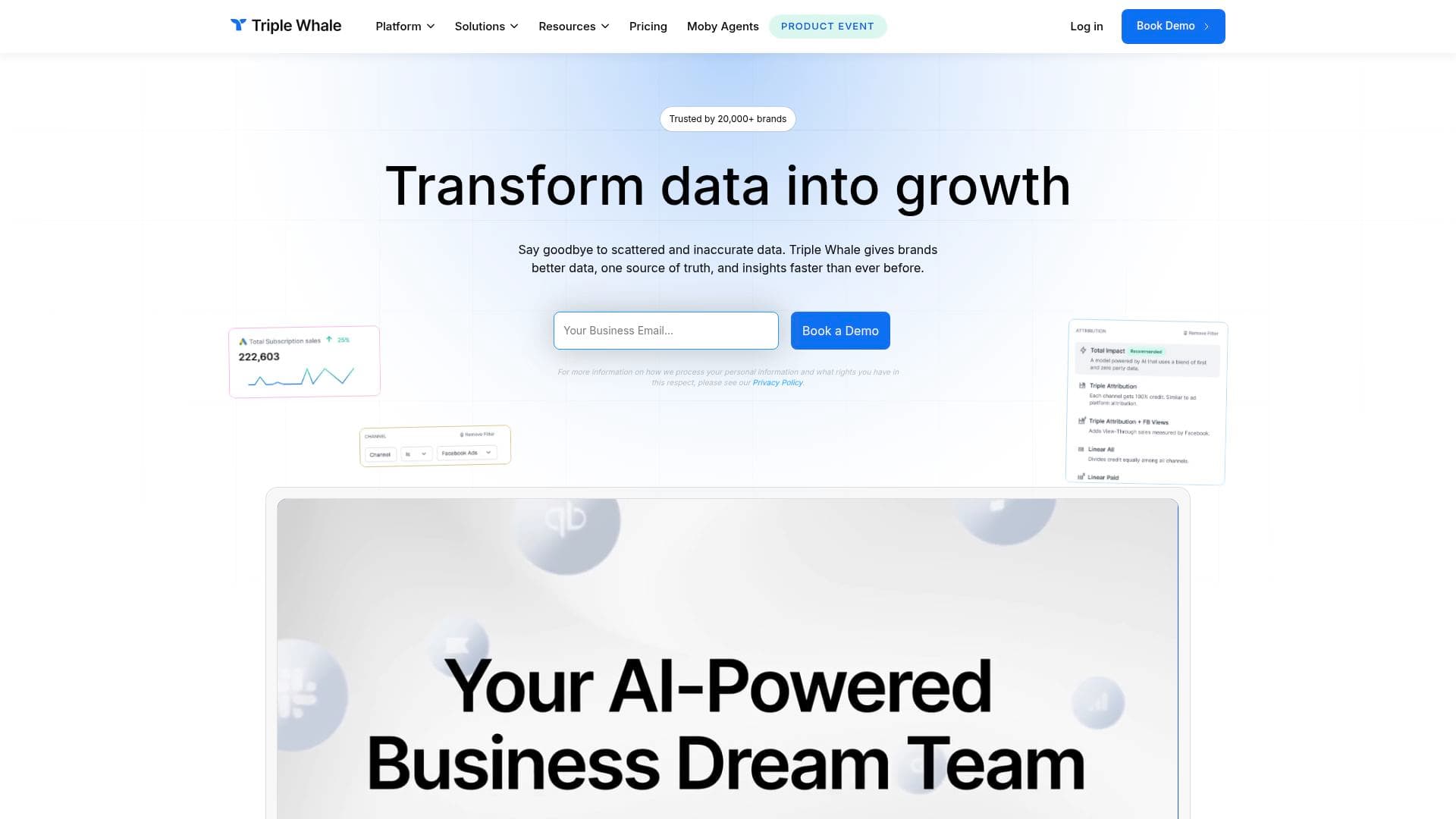
Brief Overview of Triple Whale for Content Creators
Triple Whale is a complete ecommerce intelligence platform built for brands and creators who sell products online and need accurate, real-time data to make smarter marketing decisions. The core problem it solves is scattered, inaccurate data — the kind that forces creators and brand owners to manually pull reports from spreadsheets, guess which ad creatives are working, or misattribute revenue from influencer campaigns. Rather than stitching together multiple disconnected tools, Triple Whale consolidates measurement, analytics, AI, creative intelligence, and automation into a single platform. At its heart is the Triple Pixel, a proprietary tracking technology that uses advanced identity resolution to accurately attribute every customer interaction across devices and channels. The platform's AI layer is powered by Moby, an ecommerce-specific AI trained on over $82 billion in GMV from 50,000+ brands — meaning it speaks the language of ROAS, LTV, AOV, and BFCM natively. For creator-led brands running paid campaigns across Meta, TikTok, Google, Pinterest, and beyond, this analytics platform replaces hours of manual reporting with instant, trustworthy insights. With 60+ integrations, SOC 2 Type II certification, and GDPR and CCPA compliance, it's built to handle the data needs of growing ecommerce operations at any scale.
Triple Whale Key Features for Content Creators
-
Triple Pixel Attribution: The Triple Pixel uses advanced cross-device identity resolution to track every customer and prospect interaction, solving the attribution gap that exploded after iOS14 changes gutted on-platform ad reporting. For creator-brand owners running paid ads, this means knowing exactly which ad creatives, channels, and influencer partnerships are actually driving conversions — not guessing based on platform-reported numbers that routinely undercount.
-
Moby AI (Commerce-Specific Intelligence): Moby is the platform's AI engine, trained on $82B+ in GMV from over 50,000 brands. It delivers channel budget reallocations, creative briefs, audience suggestions, lifecycle triggers, and inventory recommendations. Critically, Moby can generate images and videos, size them for different ad platforms, and set them live — making it a genuine creative and execution tool, not just a reporting dashboard.
-
Moby Agents & Deep Dives: Beyond answering questions, Moby Agents autonomously run deep analytical investigations. One brand used a Moby Deep Dive to identify that a 1,000% spike in organic TikTok traffic was driven by a celebrity wearing their product in a viral video — an insight that would have taken a human analyst hours to uncover. Agents can also automate recurring reports, turning weekly manual tasks into daily automated dashboards.
-
Unified Measurement via Compass: Compass brings Multi-Touch Attribution (MTA), Marketing Mix Modeling (MMM), and incrementality testing together in a single interface. For creator-brand owners spending across multiple channels, this means understanding not just what happened, but which channels are truly driving incremental growth — a critical distinction when scaling ad budgets.
-
Real-Time Data Platform: Triple Whale processes 9.2 billion events daily, meaning decisions are based on live data rather than yesterday's numbers. The platform connects marketing, sales, and operations channels in minutes with no data mapping required and no need to pay for a separate data warehouse.
-
Sonar Send: Sonar Send is a revenue-generating feature with documented results — one brand generated $420,000 in incremental revenue within a year of setup, with the platform claiming a 10x ROI on the entire subscription when using this feature. It's designed to activate customer data for direct revenue impact.
-
Business Intelligence Layer with Custom Dashboards: Triple Whale transforms raw data into ecommerce-specific dashboards, reports, and visualizations. The Summary Page aggregates and calculates core business metrics automatically, eliminating the need for time-consuming manual reporting. Teams that previously spent hours pulling the same insights can access them in minutes.
-
Activation Layer (Audience Syncing & Advertising Actions): The platform doesn't stop at recommendations. Through data enrichment, reverse ETL, Audience Syncing, and direct advertising actions, Triple Whale moves from insight to execution without requiring creators to jump between tools. This closes the loop between analytics and actual campaign management.
-
Context Engine: The Context Engine gives Moby a complete understanding of a brand's business, allowing it to connect relationships between metrics rather than analyzing isolated data points. Generic AI tools fail because they lack this business context — the Context Engine is what makes Moby's recommendations actionable rather than generic.
-
Forecasting with Moby: Revenue forecasting through Moby has demonstrated remarkable accuracy. In one documented case, a 6-month revenue forecast came within 2% of actual results, outperforming the client's own finance team. For creator-brand owners planning inventory, ad spend, and seasonal campaigns, this level of forecasting precision changes how growth decisions get made.
Triple Whale Target Users & Use Cases for Content Creators
Triple Whale is purpose-built for ecommerce operators, and it's particularly powerful for content creators who have built or are building product brands alongside their audience. Whether running a DTC brand, managing a merch line, or scaling an influencer-driven product business, the platform addresses the specific data challenges that come with selling across multiple paid and organic channels simultaneously.
- Primary creator types: Creator-brand founders running DTC ecommerce operations, influencer marketers managing affiliate programs, content creators who have launched product lines, and digital marketing teams at creator-adjacent brands. The platform also serves agencies managing multiple ecommerce clients.
- Experience level: The platform is designed for operators who are past the "just checking Shopify" stage and need deeper attribution and performance data. It's accessible enough for founders to use daily but sophisticated enough to replace dedicated analyst hires.
- Team size: Works for solo founder-operators who need a dashboard they can check every morning, as well as lean teams of 2-5 people managing complex multi-channel campaigns. Agencies managing multiple brand clients are also a core use case.
- Specific use cases for content creators:
- A creator-brand owner running TikTok and Meta ads who needs to know which specific ad creatives are driving purchases vs. just traffic
- An influencer with an affiliate program who suspects their influencer marketing platform is underreporting conversions (as happened with Portland Leather Goods, which discovered $3M+ in affiliate revenue was being missed)
- A creator scaling a product line who wants to identify which products to push based on actual purchase data tied to specific campaigns
- A solo operator who wants to replace hours of weekly manual reporting with automated dashboards that update in real time
- A creator preparing for a major sales event (like BFCM) who wants to forecast CPMs and revenue based on historical data
- A brand running ads across Meta, Google, TikTok, and Pinterest simultaneously who needs unified attribution rather than siloed platform-reported numbers
- A creator-brand owner evaluating whether to expand into new markets, using AI-powered analysis of AOV and growth potential by region
- A content creator who wants to understand the full customer journey from first organic touchpoint to purchase, including cross-device behavior
How to Get Started with Triple Whale
- Sign up for free: Triple Whale offers a free starting tier, accessible directly through their signup page without a credit card commitment.
- Install the Triple Pixel: The pixel is implemented on your ecommerce store to begin capturing cross-device attribution data. According to user accounts, meaningful performance data starts appearing within weeks of implementation.
- Connect your integrations: With 60+ integrations across ecommerce and retail platforms, connect your marketing channels, sales platforms, and operations tools. The platform is designed to connect in minutes without data mapping.
- Set up your Summary Dashboard: The Summary Page automatically aggregates core business metrics, giving an immediate view of financial and marketing performance without manual calculation.
- Start using Moby Chat: Begin by asking Moby simple questions about your business performance. The recommended approach for new users is to identify one repetitive reporting task per month and automate it, building trust in the AI's outputs through validation before expanding usage.
Frequently Asked Questions About Triple Whale
Is there a free version of Triple Whale? Yes, Triple Whale offers a free tier that allows brands to get started without an upfront commitment. The platform can be accessed via a free signup, with additional paid features available for brands that need more advanced capabilities.
What makes Triple Whale's AI different from generic AI tools? Moby is trained on $82 billion in GMV from 50,000+ brands, making it ecommerce-native rather than a general-purpose AI with data bolted on. The Context Engine gives Moby a complete understanding of a specific brand's business, allowing it to identify relationships between metrics rather than just reporting isolated numbers.
How does Triple Whale handle attribution after iOS14? The Triple Pixel uses advanced identity resolution to track customer and prospect interactions across devices, restoring the attribution visibility that was lost when iOS14 changes gutted on-platform ad reporting. Brands like Portland Leather Goods reported getting better attribution visibility through Triple Whale than they had even before iOS14.
How accurate is Moby's revenue forecasting? In a documented case study, Moby's 6-month revenue forecast came within 2% of actual results, outperforming the client's internal finance team. This level of accuracy supports smarter inventory planning and ad spend decisions.
How much time can Triple Whale save on reporting? Results vary, but documented cases include one team saving 450+ hours annually with Moby AI, another reducing data analysis from hours to minutes, and individual team members reclaiming three hours per week by automating a single recurring report.
Does Triple Whale support multi-channel advertising campaigns? Yes. The platform is built to unify data across channels including Meta, Google, TikTok, Pinterest, and others. The Activation Layer supports audience syncing and direct advertising actions across platforms, moving from insight to execution without switching tools.
Is Triple Whale compliant with privacy regulations? Triple Whale holds SOC 2 Type II certification and is both GDPR and CCPA compliant, making it suitable for brands operating across the US, UK, and Europe.
Bottom Line: Should Content Creators Choose Triple Whale?
For content creators who have built or are actively scaling an ecommerce brand, Triple Whale is one of the most comprehensive analytics platforms available specifically for that use case. The combination of accurate pixel-based attribution, AI-powered analysis through Moby, and an activation layer that turns insights into actual campaign actions addresses the full data lifecycle — from tracking to decision to execution.
The platform is best suited for creator-brand owners who are past the early stage and are actively running paid campaigns across multiple channels, managing affiliate or influencer programs, or preparing for high-stakes sales periods where data accuracy directly impacts revenue. The documented results are compelling: a 263% increase in product sales for one brand, $420K in incremental revenue from Sonar Send for another, and 450+ hours saved annually through AI automation.
The main consideration is that Triple Whale is purpose-built for ecommerce operations. Creators who haven't yet launched a product business or who are purely focused on content monetization through ad revenue or sponsorships will find less immediate utility. But for any creator running a DTC brand, managing product campaigns, or trying to understand which content and ads are actually driving purchases, Triple Whale delivers a level of data clarity and AI-powered intelligence that manual reporting simply cannot match.
A free tier is available, making it accessible to test before committing to a paid plan — a low-risk entry point for creators ready to move beyond spreadsheets and platform-reported metrics.
Details
One link. Every channel, rate, and piece of work brands need to evaluate you. Built for how creators actually get hired.
Claim your profile
Live creator, content, and marketing roles from real companies, with the pay, market, and context the raw job page never gives you.
Browse jobs

 Post Bridge