

Directus
Directus is a headless CMS and backend platform that lets developers and content creators manage complex content, digital assets, and permissions through an intuitive Studio interface.
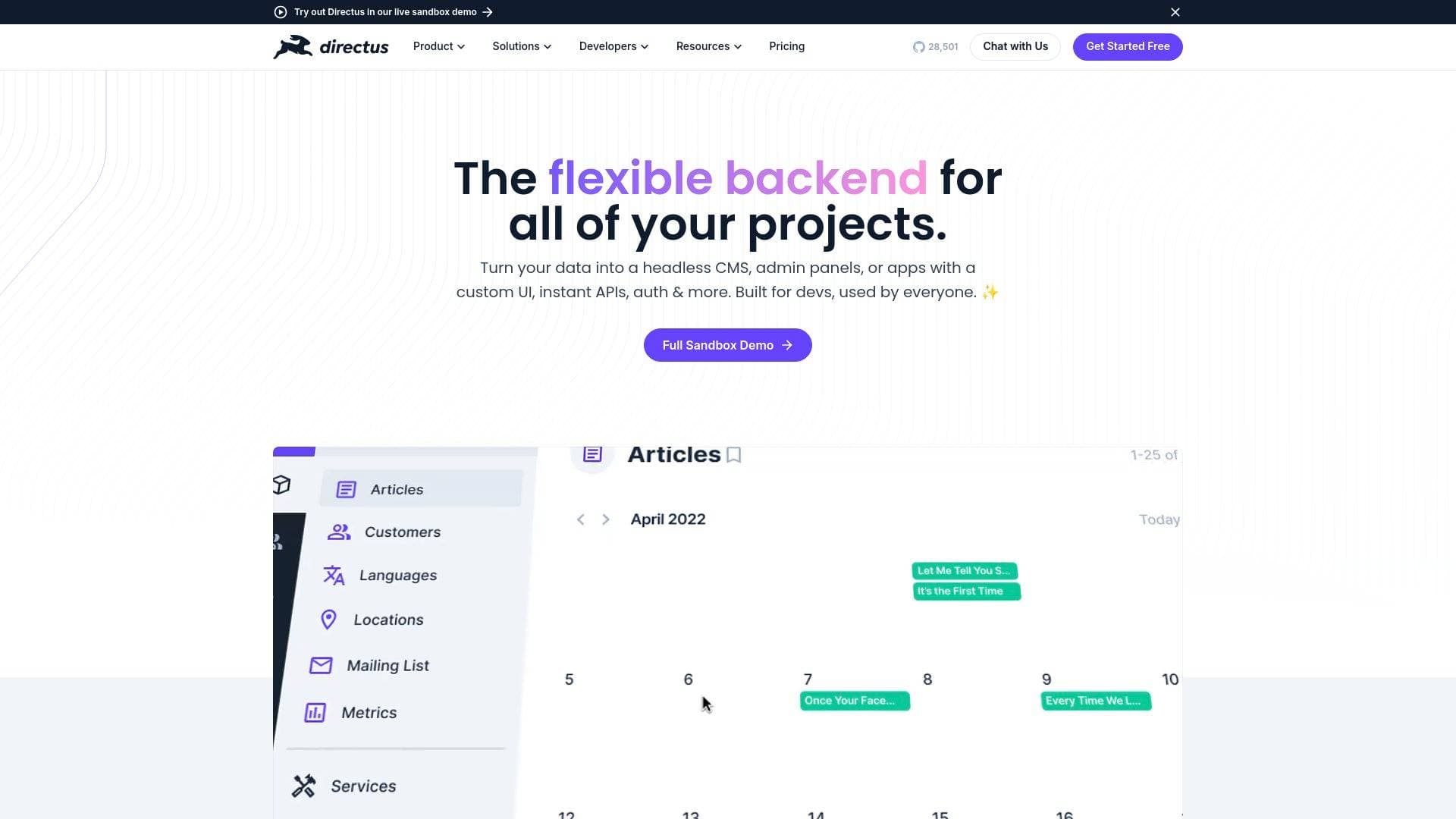
Brief Overview of Directus for Content Creators
Directus is a headless CMS and backend platform built for developers and technically-minded content creators who need far more than a traditional content management system. The core problem it solves is simple but significant: managing complex content structures, digital assets, and multi-user permissions across custom-built websites and apps without being locked into a rigid, opinionated platform. Rather than forcing creators into a predetermined content model, Directus lets users define their own collections, fields, and relationships through a visual interface, keeping data in whatever SQL database they already use. The platform connects to Postgres, MySQL, MS SQL, SQLite, and more, and immediately generates fully documented REST and GraphQL APIs with no boilerplate code required. With over 41 million Docker downloads, 32,000+ GitHub stars, and 500,000+ projects built on it, Directus has become a trusted foundation for content-driven projects at serious scale. For creators who publish across frameworks like Next.js, Nuxt, Astro, SvelteKit, or SolidStart, Directus acts as the structured data backbone that powers any frontend. A built-in AI assistant, native MCP server, and real-time WebSocket support round out a platform that goes well beyond basic content management.
Directus Key Features for Content Creators
-
Visual Data Modeling: Creators and their developer collaborators can define collections, fields, and relationships through a point-and-click interface rather than writing database migrations by hand. This means a blogger or newsletter creator working with a developer can actually participate in shaping how their content is structured, without touching code.
-
Instant REST and GraphQL APIs: Connect any SQL database and Directus immediately generates fully documented REST and GraphQL APIs. There is no boilerplate, no code generation step, and no waiting — content becomes accessible to any frontend or app the moment it is structured.
-
AI Assistant with Image and PDF Support: The built-in AI assistant can write, translate, and take action on content directly within the Studio. As of the March 2026 update, it can also process images and PDFs uploaded from a local machine or pulled from the Directus File Library, and it works across OpenAI, Anthropic, and Google Gemini providers.
-
Native MCP Server: Directus includes a native MCP (Model Context Protocol) server that connects any AI tool directly to a creator's Directus data in seconds. This means tools like Claude Desktop, Cursor, or Raycast can interact with content data while respecting the same access control policies that apply to human users.
-
Content Versioning with Global Drafts: Every versioned content item automatically gets a draft version with no manual setup required. Creators can stage changes, preview them live, and promote them when ready — a proper editorial workflow for anyone managing a content-heavy site or publication.
-
Collaborative Editing: Multiple team members can edit content simultaneously inside the Studio, added in February 2026. For creator teams managing editorial calendars, podcast show notes, or newsletter drafts, this removes the friction of working in isolated silos.
-
Visual Editor: The Visual Editor lets creators edit website content directly in place, with improved UX and live preview support. It enforces field-level permissions and supports version selection in the live preview pane, making it practical for creators who want to see exactly how content will look before publishing.
-
Policy-Based Access Control: Granular, role-based permissions extend down to the field level, giving every user and service exactly the access they need. The same access policies apply to AI tools as to human users, which matters for creators managing contributors, editors, or sponsored content workflows.
-
Flows (No-Code Automation): Directus includes a no-code automation tool called Flows, which allows creators to trigger actions based on events, schedules, or database changes. Extensions like the Algolia Operation, GitHub Operation, and LiquidJS template operation expand what these automations can do, from indexing content for search to triggering deploys on Vercel or Netlify.
-
Extensible Marketplace: The Directus Marketplace hosts a growing library of extensions including an SEO Plugin for keyword analysis, a YouTube Embed Interface for embedding videos directly in the editor, an AI Researcher Bundle powered by OpenAI or Anthropic, audio and video player interfaces, a PDF viewer, and much more. Extensions run within the same environment as the main application and can be published to the Marketplace for others to use.
-
Real-Time WebSocket Support: Directus supports full CRUD operations over a single WebSocket connection, plus GraphQL subscriptions and SDK methods. For creators building interactive apps, live comment sections, or real-time dashboards, this removes significant backend complexity.
-
Digital Asset Management: The platform includes a Files module for managing digital assets, with support for downloading multiple files and folders. Storage adapters include AWS, Supabase, Azure, Cloudinary, and GCS, all with resumable TUS uploads.
Directus Target Users & Use Cases for Content Creators
Directus sits at the intersection of content creation and technical infrastructure, making it most valuable for creators who either have development skills themselves or work closely with a developer. It is particularly well-suited to creator teams building custom digital experiences rather than relying on off-the-shelf publishing platforms.
-
Primary creator types: Developer-creators building personal sites or client projects, technical bloggers and newsletter writers who want full control over their content infrastructure, podcast producers managing episode metadata and show notes across multiple platforms, YouTube creators building companion websites or membership portals, and content teams at media organizations who need structured editorial workflows.
-
Experience level: Directus is geared toward intermediate to advanced users on the technical side. The Data Studio interface is intuitive for content editors, but the initial setup and data modeling requires developer involvement.
-
Team size: Works for solo creator-developers all the way up to large content teams. Collaborative editing, role-based permissions, and deployment controls make it practical for teams of any size.
-
Specific use cases:
- A blogger building a custom Next.js or Astro site can use Directus as the headless CMS backend, pulling structured content via the auto-generated API
- A newsletter writer can manage subscriber content, drafts, and published editions with full version history and draft staging
- A podcast creator can store episode metadata, transcripts, and audio file references in structured collections, then serve that data to any frontend or app
- A YouTube creator building a companion site can embed YouTube videos directly in the editor using the YouTube Embed Interface extension and manage all related content in one place
- A content team can use Flows to automatically trigger a Vercel or Netlify deploy whenever new content is published, removing manual steps from the publishing process
- A creator managing SEO can use the built-in SEO Plugin to analyze content for keywords and manage metadata and social sharing previews directly within the CMS
- A creator with multiple contributors can assign granular field-level permissions so editors can only access and modify the content relevant to their role
- A technically-minded creator building an interactive app (like a live Q&A or real-time leaderboard) can use WebSocket support to push data updates without building a separate backend
How to Get Started with Directus
- Register on Directus Cloud: Create a project at directus.cloud, where a starter tier is available. Alternatively, self-host using Docker, which has been pulled over 41 million times.
- Model your content visually: Use the Data Studio to define collections (like "Posts," "Episodes," or "Products"), add fields, and set up relationships between collections through the visual interface.
- Connect your frontend: Use the instantly generated REST or GraphQL API endpoints to pull content into any framework — Next.js, Nuxt, Astro, SvelteKit, SolidStart, and others are all supported with dedicated integration guides.
- Install extensions: Browse the Directus Marketplace to add tools like the SEO Plugin, YouTube Embed Interface, or AI Researcher Bundle to extend the Studio for your specific content workflow.
- Set up Flows for automation: Configure no-code automations to handle tasks like triggering deploys, sending emails, or syncing content to search indexes whenever content is created or updated.
Frequently Asked Questions About Directus
What databases does Directus support? Directus works with any SQL database including Postgres, MySQL, MS SQL, and SQLite. Data always stays in the connected database — Directus does not move or copy it to a proprietary store.
Does Directus have AI features built in? Yes. Directus includes a built-in AI assistant that can write, translate, and take action on content directly in the Studio. It supports OpenAI, Anthropic, and Google Gemini providers. The AI assistant can also process images and PDFs as of March 2026. A native MCP server is also included, allowing external AI tools like Claude Desktop or Cursor to connect to Directus data while respecting existing access control policies.
Can multiple people edit content at the same time? Collaborative editing was added in February 2026, allowing multiple team members to work on content simultaneously within the Studio.
How does content versioning work? Every versioned item automatically gets a global draft version with no manual setup required. Creators can stage changes, preview them live in the Visual Editor, and promote them when ready. A Content Comparison Modal allows side-by-side review of version and revision changes.
What frameworks does Directus work with? Directus provides dedicated integration guides and templates for Next.js, Nuxt, Astro, SvelteKit, SolidStart, and Eleventy (11ty), among others. Because it generates standard REST and GraphQL APIs, it can work with any frontend framework.
Is Directus open source? Directus has over 32,000 GitHub stars and is available for self-hosting via Docker. A managed cloud version is also available through Directus Cloud, with a starter tier.
What automation capabilities does Directus include? Directus includes Flows, a no-code automation tool that triggers actions based on events, schedules, or database changes. Extensions expand Flows with integrations for Algolia, Elasticsearch, OpenSearch, GitHub Actions, HubSpot, Resend email, and more.
Bottom Line: Should Content Creators Choose Directus?
Directus is a strong choice for content creators who need a flexible, developer-friendly CMS backend that can power any custom-built site or app. It is especially valuable for creators who publish on frameworks like Next.js, Astro, or Nuxt and want a structured, API-first content layer rather than a locked-down publishing platform. The combination of visual data modeling, instant API generation, built-in AI tools, collaborative editing, and a rich extension marketplace gives technically capable creators a genuinely powerful foundation.
The main limitation to be aware of is that Directus requires meaningful developer involvement to set up and configure. It is not a drag-and-drop website builder or a simple blogging platform — it is infrastructure for content-driven projects. Solo creators without coding experience will need a developer partner to get the most out of it.
For creator teams, developer-bloggers, podcast producers building custom apps, or any creator who has outgrown the constraints of traditional CMS platforms, Directus offers a level of control and extensibility that is hard to match. With 500,000+ projects already built on it and an active community of 16,000+ members, it is a mature, well-supported platform worth serious consideration.
Details
One link. Every channel, rate, and piece of work brands need to evaluate you. Built for how creators actually get hired.
Claim your profile
Live creator, content, and marketing roles from real companies, with the pay, market, and context the raw job page never gives you.
Browse jobs

 Post Bridge