
How to Grow on Social Media (Ignore the Algorithm)
Everyone's chasing the algorithm. But the creators who actually grow on social media are focused on something else entirely — their audience. Here's how to do the same.
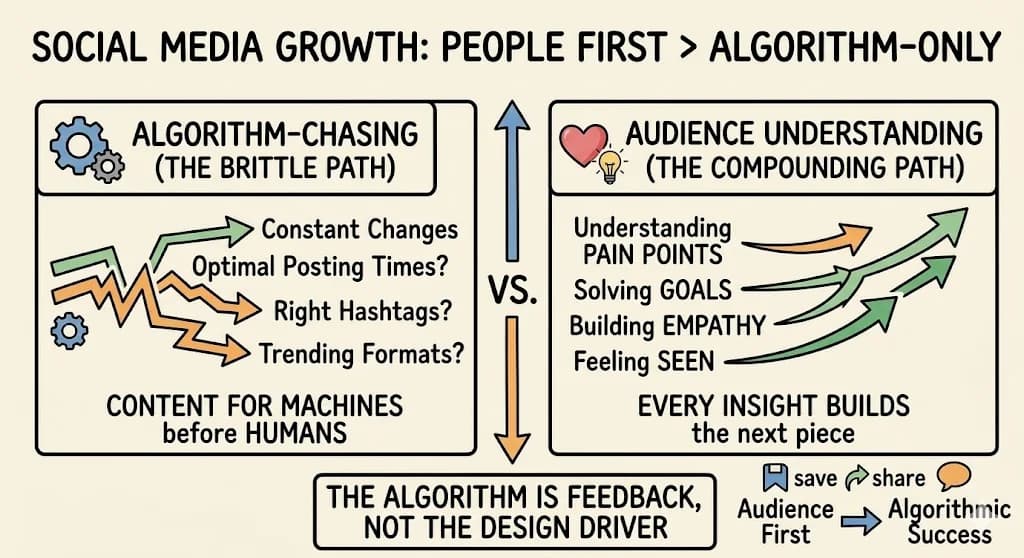
Everyone's obsessed with the algorithm. Which hashtags to use, when to post, how long your reel should be, whether LinkedIn carousels outperform single images this week. It's exhausting, and it's costing you real growth.
The algorithm doesn't decide your success. People do.
The Algorithm Isn't Your Audience
Every social media platform (Instagram, LinkedIn, TikTok, YouTube) designs its algorithm to do one thing: surface content that resonates with humans. Saves, shares, comments, and watch time aren't algorithmic tricks. They're human responses. When your reel stops someone mid-scroll, that's psychology at work, not SEO.
Chasing algorithm updates is a losing game. They change constantly. But human psychology? That stays remarkably consistent. People always want to feel understood, solve their problems, and reach their goals. Build your content strategy around that, and you'll outperform creators who are stuck studying platform rules.
This isn't just a theory. Marketing researchers and practitioners who study audience-first content consistently find the same pattern: content built around human pain points, goals, and user experience naturally satisfies algorithms because it drives the engagement behaviors those algorithms are designed to reward: saves, shares, time spent, return visits.
How to Actually Grow on Social Media: Put People First
 Shifting from algorithm optimization to audience psychology means asking better questions. Instead of "What does the algorithm want?" ask:
- What is my audience struggling with right now?
- What goals are they trying to achieve?
- What does their daily experience actually look like?
This is the foundation of social media growth that lasts. Whether you're crafting a newsletter, designing a LinkedIn carousel, writing a caption, or filming a reel, every piece of content should speak directly to a real human pain point or desire.
You've probably experienced this yourself: you stumble across a post that makes you think "this person gets me" and you immediately save it, share it, or follow the creator. That reaction has nothing to do with when they posted or how many hashtags they used. It happened because the content spoke to something real in you.
That's the thing algorithm-obsessed creators miss entirely.
Why Algorithm-First Thinking Actively Hurts Your Social Media Growth
 AMA Boston put it well when they described a widespread problem in modern marketing: teams create content that must perform for machines before it ever reaches humans. The result is content that chases ranking and distribution signals at the expense of actual human relevance.
And here's what that looks like in practice: you spend hours researching the "optimal" posting time, craft a caption loaded with trending hashtags, and publish a reel that technically hits every algorithmic checkbox. Then it lands flat. No saves. No shares. Comments that go nowhere.
Meanwhile, a creator in your niche posts something raw and honest about a struggle their audience faces, and it explodes. Not because they cracked the algorithm. Because they cracked their audience.
Algorithm-chasing is brittle. Audience understanding compounds. Every insight you gain about your people makes your next piece of content better, and the one after that. There's no such advantage in memorizing this week's best posting window.
Actionable Steps to Optimize for Humans, Not Robots
 1. Research your audience deeply, and keep doing it.
This isn't a one-time exercise. Use your analytics not just to track performance numbers, but to understand who is actually engaging. What content do they save and share your content most often? That tells you what's landing emotionally, not just algorithmically.
Practitioners who study content mapping recommend identifying specific audience segments first, then documenting the exact problems each segment is trying to solve. Surface-level assumptions won't cut it. You need to understand what people are genuinely struggling with before you create a single piece of content around it.
2. Get specific about their pain points.
"Wants to grow online" is not a pain point you can write to. "Struggling to get consistent engagement despite posting daily": now that's something you can address directly in a reel, a LinkedIn carousel, or a newsletter.
The more specific you get, the more your audience feels seen. And feeling seen is what makes someone stop scrolling.
A useful exercise: map each pain point to a root cause by asking "why" repeatedly. If your audience struggles with inconsistent engagement, why? Because their content doesn't connect emotionally? Because they're creating for the algorithm instead of for people? Dig until you hit something real.
3. Map pain points to where your audience is in their journey.
Someone who just realized they have a problem needs different content than someone actively looking for a solution. A creator building an audience on multiple social media platforms should think about this two-dimensionally: what is the pain point, and where is this person right now?
A reel might be perfect for the awareness stage, stopping someone mid-scroll with something that makes them think "wait, that's exactly my problem." A detailed LinkedIn carousel or a long-form newsletter works better when someone already knows what they're looking for and wants depth.
Match your types of content to both the pain point and the moment. That's how you actually grow.
4. Create content that answers real questions.
Frameworks like the 5-3-2 rule (5 curated posts, 3 original, 2 personal) only work when the content itself connects with real people. The ratio doesn't matter if none of the posts speak to something your audience actually cares about.
Before you write a caption or script a reel, ask: does this directly address a question, struggle, or goal my audience has? If you can't answer that clearly, the content isn't ready.
5. Prioritize user experience across every type of content.
This goes beyond formatting. Yes, your LinkedIn carousel should be easy to swipe and absorb. Your reel should hook emotionally in the first two seconds. Your newsletter should feel like a letter from someone who genuinely understands what you're going through.
But user experience also means reducing cognitive load: short paragraphs, clear language, a structure that doesn't make people work hard to understand what you're saying. Researchers who study psychology-first content consistently find that cognitive ease (clear language, structured content) improves readability and reduces the drop-off that kills your engagement metrics.
Emotional resonance matters just as much. Stories and examples tied to real pain points keep people reading, watching, and coming back. Curiosity gaps in your opening lines pull people in. Unexpected insights make people share.
6. Empathize in every post, not just the ones you think are "personal."
The creators who win on every social media platform aren't the most technical. They're the most human. They write and film as if they know exactly what the person on the other side is going through, because they've done the work to actually find out.
Empathy isn't a content type. It's a lens you apply to everything you create. A how-to reel can be empathetic. A data-driven LinkedIn post can be empathetic. A product-focused newsletter can be empathetic. It comes down to whether you're speaking to a real human experience or just filling content space.
Social Media Growth Basics That Still Matter
None of this means the fundamentals don't count. To grow your social media, you still need to post consistently, show up on the platforms where your audience actually is, and use the content types each platform rewards: short-form reels, carousels, or live video. A few relevant hashtags and a nod to current trends won't hurt either.
The difference is priority. Do these things in service of real people, not in place of understanding them. Consistency plus genuine audience insight is what builds a lasting social media presence and steady social media growth. Chasing hashtags and trends without that foundation just earns you followers who never engage.
Use the Algorithm as Feedback, Not as a Blueprint
Here's a reframe that changes how you think about all of this: treat the algorithm as a feedback loop, not a design driver.
Create for people first. Then watch which pieces the algorithm amplifies, because when something gets pushed, it's almost always because real humans engaged with it in a meaningful way. Use that signal to refine your understanding of your audience, not to reverse-engineer algorithmic features.
This keeps your strategic center exactly where it belongs: on the humans you're trying to reach. And it means your social media growth strategy gets smarter over time, not more dependent on whatever the platform decides to change next week.
The Shift That Changes Everything
Marketing has always been about psychology. The platforms are just the delivery mechanism. When you optimize for the person watching, reading, or scrolling (rather than the algorithm behind the screen), you build something far more powerful: genuine connection.
And genuine connection is what turns followers into fans, and fans into customers.
Stop studying the algorithm. Start studying your people. That's how you actually grow.
Read more about Audience Building & Growth for Content Creators
📚 Complete Guides
- How to Build an Audience as a Content Creator
- How to Find Your Target Audience (Start With One Person)
⚡ Tactics & Strategies
- 30 Daily Outbound Pitches for UGC Deal Generation
- 50% Retention Rate Optimization for YouTube Algorithm Success
- Age Bracket as Superpower Strategy for Older UGC Creators
- Audience Consistency Strategy to Avoid Algorithm Penalties
- Audience Psychology Over Algorithm Optimization, Focusing on Human Pain Points and Goals Instead of Platform Tactics
📄 Related Articles
- Owned Audience Strategy: Converting Discovery Platforms to Relationship Platforms
- How to Niche Down Without Choosing Too Early
- How Audience Reachability Score Transforms Instagram Creator Marketing Analytics
- Creator Collectives: How They Land Bigger Brand Deals
- Personal Brand Identity: How One Signature Item Built Instant Recognition
- How to Pitch Brands as a Creator (and Land Deals)
- Content Pillars for Social Media: How to Choose Yours
- How to Increase Your LinkedIn Reach (Mentions + Fundamentals)

Alex Kirillov
One link. Every channel, rate, and piece of work brands need to evaluate you. Built for how creators actually get hired.
Claim your profile
Live creator, content, and marketing roles from real companies, with the pay, market, and context the raw job page never gives you.
Browse jobs