How to Soft Launch a Product: Staggered Launch Strategy for Content Creators
Learn how content creators use staggered product launch strategies to scale without crashes. Discover the 7-step framework that builds trust while preventing technical failures.
Details
Most content creators make the same critical mistake on launch day: they release their product or service to their entire audience simultaneously. You're excited, your followers are ready, and you think bigger numbers mean better results. But here's what actually happens: your payment systems crash, your customer service gets overwhelmed, and you create negative social proof instead of the momentum you desperately need.
Smart creators are taking a different approach, one that tech giants like LinkedIn have perfected. Instead of launching to everyone at once, they're using a soft launch approach, a staggered, controlled release of a product to a limited audience before going wide. This ensures quality, builds genuine anticipation, and allows for scaling without breaking everything.
What Is a Soft Launch, and Why Does It Matter?
A soft launch refers to the practice of releasing a new product or service to a small, select group before the official launch to the public. Think of it like a soft opening at a restaurant: the doors are open, but you're not running full-page ads or hosting a grand opening event yet. You're testing, listening, and fixing.
The purpose of a soft launch is simple: gather real feedback, catch problems early, and fine-tune your offer before it reaches everyone. Soft launches typically involve a limited release to beta testers, loyal subscribers, or a specific geographic region, giving you a controlled environment to validate what you've built during product development.
So what's the difference between a soft launch and a hard launch? A hard launch is your full-scale launch: the big announcement, the marketing campaigns running at full volume, the grand opening energy directed at your entire target audience. A soft launch and a hard launch serve different purposes. The soft launch de-risks the hard launch by making sure everything works before you go all in. Understanding the difference between a soft launch and a hard launch is the first step toward building a smarter launch plan.
Why use a soft launch? Because launching a new product without testing it on a real, smaller group of users is like skipping rehearsal and going straight to the main stage. Early buzz built on a smooth experience is far more valuable than the noise from a chaotic release.
Why Traditional Product Launches Fail for Large Audiences
 When you launch your product to your entire email list or social media following simultaneously, you're essentially gambling with your reputation. Your payment systems buckle under unexpected load, customer support tickets pile up faster than you can respond, and technical issues get magnified across your entire audience.
This creates the opposite of what you want. Instead of positive social proof from happy early customers, you get frustrated comments about broken checkout pages and delayed deliveries. Your launch momentum dies before it even starts.
The solution lies in treating your launch like a major tech company would, with a carefully planned rollout that prioritizes stability and user experience over speed. Think of it as building trust through controlled growth rather than hoping everything works perfectly on launch day.
The 7-Step Staggered Soft Launch Framework
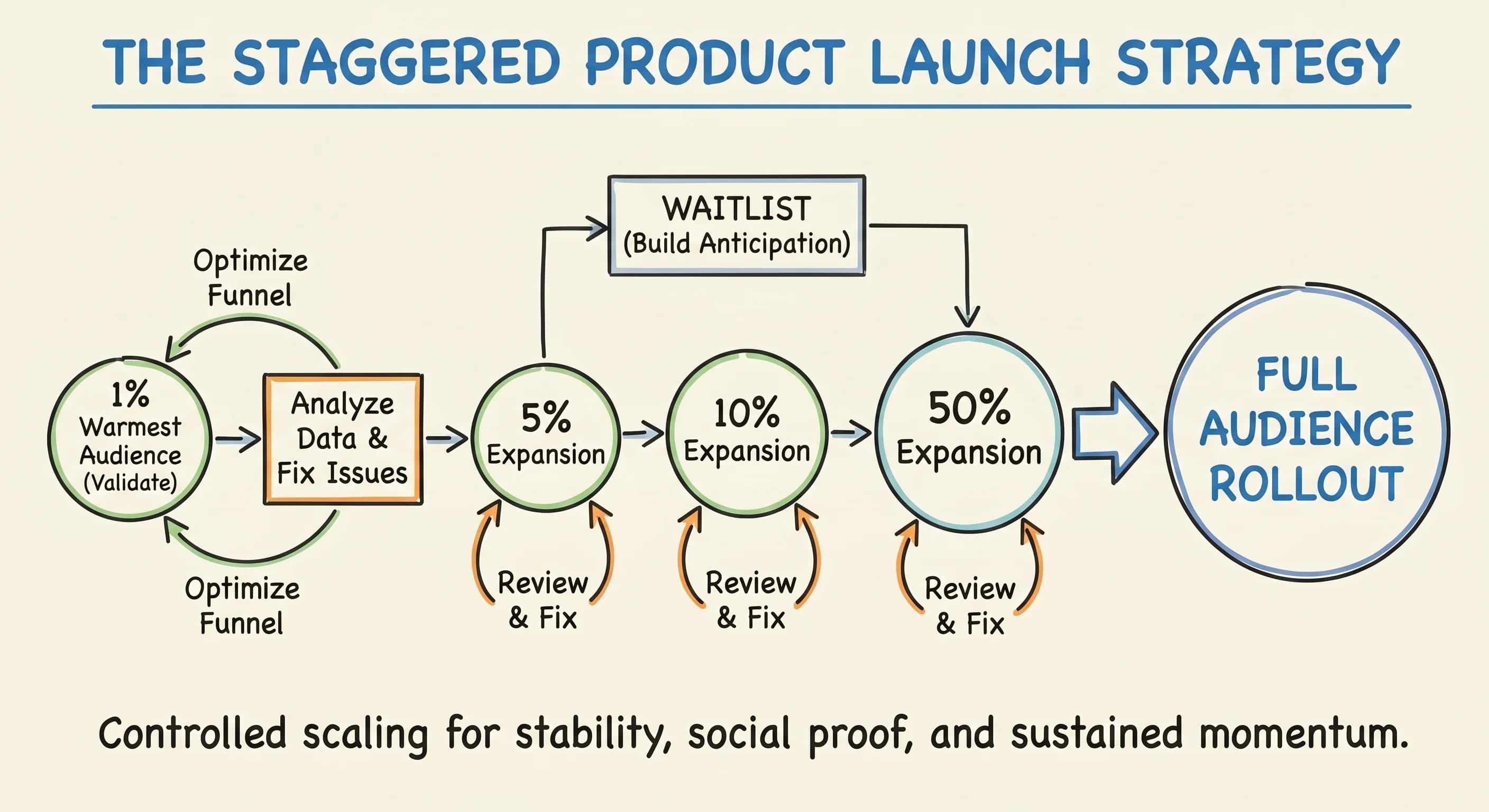
 Successful creators follow a predictable pattern that mirrors how tech companies roll out new features. When you're launching a product, start with your most engaged segment, typically around 1% of your audience or your warmest subscribers. This limited audience lets you validate demand and monitor key success metrics without risking your entire reputation.
Next, analyze performance data from your initial group. Track conversion rates, identify technical issues, and gather feedback. This pre-launch validation phase is crucial for your marketing efforts before scaling. You're not just testing your product, you're testing every single step of your customer journey.
Here are the core soft launch strategies that work for content creators:
- Start with a limited release to your most engaged subscribers or beta testers. Keep this group small enough to manage personally.
- Use a soft launch to gather data: gather data on conversion rates, support volume, and user behavior before you expand.
- Make adjustments based on what you learn. Fix friction points, clarify confusing steps, and update your messaging.
- Gradually increase access: 5%, then 10%, then 50% of your audience. At each milestone, check your systems, customer feedback, and conversion metrics before moving on.
- Build a waitlist for potential customers not yet included. This creates social proof and helps amplify your product organically as people discuss their early access.
- Monitor each expansion phase carefully. Look for drops in conversion rates or increases in support inquiries that signal you're scaling too quickly.
- Use each phase's data to sharpen your messaging for the next tier. What worked with your superfans might need adjustment for your broader audience.
Take TBH's approach as an example. They launched to specific small communities first via waitlists and surveys to filter ideal users, measuring success signals before expanding. This generated strong word-of-mouth promotion and proved retention through targeted scaling. Readiness at each stage, not speed, drove their success.
The exclusivity factor works in your favor. A soft launch isn't a delay, it's a strategy to increase the chances of your full launch landing well.
Soft Launch vs. Hard Launch: Choosing Your Approach
Understanding when to use a soft launch versus a hard launch shapes everything downstream. Here's how to think about it.
A soft launch is right when:
- You're launching a new product or service with untested systems or messaging
- You want to test the waters with a smaller segment before committing your full marketing budget
- Your product development is complete but you want real-world validation
- You're entering a new market or a specific geographic area for the first time
A hard launch makes sense when:
- Your soft launch data confirms your systems, messaging, and offer are solid
- You're ready to run full marketing campaigns across all channels, including social media marketing
- You've incorporated feedback and are confident in the experience you're delivering
Soft launches typically last anywhere from a few days to a few weeks, depending on how quickly you can gather data and act on it. There's no universal rule, but the goal is to move toward your full launch with confidence, not to stay in soft launch mode indefinitely.
What do you hope to achieve through your soft launch? If you're looking to gather feedback, build awareness, or generate early sales, your soft launch plan will look different for each goal. Define that before you start.
Platform-Specific Soft Launch Strategies for Content Creators
 For B2B content creators, a soft launch might mean opening access first to your LinkedIn newsletter subscribers before expanding to your broader professional network. These are typically your most engaged followers who already trust your expertise.
TikTok creators could start with their most engaged commenters, those who consistently interact with your content, before opening access to all followers. These early adopters often become your best advocates, creating authentic testimonials that no paid marketing can replicate.
YouTube creators have found success launching first to their channel members or Patreon supporters. These paying subscribers are naturally more invested in your success and more likely to provide constructive feedback during early phases.
A mobile app soft launch follows the same logic: release to a limited audience in one region or via invite only, monitor crash rates and user flows, then expand. The principle is identical whether you're launching a course, a physical product, or a digital tool.
The key is ensuring your technical infrastructure, whether that's your website, payment processor, or delivery system, can handle each level before scaling up. This approach works in tandem with your content strategy, allowing you to build authentic testimonials and case studies from early users that fuel your wider release.
Post-Launch Optimization and Analytics
Each phase of your staggered soft launch provides valuable data for your go-to-market strategy. Track which messages resonate most with different audience segments. Use this intelligence to sharpen your campaign for subsequent rollout phases.
Jasper AI demonstrated this during their rapid scaling. After validation with small groups, they used early influencer access and phased distribution to dominate their category, showing what's possible when post-launch data drives decisions rather than assumptions.
Monitor your analytics closely during each expansion. Look for patterns in user behavior, conversion rates at different price points, and recurring feedback themes. This data becomes invaluable for future launches and helps you understand your audience at a deeper level.
Set up milestone check-ins with go/no-go reviews before each expansion phase. Use daily stand-ups 48-72 hours before each tier to confirm scalability. This level of planning might feel like a lot, but it's exactly what successful SaaS companies do before any major release.
With your audience already tuning in after a well-run soft launch, keeping momentum going post-launch means staying responsive: answer questions publicly, share early wins, and keep delivering value so the conversation stays alive.
Building Trust Through Controlled Growth
 This methodical approach does more than prevent technical failures, it builds genuine trust with your audience. When people see others successfully using your product before they gain access, it creates social proof that no amount of marketing can replicate. That early buzz, earned through a smooth and intentional limited release, is what carries you into a confident full launch.
Your soft launch strategy becomes a competitive advantage. You're not just preventing crashes, you're creating a premium experience that makes people want your product more, not less.
By the time you reach your full audience, you're delivering a proven, optimized experience. Your customer service team knows the common questions, your technical systems can handle the load, and your messaging has been refined based on real user feedback.
This approach transforms your product launch from a one-day event into a sustained growth strategy. Each phase builds on the previous one, creating momentum that carries well beyond the opening week. Knowing how to soft launch a product, and doing it with intention, sets the foundation for long-term success, ensuring maximum return while building the trust that keeps customers coming back.
Ready to launch your product successfully? Start small, listen carefully, and scale with confidence.
Read more about Systems, Workflows & Operations for Content Creators
📚 Complete Guides
⚡ Tactics & Strategies
- 30 Daily Outbound Pitches for UGC Deal Generation
- 50% Retention Rate Optimization for YouTube Algorithm Success
- AI Workflow Integration for Content Reduction
- Audience Consistency Strategy to Avoid Algorithm Penalties
- Audience Poll on Instagram to Source Q&A Content in Advance of Recording
📄 Related Articles
- TikTok Creator Search Insights: How to Find Content Gaps That Guarantee Views
- The AI Content Creation Workflow: Turn 37 Seconds Into 1,200 Words
- The AI Content Workflow That Cuts Production Time by 70%
- Email Segmentation: The Base Sending Strategy That Works
- Influencer Campaign Report: How Smart Reporting Systems Build Stronger Brand Relationships
- Email List Growth Strategies: Turn Instagram Frustration Into Subscribers
- How to Write a Nonfiction Book (Newsletter-First)
- How to Get Traffic From Pinterest: Pins That Compound for Years

Alex Kirillov
Details
One link. Every channel, rate, and piece of work brands need to evaluate you. Built for how creators actually get hired.
Claim your profile
Live creator, content, and marketing roles from real companies, with the pay, market, and context the raw job page never gives you.
Browse jobs