How to Negotiate Brand Deals as a Content Creator Using Your Membership Audience
Your membership audience is already buying what you recommend for free. Here's exactly how to negotiate brand deals, affiliate codes, and long-term partnerships as a content creator.
Details
You already recommend products to your audience for free. Every time you mention something, your members rush to buy it. You've probably thought 'this is insane' watching it happen in real time, and you're right, it is. But here's what's even more insane: you're not getting paid for it yet.
That stops now.
Why Your Engaged Community Is Your Greatest Negotiation Asset
 You don't need millions of followers to negotiate brand deals. That's one of the biggest myths holding creators back. Can you get brand deals with 1,000 followers? Absolutely, if you can prove that when you speak, your audience acts. A loyal membership or Facebook Group gives you exactly that proof.
The 3 R's of influencer marketing, Reach, Relevance, and Resonance, all matter to brands. A highly engaged community scores perfectly on all three. Affiliate marketing consultant Matt McWilliams, who works directly with affiliate managers and brands, puts it plainly: what brands want to know is 'what are the data, what are the metrics, how many followers, what's your list size, what's your value proposition.' Your membership gives you the most compelling version of that answer possible.
Your follower count is just one number on the page. What matters far more is what those followers actually do. When you can show a brand that your members buy what you recommend, that conversion track record becomes the most persuasive thing in your pitch.
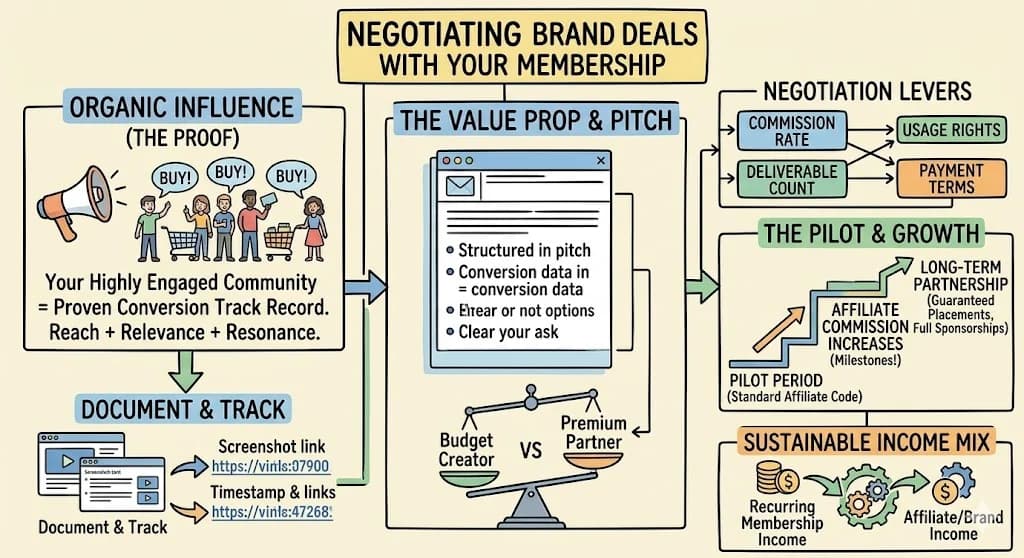
Document your influence before you do anything else. Screenshot the comments when members say they bought something you recommended. Track the links. Note the timestamps. Build a simple media kit that shows your engagement rate and the direct purchasing behaviour of your members. That evidence transforms you from someone who creates content into a legitimate partner that brand wants to work with.
What Is a Brand Deal, and What's the Difference From a Sponsorship?
Before landing a brand deal, it helps to understand what you're actually agreeing to. A brand deal is a paid arrangement where a creator promotes a product or service to their audience in exchange for a fee, free product in exchange for coverage, or a commission on sales. A sponsorship typically refers to a brand funding a piece of content, a video, a post, or a series, in return for visibility.
The practical difference matters when you're negotiating. Sponsorships usually involve a flat fee for specific deliverables. Broader arrangements can cover ongoing social media content, ambassador roles, or performance-based income through affiliate structures. Understanding which model a brand wants helps you negotiate the right terms from the start.
One-time deals work well when you want to test a relationship with a new brand. But for long-term sustainability, an ongoing brand partnership almost always generates more income and requires less constant pitching. And yes, brands expect negotiation, so don't treat the first offer as fixed.
Your Value Proposition: What Can You Bring to the Table?
Brands receive hundreds of pitch emails every week. In those first few seconds of reading, they're looking to answer one thing: can we trust this creator with our brand? Your personal brand, your niche authority, and your audience's proven buying behaviour are your answers.
Ask yourself honestly: are you a budget-friendly, one-time promo creator, or a premium partner who delivers consistent results? Neither is wrong, but knowing which one you are shapes every conversation you have. If you've been doing affiliate work and seeing strong conversion rates, say so. That's not boasting, that's a value proposition.
What can you bring to the table that other creators can't? For membership-based creators, the answer is simple: a captive, high-trust audience that acts on recommendations. That's rare, and it's worth money. A microinfluencer with a deeply engaged niche community can genuinely outperform a larger account with passive followers, and brands working in the creator economy increasingly know it.
High-quality content matters here too. Brands reviewing your pitch will look at whether your output matches their brand image. Clean production, consistent posting, and a clear niche all signal that you're a professional worth investing in. Partnerships that benefit both sides start with a creator who's clearly done the work.
How to Pitch Brands and Land Your First Deal
 The biggest mistake new creators make is waiting until they feel 'big enough' to pitch brands. Start now, with what you have.
Step 1: Identify What You Already Recommend
List every product or service you recommend organically to your membership, the things you mention for free because you genuinely love them. These existing authentic endorsements are your strongest pitch. The relationship already exists in practice, it just isn't paid yet.
This is the move that associations and member organisations have been using for years. MemberClicks describes how associations promote products 'your members already want or need' and then formalise those recommendations into affiliate deals as a revenue stream. You're doing the same thing, just as an individual creator.
Step 2: Write a Strong Pitch Email
A good pitch email is short, specific, and evidence-led. Open with who you are and what your audience does. Include your engagement rate, a conversion example if you have one, and a clear ask.
Something like: 'Every time I mention your product in my membership community, they go and buy it. I'd love to explore whether you have an affiliate program or a creator code I could share with my members. Would you be open to discussing a small test collab to start?'
That's not a boast. That's a value proposition. And according to McWilliams, that's exactly the kind of specific, conversion-backed pitch that gets brands interested, even if your audience is smaller and more niche. Less experienced creators often skip this step because they're afraid of losing the deal before it even starts. Don't be. Brands with influencers on their radar expect outreach.
Step 3: Use Influencer Marketing Platforms to Find Opportunities
If cold outreach feels daunting, influencer marketing platforms like AspireIQ, Grin, or Creator.co connect creators directly with brands looking for collabs. These platforms make it easier to find brands that already want to work with creators in your niche, and they often streamline contract and payment processes too.
Have you tried influencer marketing platforms before? If not, they're worth exploring alongside direct outreach, especially when you're building your first portfolio of paid work.
The Strategy Behind the Discount Code
 When a brand gives you an exclusive discount code to share with your members, everyone wins. Your members get savings, the brand gets measurable new customers, and you earn a commission. This is the 70/30 principle in negotiation in action, an outcome where both sides feel they've genuinely gained something.
The code also does something powerful for your community. InfluenceFlow notes that when followers see a discount code, they recognise that you negotiated it specifically for them. It helps build trust and makes membership feel more valuable. You're not just a creator, you're someone who shows up for your people.
Tracking platforms like Impact and Refersion let brands measure every conversion tied to your code, which means you're handing them exactly the ROI data they need to justify paying you. That data becomes your proof for the next negotiation, and your past performance across these tracked campaigns is what lets you charge accordingly when you revisit the rate.
How to Negotiate Brand Deals: Negotiation Tactics That Actually Work
So, a brand only wants to pay you affiliate commission? That's a starting point, not a final offer. When you're figuring out how to negotiate brand deals, there are more levers than just the commission rate, and knowing how to use them is what separates creators who get paid well from those who are quietly leaving money on the table.
Know your worth before the conversation starts. Set a baseline for what you'll accept per video, per post, and per campaign before any brand reaches out. That number should reflect your scope of work, your production time, your audience's buying behaviour, and current market rates for your niche. If you don't set a baseline upfront, you're negotiating blind.
One popular question becomes: who should make the first move? The short answer is, make the first move if you can. Whoever names the first number anchors the conversation. If you let the brand go first, you risk anchoring low and spending the rest of the discussion trying to climb back up. Naming your rate confidently signals that you know what you're worth.
Accepting the first offer is one of the most common mistakes creators make. Brands expect negotiation. When you accept instantly, you signal either that you're less experienced or that you've underpriced yourself, and neither helps your long-term positioning. Counter, even if it's just asking for better payment terms or a clearer scope.
Ask the right questions early in every conversation:
- 'Can we clarify the deliverables for this project?'
- 'Are the rights for organic use only, or will they run paid ads using my content?'
- 'What is the exclusivity timeframe?'
- 'Does this cover one video or multiple pieces of content on social media?'
Those questions aren't difficult. They're professional. And they give you the information you need to avoid underselling yourself or agreeing to a scope of work that was never clearly defined.
Usage rights are where creators most often get caught out. If a brand wants to run paid ads using your content on TikTok and Instagram, or boost it via Meta, that's a separate and significant value exchange from the original post. Clarify this in every deal. An exclusivity clause is another area worth scrutinising: if a brand wants you to avoid all competing products, they need to pay for that restriction, and the timeframe should be clearly written into the agreement. A vague exclusivity clause with no end date is a major red flag.
Want to be a negotiation pro? Prepare your numbers before any conversation. Know your average engagement rate. Know how long it takes you to produce high-quality content from ideation to final edit. Know what your rate is for one video versus a multi-month arrangement. Having those numbers ready means you can answer questions confidently and avoid agreeing to terms that undervalue your work.
Using Negotiation Levers: What to Trade and What to Hold
So, how can you use different components of a creator's scope of work to give everyone what they want? Think of each element as a lever: deliverable count, exclusivity, usage rights, posting windows, approval rounds, Instagram Stories versus feed posts, and payment terms. Move one and others shift too.
For example: if a brand can't meet your per video rate, you can offer to reduce the deliverable count rather than dropping your price. One video at your full rate is better than three videos at a discount. Or, if they want exclusivity, use that as the reason to increase the fee rather than accepting it as a given.
I've seen deals vary wildly for similar deliverables, and frankly, those 'industry standard' rates you find online don't always reflect what's actually possible. Your conversion rates, your niche, and your audience's trust level all affect what you can reasonably ask for. Don't let a rate card tell you what you're worth if your numbers say otherwise.
And if a brand simply won't move? Be afraid to walk away, or don't. Creators who are afraid to walk away consistently get the worst deals. If the numbers don't work and the scope is unreasonable, it's okay to pass. The brands that value what you bring will come back, or better ones will come forward.
From Affiliate Codes to a Long-Term Partnership
 Affiliate codes are the starting point, not the destination. Once you have trackable sales data from your membership, you have everything you need to pitch for an ongoing relationship and full sponsorships.
A brand that sees consistent conversions from your community will naturally want more. That's when you can explore co-branded experiences like member-only workshops or product bundles, larger content deliverables, and guaranteed placements across multiple platforms.
McWilliams specifically recommends pitching things like 'friend of [creator] discount' offers and exclusive extended trials for your audience as negotiation tools that 'make you the hero' to your members. That kind of arrangement deepens community loyalty while increasing your value to the brand simultaneously.
Your membership also gives you something most influencers can't offer: a feedback loop. Brands will pay more when you can offer product feedback from a real, engaged audience. Surveys, sentiment, feature requests, these are things your members can provide, and they're genuine added value you can bundle into a bigger deal.
Could they announce the relationship in a way that elevates your status for future negotiations? Absolutely. A brand publicly naming you as a partner, especially a well-known one, adds social proof that makes your next pitch easier. Ask about it. It costs them nothing and gains you credibility.
Diversifying Beyond Sponsorships: Building a Sustainable Income Stream
For a creator aiming for long-term sustainability, relying on any single source of income is risky. One often-overlooked strategy is treating your membership itself as an income stream. Platforms like Patreon, Memberful, or a private Facebook Group with paid tiers give you recurring revenue that doesn't depend on any single brand.
Combining that with affiliate income, sponsorships, and the occasional one-time deal with brands you love gives you a genuinely diversified income. You grow your audience, deepen trust, and reduce the vulnerability that comes from depending on one revenue source.
Creators posting content on social media across TikTok and Instagram are increasingly building this kind of layered income model. Short-form content is driving affiliate conversions at a rate that surprises many brands, which makes creators with engaged followings increasingly attractive as partners, even at modest audience sizes.
Start Monetising Your Influence Today
The influence exists. The conversions are already happening. You just need to formalise them.
Document what's already happening. Reach out to brands you genuinely use and love. Write a clear pitch email. Ask the right questions about affiliate programs and creator codes. And build from there, from a code to a commission, from a commission to a long-term arrangement, from a single post to a sponsorship that reflects the real value your community delivers.
You don't need a massive following. You need proof. And you already have it.
Read more about Monetization & Business Models for Content Creators
📚 Complete Guides
- Content Creator Monetization: Proven Revenue Streams
- Content Creator Income Streams: 7 Ways to Build Financial Stability
⚡ Tactics & Strategies
- 30 Daily Outbound Pitches for UGC Deal Generation
- Affiliate Code Negotiation Using Membership Audience Influence
- Age Bracket as Superpower Strategy for Older UGC Creators
- B2B Merchandise Bulk Sales to Industry Professionals- Packaging Products as Client Gifts for Lawyers and Service Providers
- Becoming Your Own Sponsor by Plugging Your Offer Within Episodes
📄 Related Articles
- How to Sell Wholesale as a Content Creator
- Creator Collectives: How They Land Bigger Brand Deals
- How to Pitch Brands as a Creator (and Land Deals)
- Curated Newsletter: How to Make Yours Feel Prestigious
- Media Kit Examples: How to Create One That Lands Brand Deals
- Brand Pitch Email Template: The 30-Pitch Strategy That Hit $10K
- How to Grow Email List with Instagram: The Commenter Spotlight Strategy
- Crowdfunding for Creators: How to Know If Your YouTube Audience Is Ready
🧮 Calculators

Alex Kirillov
Details
One link. Every channel, rate, and piece of work brands need to evaluate you. Built for how creators actually get hired.
Claim your profile
Live creator, content, and marketing roles from real companies, with the pay, market, and context the raw job page never gives you.
Browse jobs