
How to Sell Wholesale as a Content Creator
Learn how to sell wholesale products to lawyers, mediators, and real estate agents as a niche content creator. Build a recurring B2B bulk order revenue stream with themed milestone kits.
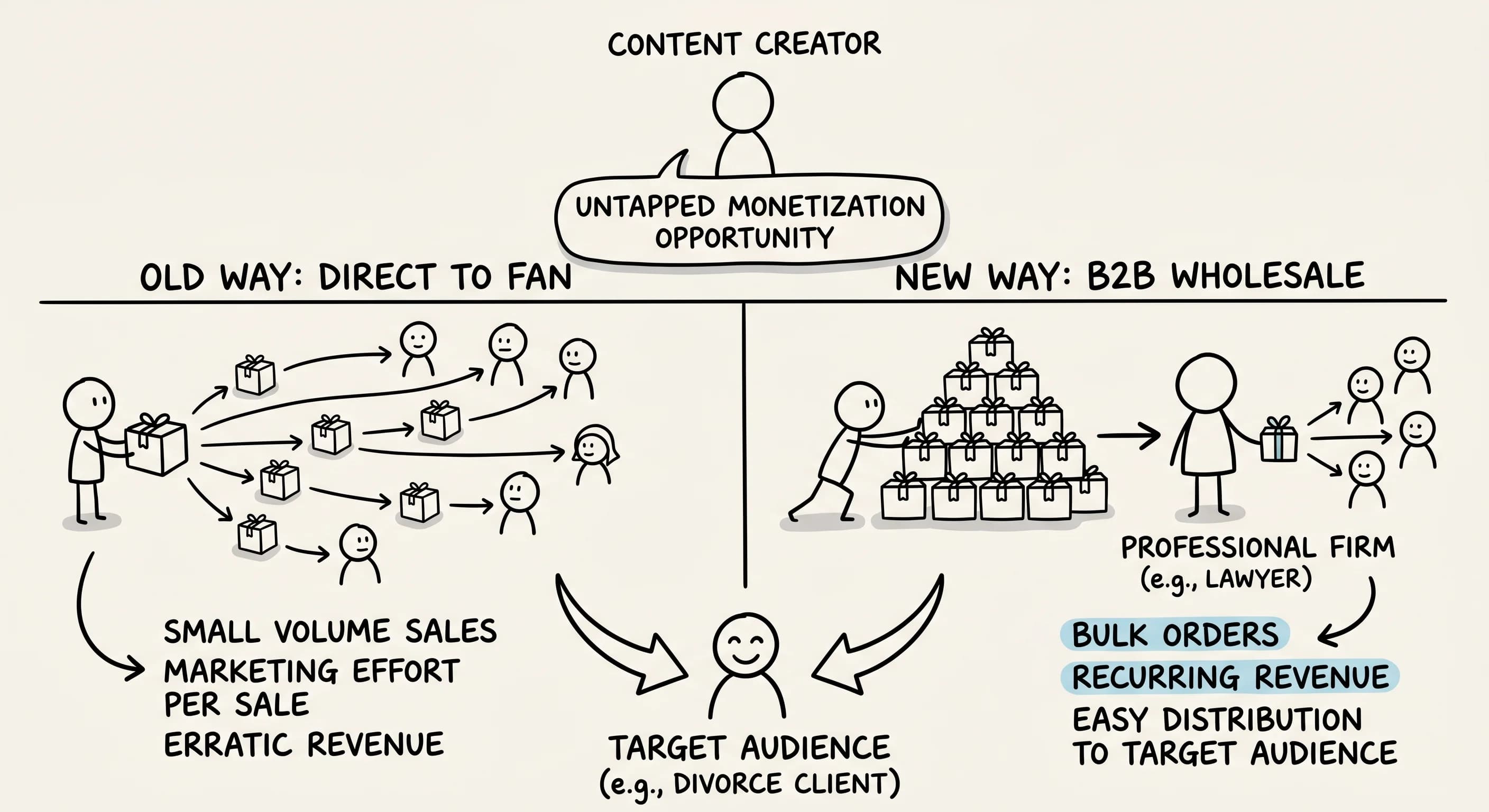
Most content creators think about merchandise as a direct-to-fan play. But what if your wholesale business model included lawyers, mediators, and real estate agents buying your products in bulk, automatically delivering your brand to your exact target audience? That's not a fantasy. It's an untapped monetization channel hiding in plain sight.
How Selling Wholesale Works
Before the creative angle, the basics. Selling wholesale means selling your products in bulk, at a lower price, to a business that resells or gives them away, instead of selling individual products at retail price to consumers.
- Wholesale pricing: the standard wholesale price is roughly 50% of your retail price. That sounds steep, but you make it up in volume and far lower marketing effort per sale. Just make sure your wholesale price still preserves a profit margin.
- Minimum order quantity (MOQ): set an MOQ so each wholesale order is worth fulfilling, often 10 to 25 units for small businesses starting out.
- Where to sell: you can sell wholesale directly to retailers and businesses over email or LinkedIn, or list on a wholesale marketplace like Faire, where retailers browse and place orders.
- Wholesale vs retail: many creators run both, selling wholesale to businesses and retail directly to fans from the same product line.
Once you understand how wholesale works, the real edge is choosing the right wholesale customers. For niche creators, the most overlooked buyers aren't retailers at all, they're the professionals who serve your exact audience.
Why Wholesale Selling Makes Sense for Niche Creators
 If you create content for a specific audience, say, people navigating divorce, professionals already serve that same audience every day. Divorce lawyers, mediators, and real estate agents handling divorce-related home sales interact with your niche at deeply emotional, high-stakes moments. They have budgets. They want to differentiate. And nobody is selling them a ready-made, meaningful client gift solution.
That's your opportunity to sell wholesale.
Is wholesale selling actually profitable? Absolutely, especially when you're the supplier to a captive B2B market with no direct competitors. A single law firm placing a bulk order quarterly can generate more revenue than hundreds of individual online sales, with far less marketing effort.
And here's what validates this: corporate gifting companies like Packed with Purpose already work with professional services firms, including law, consulting, and financial services, selling themed gift boxes tied to client milestones like onboarding, deal closings, and transitions. The model is proven. The divorce-niche version of it? Almost nobody is doing it.
Start Selling Themed Packages Tied to Buying Moments
 The key to winning this wholesale strategy is creating packages built around specific emotional milestones. Think about how real estate agents already use closing gift box vendors to send curated, themed packages to clients at closing. That pattern exists and works. You're applying the same logic to a different, deeply underserved life moment.
Here's what that looks like in practice:
- "You Just Hired a Lawyer Survival Kit" -- journals, affirmation cards, self-care items
- "Congratulations, Your Divorce Is Final Kit" -- celebratory merchandise for the next chapter
- "New Chapter Starter Pack" -- post-settlement essentials for rebuilding
Bundle your existing wholesale items, journals, apparel, digital guides, into these kits. Give each package a compelling name the professional can proudly present. When you sell products this way, the professional looks thoughtful and differentiated. You get recurring bulk order revenue and brand distribution directly to your target audience.
You can also offer tiered packages to match different client types and case values. A basic kit might include a journal and a small wearable. A premium kit adds a higher-end self-care item. A VIP kit goes deeper for high-value cases. This mirrors how corporate gifting platforms already structure their offerings and makes it easy for firms to match the kit to the client.
How to Sell Your Products Wholesale to Retailers and Professionals
 Direct outreach works best here. Skip the trade show initially and go straight to law firms via email or LinkedIn. Frame your pitch around their business outcome: "This costs less than three minutes of your billable rate and turns a transaction into a relationship."
Position your offer as a turnkey client care program, not just a product sale. Fulfillment providers in the corporate gifting space consistently point out that professional firms value solutions where someone else handles the kitting, packaging, and shipping. That's your edge. You manage the assembly and logistics. They just place the order and look great to their clients.
Set a minimum order quantity that makes fulfillment worthwhile. Ten to 25 units per order is reasonable for small businesses starting out. Offer wholesale prices that preserve your profit margin while making bulk purchasing a no-brainer for the firm.
Also consider offering two fulfillment options. Bulk shipping to the firm's office is the lowest-friction starting point. A premium option lets the firm submit client addresses and you ship the kits directly, similar to how corporate gift fulfillment partners already operate. That second option embeds you deeper into their workflow and makes switching away from you much harder.
Expand Your Online Wholesale and Retail Simultaneously
The smartest move? List the same packages publicly for e-commerce customers, friends buying gifts for someone going through a divorce. This dual-channel approach means you're selling wholesale online to B2B buyers while your retail storefront captures organic demand. One product line. Two revenue streams. Maximum reach.
You become both wholesaler and direct seller, with professionals acting as an unpaid distributor network for your brand.
This pattern is well established. Artisanal product makers already wholesale their products specifically as client gifts for professionals, offering reduced wholesale-only pricing for firms that want to send gifts to clients regularly. You can do the same thing but with the added advantage of owning the niche content and audience that makes your products uniquely meaningful.
On the co-branding side, consider offering firms the option to add a custom card or a simple logo sticker to the packaging. It increases the firm's sense of ownership over the gift while keeping your operations simple. And every item that leaves in that kit still carries your brand directly to the person going through the divorce, your actual target audience.
Your Market Research Starting Point
Before you send a single email, do your market research. Identify five local divorce attorneys, mediators, or real estate agents who specialize in divorce-adjacent transactions. Look at their websites and LinkedIn profiles. Notice how they talk about client experience and differentiation. That language is your pitch.
Expand your professional categories beyond just lawyers. Mediators, collaborative divorce practitioners, financial advisors specializing in wealth transition, divorce coaches, and even moving or downsizing specialists all meet the same criteria. They work with your audience at emotionally significant moments. They have budgets. And they want to stand out.
Craft a simple pitch email. Attach a one-page package overview with your kit names, what's included, wholesale prices, and minimum order quantities. Keep it short. Make the business case obvious. Your most profitable wholesale business opportunity might be one cold email away.
One more thing to consider: down the line, you can approach this as a subscription or trigger-based model. Offer firms a monthly kit allocation billed on a recurring basis, or a direct fulfillment service where they submit client details and you ship. That kind of recurring structure smooths your revenue and makes you a permanent part of their client experience workflow, not just a one-time supplier.
Read more about Monetization & Business Models for Content Creators
📚 Complete Guides
- Content Creator Monetization: Proven Revenue Streams
- Content Creator Income Streams: 7 Ways to Build Financial Stability
⚡ Tactics & Strategies
- 30 Daily Outbound Pitches for UGC Deal Generation
- Affiliate Code Negotiation Using Membership Audience Influence
- Age Bracket as Superpower Strategy for Older UGC Creators
- B2B Merchandise Bulk Sales to Industry Professionals- Packaging Products as Client Gifts for Lawyers and Service Providers
- Becoming Your Own Sponsor by Plugging Your Offer Within Episodes
📄 Related Articles
- Psychographic Segmentation: A Data-Driven Guide for Newsletters
- Newsletter Niche: Should You Niche Down or Go Broad?
- Membership Community: Test It Before You Charge
- Affiliate Marketing for Content Creators: The Gift-to-Revenue Pipeline
- Instagram Brand Partnerships: The Flirt and Follow Strategy
- How to Price Creative Services: The Four-Pillar Framework for Freelancers and Designers
- Swipe File: How to Build One With Gmail Labels
- How to Build an Organic Marketing Strategy That Compounds Over Time
🧮 Calculators

Alex Kirillov
One link. Every channel, rate, and piece of work brands need to evaluate you. Built for how creators actually get hired.
Claim your profile
Live creator, content, and marketing roles from real companies, with the pay, market, and context the raw job page never gives you.
Browse jobs