Crowdfunding for Creators: How to Know If Your YouTube Audience Is Ready
Most crowdfunding campaigns fail not because of the product but because of the relationship. Learn the 3 audience readiness signals every YouTube creator needs to check before launching on Kickstarter or Indiegogo.
Details
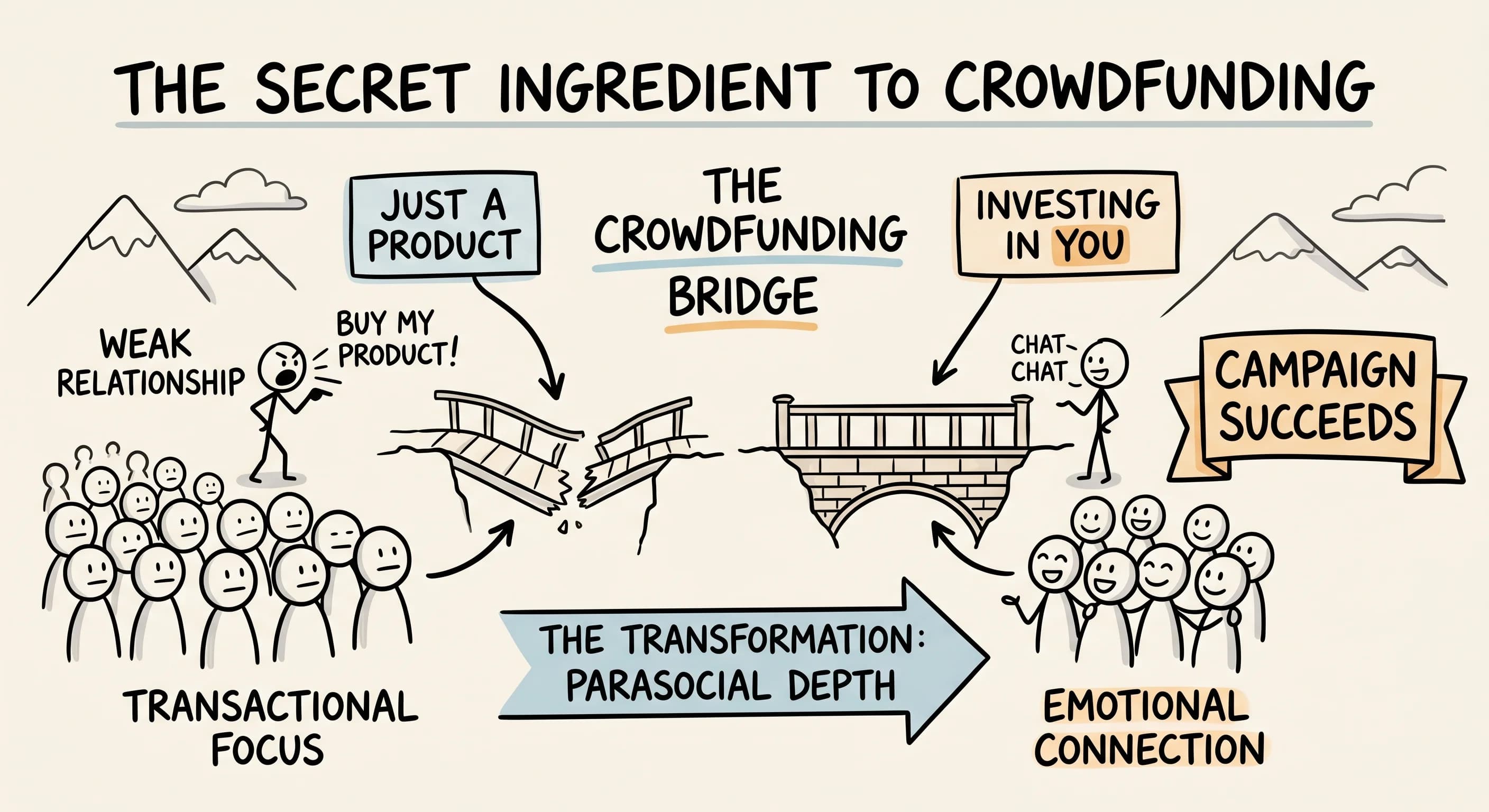
Most creators launch a crowdfunding campaign and wonder why it fails. The answer usually isn't the product. It's the relationship. Before you hit publish on Kickstarter or Indiegogo, there's one signal that predicts success better than your follower count, your landing page, or your funding goal: parasocial relationship depth.
If your audience feels like they genuinely know you, your chances of running a successful crowdfunding campaign skyrocket. Research on online parasocial relationships consistently shows that perceived friendship and intimacy with a creator predicts willingness to support them financially, even when content is available for free.
What Makes a Good Crowdfunding Campaign for Creators?
 Successful crowdfunding for creators isn't transactional. It's emotional. A backer isn't just buying a product. They're investing in you. Crowdfunding platforms like Kickstarter are built around storytelling: here's what we want to create, here's why it matters, here's who's behind it. Creators who communicate that message most powerfully are the ones who raise funds consistently.
YouTubers and streamers producing long-form content have a structural advantage here. Extended watch times create a lock-in effect where audiences spend hours with creators, learning their personalities, values, and quirks. Fundraising practitioners note that when supporters regularly see a familiar person sharing candid, personal updates, familiarity becomes the bridge between awareness and action. That emotional bond converts.
By the time a creator launches a creative project, fans feel genuine pride and excitement. That's not an accident. That's parasocial depth doing its job.
The 3 Crowdfunding Readiness Signals for YouTube Creators
1. Parasocial Depth
 Scroll your YouTube comments. Do viewers reference personal details from your videos? Do they respond emotionally, not just to your content, but to you? Comments like "I've been watching you for years, I had to back this" are the clearest sign your crowdfunding campaign will get traction.
Researchers who study parasocial relationships in social media identify four key dimensions that predict whether a fan will take action to support a creator: how interested they are in you, how much they feel they know you, how much they identify with you, and whether they feel a sense of ongoing interaction with you. When those four things are strong, you've got an audience that's ready to back something. When they're weak, even the best Kickstarter page won't save you.
The pattern shows up consistently with YouTubers and podcasters: creators who emphasize personal connection, behind-the-scenes access, and "you know me" narratives turn fans into financial supporters far more reliably than those who only post tutorials or trend-chasing content.
2. Prior Conversion History
Have you successfully sold merch, courses, or driven results for brand partnerships? If your audience has converted before, they'll convert again. This is one of the most overlooked use cases for analyzing your channel's data before you start crowdfunding.
Past conversion is essentially a revealed-preference test. It tells you that your parasocial depth is strong enough to actually move people. A viewer who once bought your merch or clicked through on a brand deal you recommended has already demonstrated they trust your recommendation enough to act on it. That same trust is exactly what you need when you launch.
3. Existing Paying Fans
Do you have a membership tier or subscription community? Paid-tier subscribers are your highest-propensity backers. Platforms like Kickstarter and Indiegogo work as complementary crowdfunding sites alongside a subscription model. Your paying members are already in what researchers describe as the "commitment" stage of a parasocial relationship. They're not just watching. They're voluntarily paying just to be closer to you and your work.
Reward your top fans with early access and exclusive perks when you launch. They'll become your campaign's loudest advocates, and those early backers matter more than most creators realize. Research on crowdfunding contribution dynamics shows that early contributors act as social signals that coordinate further contributions from the wider audience.
Rule of thumb: Only proceed if at least two of these three signals are strong.
What Type of Audience Are You Targeting With Crowdfunding?
 The most common reason for a failing crowdfunding campaign isn't a weak idea. It's a weak audience relationship. Small businesses and first-time creators often target broad audiences instead of nurturing the devoted core that actually backs projects.
You've probably seen this play out: a creator with 500,000 subscribers launches on Kickstarter and struggles to hit a modest goal. Meanwhile, another creator with 30,000 subscribers blows past their target in 48 hours. The difference is almost never the product. It's how deeply those 30,000 people feel connected to the person asking.
YouTube's long-form format is uniquely built to create that depth. Prioritize videos that share your creative process, your values, and your story, not just tutorials or trending topics. Recurring formats work especially well because they build routine parasocial contact. Your audience starts to expect you, look forward to you, and think of you as a consistent presence in their life. That's the foundation a crowdfunding campaign is built on.
Best Crowdfunding Platforms for Content Creators: Choosing the Right Crowdfunding Site
Not every crowdfunding platform is built the same way, and the one you choose shapes how your campaign runs, what fees you pay, and who you can reach. Here's a quick orientation so you can pick the right fit.
Kickstarter runs on all-or-nothing funding: you only receive funding if you hit your goal by the deadline. That structure creates urgency and social proof, which is exactly why it works so well when your audience relationship is already strong. It's the go-to fundraising platform for physical products and creative projects with a clear deliverable.
Indiegogo offers flexible funding as an option, meaning you keep the money raised even if you don't reach your goal. That's useful for early-stage projects where partial funds still move things forward, though it can reduce the campaign's sense of urgency.
GoFundMe is built for donation-based crowdfunding: personal causes, charitable causes, community projects, and nonprofits rather than product launches. A fundraiser on GoFundMe works differently from a Kickstarter campaign because there's no reward tier structure. Each donor gives because they believe in the person or cause, which makes peer-to-peer sharing and personal storytelling even more critical to how much money raised you can actually expect.
Equity crowdfunding platforms let a startup or early-stage business raise money by offering shares to backers, including accredited investors and in some cases the general public. Private companies use this route to generate interest from people who want a financial stake, not just a product or a thank-you. It's a different model entirely, and it comes with regulatory requirements, but it's worth knowing it exists if you're thinking beyond rewards-based crowdfunding.
When you're comparing the best crowdfunding platforms, pay close attention to the platform fee and any payment processing fees on top of it. Payment processing and payment processing fees are almost always separate line items, so the headline rate you see isn't always what you actually keep from your funds raised. Running the numbers on fees before you commit is one of the most practical things small business owners and independent creators can do before they launch.
For most content creators, rewards-based crowdfunding on Kickstarter or Indiegogo is the clearest path. GoFundMe suits personal fundraising or social impact work better than it suits product launches. Equity crowdfunding is its own world, better matched to a startup with a scalable business model than to an individual creator funding a single project.
Which crowdfunding platform is the best option for your small business or creative channel? It comes down to your project type, your relationship with your audience, and how the fee structure affects what you actually keep. There's no single best crowdfunding answer for every crowdfunder, but knowing how each platform is designed helps you make the call that fits.
Is Crowdfunding the Wave of the Future?
For content creators especially, the answer looks like yes. The shift toward direct creator-to-audience funding has been building for years, and crowdfunding sits right at the center of it. As advertising revenue becomes less predictable and platform algorithms keep changing, more creators are recognizing that their audience relationship is their most durable asset, and a fundraising campaign is one of the clearest ways to turn that relationship into direct support.
Donation-based crowdfunding has already normalized the idea that fans pay for creators they love, not just products they want. That behavior is expanding. Whether it's a fully funded Kickstarter for a documentary, a GoFundMe fundraiser for a community project, or an equity crowdfunding round for a creator-led startup, the common thread is the same: people back people they feel connected to.
For a crowdfunder who's built genuine parasocial depth with their audience, that's a real and growing opportunity.
Start Crowdfunding for Creators on the Right Foundation
Before you build your landing page or choose between the best crowdfunding sites for your project, audit your audience relationship first.
Parasocial depth is your most powerful asset. Build it intentionally on YouTube through self-disclosure, consistent persona, and recurring long-form formats. Measure it honestly by looking at your comments, your conversion history, and your paid fan base. And launch only when the signals align.
One practical way to assess your readiness before you launch a fundraising campaign: look at what percentage of your audience comments reference you personally rather than just the topic of the video. Check whether your membership tier has meaningful uptake relative to your total audience. Review whether past brand partnerships or product mentions actually drove clicks and sales. If those three boxes are ticked, or at least two of them, you're in a strong position to raise money and reach your goal.
If they're not, that's not a reason to give up. It's a clear signal of where to focus your content strategy before you commit to a campaign. Build the relationship first. The crowdfunding will follow.
That's how successful crowdfunding campaigns are made.
Read more about Monetization & Business Models for Content Creators
📚 Complete Guides
- Content Creator Monetization: Proven Revenue Streams
- Content Creator Income Streams: 7 Ways to Build Financial Stability
⚡ Tactics & Strategies
- 30 Daily Outbound Pitches for UGC Deal Generation
- Affiliate Code Negotiation Using Membership Audience Influence
- Age Bracket as Superpower Strategy for Older UGC Creators
- B2B Merchandise Bulk Sales to Industry Professionals- Packaging Products as Client Gifts for Lawyers and Service Providers
- Becoming Your Own Sponsor by Plugging Your Offer Within Episodes
📄 Related Articles
- Influencer Contract Template: What to Include (and Why)
- Online Course Feedback: Use It to Improve Your Course
- UGC Usage Rights Explained: What to Charge and How to License
- Usage Rights Pricing: How Content Creators Can Maximize Revenue from Brand Partnerships
- Welcome Email: Examples and a Sequence That Converts
- Email Sender Reputation: How to Protect It
- Why Content Creators Must Demand Monetary Payment for Influencer Partnerships
- Long-Form Content: Why It Works and How to Use It
🧮 Calculators
Read more YouTube Resources for Content Creators
📚 Complete Guides
⚡ Tactics & Strategies
- 50% Retention Rate Optimization for YouTube Algorithm Success
- Candy vs Vegetables Packaging Strategy for Educational Content
- Click-Through Rate Optimization as YouTube's Primary Success Metric
- Creating Viral Content Through Polarizing and Educational Hooks
- Doubling Production Effort Per Video to Exponentially Increase Views
🧮 Calculators

Alex Kirillov
Details
One link. Every channel, rate, and piece of work brands need to evaluate you. Built for how creators actually get hired.
Claim your profile
Live creator, content, and marketing roles from real companies, with the pay, market, and context the raw job page never gives you.
Browse jobs