How to Host a Live Event as a Content Creator to Make Money (Step-by-Step Guide)
Learn how to host a live event as a content creator to make money with tickets, sponsors, and reusable content. Start with 50 people and scale from there.
Details
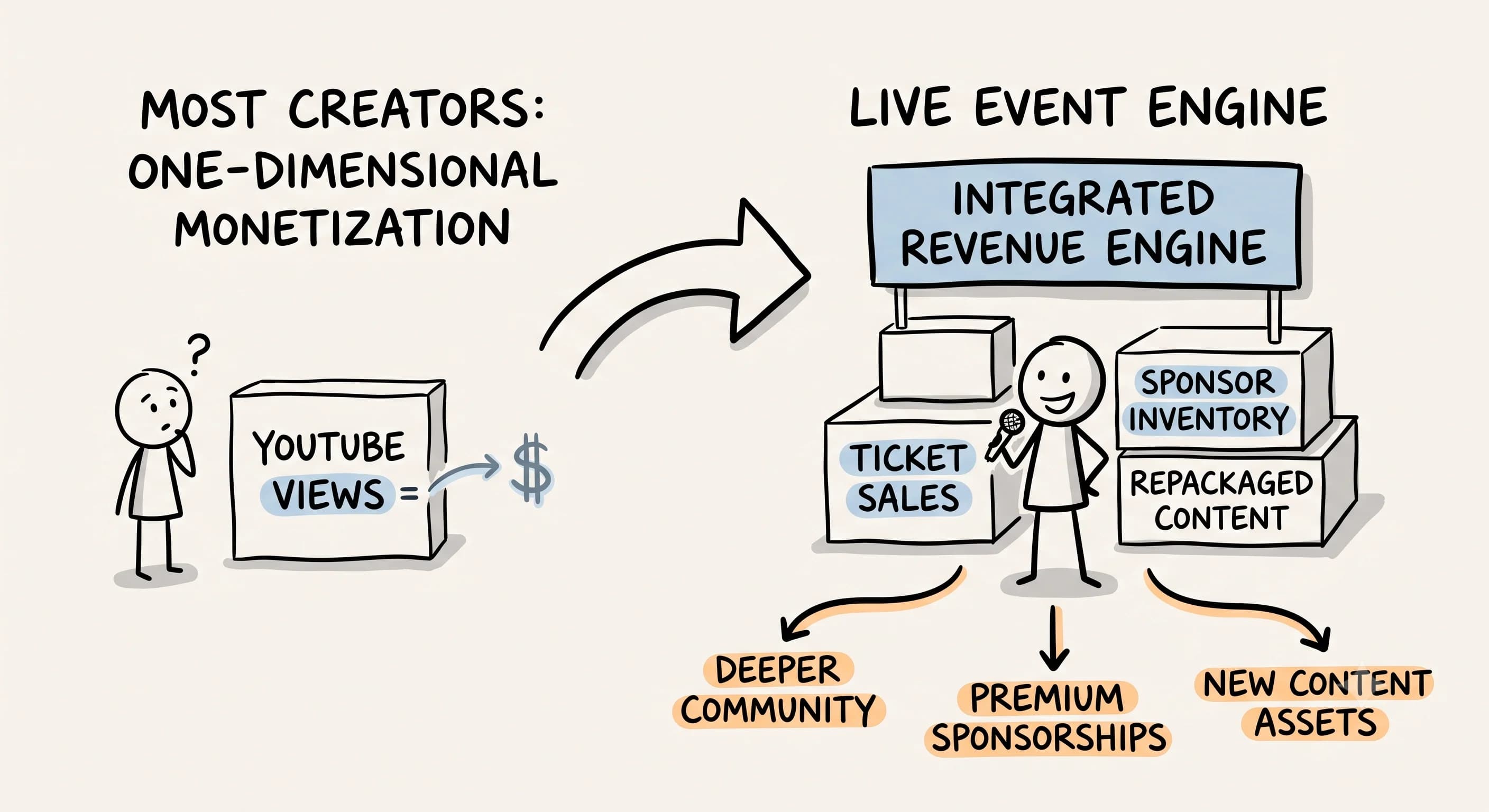
Most YouTube creators think about monetization in one dimension: views equal revenue. But the smartest creators are building income streams that exist entirely outside the algorithm. Live events are one of the most powerful and underutilized tools available to niche content creators today, and they can transform your audience into a thriving, revenue-generating community.
Whether you create math content, personal finance videos, cooking tutorials, or industry-specific education, hosting in-person events is a monetization strategy worth serious attention. Here is how to make it work.
Why Live Events Generate Revenue Beyond YouTube AdSense
 Live events create multiple income layers simultaneously. According to Sequence Events, live events function as a three-part monetization engine for creators: ticket sales, sponsor inventory, and new content that can be repackaged after the event. That is a level of monetization density that a standard YouTube upload simply cannot match.
More importantly, live events give you something incredibly valuable to offer a sponsor: a captive, highly engaged, niche audience in a physical space. Brands are not just paying for video views anymore. According to Digiday, IRL creator events are rising precisely because brands want access to creator audiences in physical settings, which expands sponsorship opportunities well beyond standard video integrations. That is a premium advertising environment, and smart brands will pay for it.
For creators with a newsletter, a LinkedIn presence, or an active YouTube community, a live event is the natural next step in deepening those relationships and opening new pricing tiers for your sponsorship packages.
How to Monetize a Live Event: Start Small and Think Local
 You do not need a thousand attendees to make a live event profitable. Start with 50. Seriously.
Identify 50 people in your niche in one city. If you are a YouTube creator covering personal finance, search LinkedIn and your existing subscriber base for followers in New York, Chicago, or Los Angeles. Announce the event through your newsletter, your channel community tab, and your LinkedIn profile. You will be surprised how quickly a targeted, passionate audience responds when given the chance to connect in person.
According to Lineup, the repeatable event model is the strongest success pattern identified across creator event sources: start with a small live audience, prove demand with ticket sales, add one sponsor, film the event for content reuse, then replicate in new cities or on a recurring schedule. That sequence is worth writing down.
Here is a simple framework to host your first event:
- Choose a format -- a guest speaker panel, a video debut screening, a networking mixer, or a workshop.
- Set your ticket pricing -- even $50 to $100 per attendee creates meaningful revenue with 50 people in the room.
- Find one event sponsor -- approach a brand already active in your industry and offer them logo placement, a speaking slot, or a branded activation.
- Film everything -- the content you capture becomes future YouTube videos, extending the return on your investment.
This model mirrors what podcasts have done with live recordings for years. The platform is different, but the principle is identical: give your audience a reason to show up in person and give a sponsor a reason to fund it.
How to Host an Event With Little to No Upfront Money
One of the biggest fears creators have is the financial risk of hosting an event. The good news is that a sponsor can cover most of your costs before a single ticket is sold.
Approach brands in your niche with a clear pitch: you are hosting an exclusive, invite-only event for 50 highly engaged industry professionals, and you are offering one brand the visibility that comes with being the sole sponsor. Use your YouTube analytics, your newsletter open rates, and your LinkedIn engagement to demonstrate audience quality. Brands respond to specificity.
Once you have even one sponsor committed, use that commitment to finalize your venue, confirm your speakers, and open ticket sales. The attendee revenue then becomes pure profit.
The pitch does not need to be elaborate. A one-page breakdown showing your audience size, engagement rate, and the event format is often enough to get a brand interested. You are not asking for a blank check -- you are offering them a room full of people who already care deeply about the topic they sell into. That is a genuinely compelling offer.
Generate Revenue Long After the Event Ends
 Here is something most creators miss when they think about live events: the monetization does not stop when the room empties out.
According to InEvent, events should be treated as reusable content assets, with post-event video, replays, clips, and on-demand access extending monetization beyond the live day. Ticket Fairy reinforces this point, noting that capturing and repurposing event content can materially improve ROI through clips, video-on-demand, and social distribution.
Film your speakers. Film the room. Film the hallway conversations if you can. One live event with a compelling guest can generate a full-length YouTube video, a highlights reel, a short-form clip series, and behind-the-scenes content -- all from a single evening. That compounds the return on every dollar and hour you invest in producing the event.
If you are already creating content consistently, you know how hard it is to generate fresh, high-value material. A live event essentially hands you a content production day wrapped inside a revenue-generating experience. That is a genuinely efficient use of your time.
Scale the Model Across Cities and Formats
 If your first event works, the real opportunity opens up. Replicate the format in a second city. Then a third. A creator with an engaged national audience can effectively build a live event tour, generating sponsor revenue and ticket income in multiple markets simultaneously.
According to a Creator Spotlight on Creative Mornings, their model of local chapters with recurring guest-speaker events is exactly the structural approach that works for scaling a live event series across cities. Creative Mornings operates local chapters with rotating guest speakers across dozens of cities, and that recurring format is what makes it sponsor-friendly and community-sticky.
Lineup's research supports this directly: repeatable formats with a fixed cadence and local chapters are the best way to make creator events scalable and appealing to sponsors who want a predictable, ongoing platform to invest in.
A recurring live event series does three things at once. It builds community loyalty among your most engaged audience members. It creates consistent, predictable revenue you can actually plan around. And it gives sponsors a long-term home rather than a one-off placement -- which means you can charge more and retain them across multiple events.
Consider building a monthly or quarterly format. Even four events per year across two or three cities starts to look like a legitimate media property that sponsors want to be associated with.
The Monetization Strategy That Compounds
Live events are not just a revenue stream. They are a community-building engine that deepens audience loyalty, expands your sponsor inventory, and generates content simultaneously. For YouTube creators ready to move beyond ad revenue, hosting in-person events is one of the most strategic moves available to you right now.
The barrier to entry is lower than you think. You do not need a venue contract, a production crew, or a massive audience to start. You need 50 people in one city who care about your niche, one brand willing to sponsor the experience, and a camera to capture what happens.
Start with 50 people. One city. One sponsor. Film everything. Then do it again somewhere else.
Read more about Monetization & Business Models for Content Creators
📚 Complete Guides
- Content Creator Monetization: Proven Revenue Streams
- Content Creator Income Streams: 7 Ways to Build Financial Stability
⚡ Tactics & Strategies
- 30 Daily Outbound Pitches for UGC Deal Generation
- Affiliate Code Negotiation Using Membership Audience Influence
- Age Bracket as Superpower Strategy for Older UGC Creators
- B2B Merchandise Bulk Sales to Industry Professionals- Packaging Products as Client Gifts for Lawyers and Service Providers
- Becoming Your Own Sponsor by Plugging Your Offer Within Episodes
📄 Related Articles
- UGC Usage Rights Explained: What to Charge and How to License
- Usage Rights Pricing: How Content Creators Can Maximize Revenue from Brand Partnerships
- Business Vlog Ideas: How to Find Your Niche While Satisfying Your Creative Passion
- Welcome Email: Examples and a Sequence That Converts
- Email Sender Reputation: How to Protect It
- Authentic Content: Why It Beats Polished Perfection
- Why Content Creators Must Demand Monetary Payment for Influencer Partnerships
- Long-Form Content: Why It Works and How to Use It
🧮 Calculators
Read more YouTube Resources for Content Creators
📚 Complete Guides
⚡ Tactics & Strategies
- 50% Retention Rate Optimization for YouTube Algorithm Success
- Candy vs Vegetables Packaging Strategy for Educational Content
- Click-Through Rate Optimization as YouTube's Primary Success Metric
- Creating Viral Content Through Polarizing and Educational Hooks
- Doubling Production Effort Per Video to Exponentially Increase Views
🧮 Calculators

Alex Kirillov
Details
One link. Every channel, rate, and piece of work brands need to evaluate you. Built for how creators actually get hired.
Claim your profile
Live creator, content, and marketing roles from real companies, with the pay, market, and context the raw job page never gives you.
Browse jobs