
Emotional Marketing: Build Real Connection, Not Story Arcs
Stop forcing story frameworks and start building real emotional connection. Learn the emotional marketing strategies that help your audience feel something and make decisions.
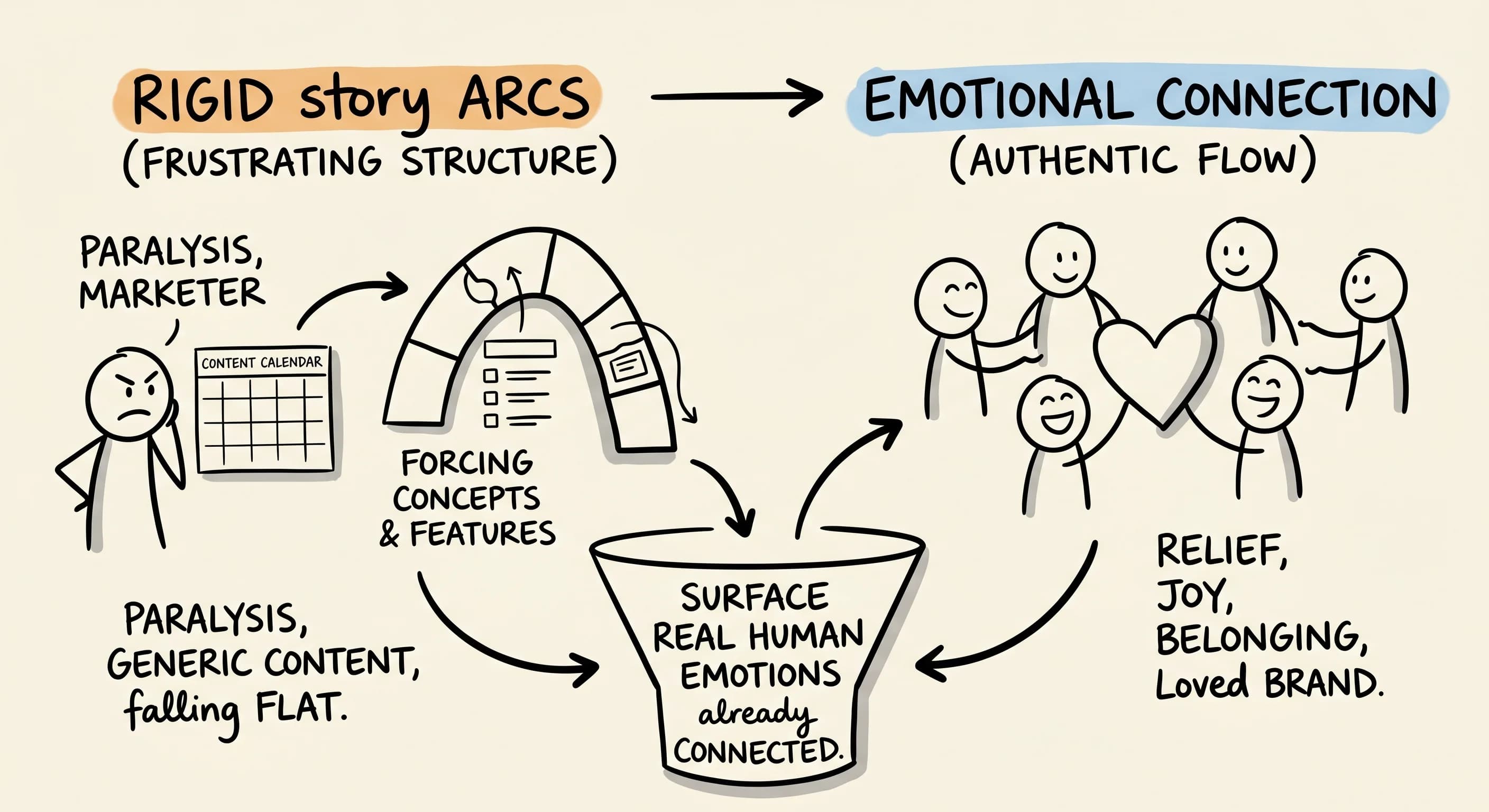
Most marketers have been there, staring at a blank content calendar, trying to force their brand into a hero's journey framework or a perfectly structured story arc. The result? Paralysis, generic content, and a message that falls flat before it ever reaches the people it was meant for.
The power of emotional marketing has nothing to do with structure. It is about surfacing the real human emotions already connected to what you sell. And if you have ever wondered how to develop an emotional marketing strategy that actually works, the answer starts with understanding what emotional marketing actually is.
What Is Emotional Marketing?
Emotional marketing, sometimes called emotional branding, is the practice of using human feelings, values, and psychological triggers to connect with an audience at a deeper level than facts or features ever could. Rather than leading with specifications, emotional marketing creates a sense of belonging, aspiration, relief, or joy that makes a brand feel personally relevant.
When you think of hugely successful marketing campaigns and brands, what names come to mind? Nike, Apple, Dove. None of them lead with product specs. They lead with feeling. That is not an accident. Emotional marketing builds stronger connections with audiences that rational messaging simply cannot replicate.
The data is clear from a report by Tracksuit: emotional campaigns double profit growth compared to rational ads, brands with emotional connections maintain premium pricing, and the type of content that taps into genuine feeling gets 27 percent more organic sharing. So what does this mean for you? It means emotion in your marketing is not a soft, optional extra. It is a core business lever.
How Successful Is Emotional Marketing?
The evidence is compelling. Research consistently shows that purchasing decisions are driven far more by emotion than by logic. Neuroscientist Antonio Damasio demonstrated that people with damage to the emotional centres of their brains struggle to make decisions at all, even simple ones, because the decision-making process is fundamentally emotional.
For brand builders, this means the goal is not to inform your audience. It is to make them feel something specific first, then give them the rational reasons to act on that feeling. Effective marketing does both, but emotion leads.
Where traditional marketing often focused on features, benefits, and rational comparisons, emotional marketing efforts go deeper by addressing how a customer feels at every stage of their journey. Strong emotional resonance in your messaging is what separates brands that are merely known from brands that are genuinely loved.
One of the most underrated paths to loyalty is consistency of emotional experience. Brand loyalty is not built by a single campaign. It is built by repeatedly delivering the same emotional promise across every touchpoint, so customers come to trust and rely on the feeling your brand produces.
Why Emotional Marketing Strategies Beat Story Frameworks
 Marketing strategist Anne makes a compelling case: the confusion in the marketplace around storytelling comes from over-indexing on structure. When a marketer obsesses over story arcs and narrative frameworks, they miss the simpler, more powerful task at hand, which is helping your target audience feel something.
An emotional bond with your audience does not require a three-act structure. It requires honesty and a willingness to show real people solving real problems. That is what makes audiences lean in, trust you, and ultimately act in your favor.
Research from the Product Marketing Alliance backs this up. Their work on human-centered storytelling explicitly warns that frameworks should serve understanding, not become an end in themselves. The most powerful approach puts people and their emotional needs at the core, not the narrative model. Brands that shifted from feature-heavy content to customer problem stories consistently saw better engagement once content showed real people and their emotional struggles rather than abstract, structured messaging.
Understanding Your Audience Emotionally
Understand Your Audience Before Creating Content
An effective emotional marketing strategy starts with deeply understanding the specific, concrete problems your customers face, not abstractly, but emotionally. Ask yourself: what does it feel like to have this problem? What relief does the solution deliver? Building genuine empathy for your audience at this level is where meaningful emotional engagement truly begins.
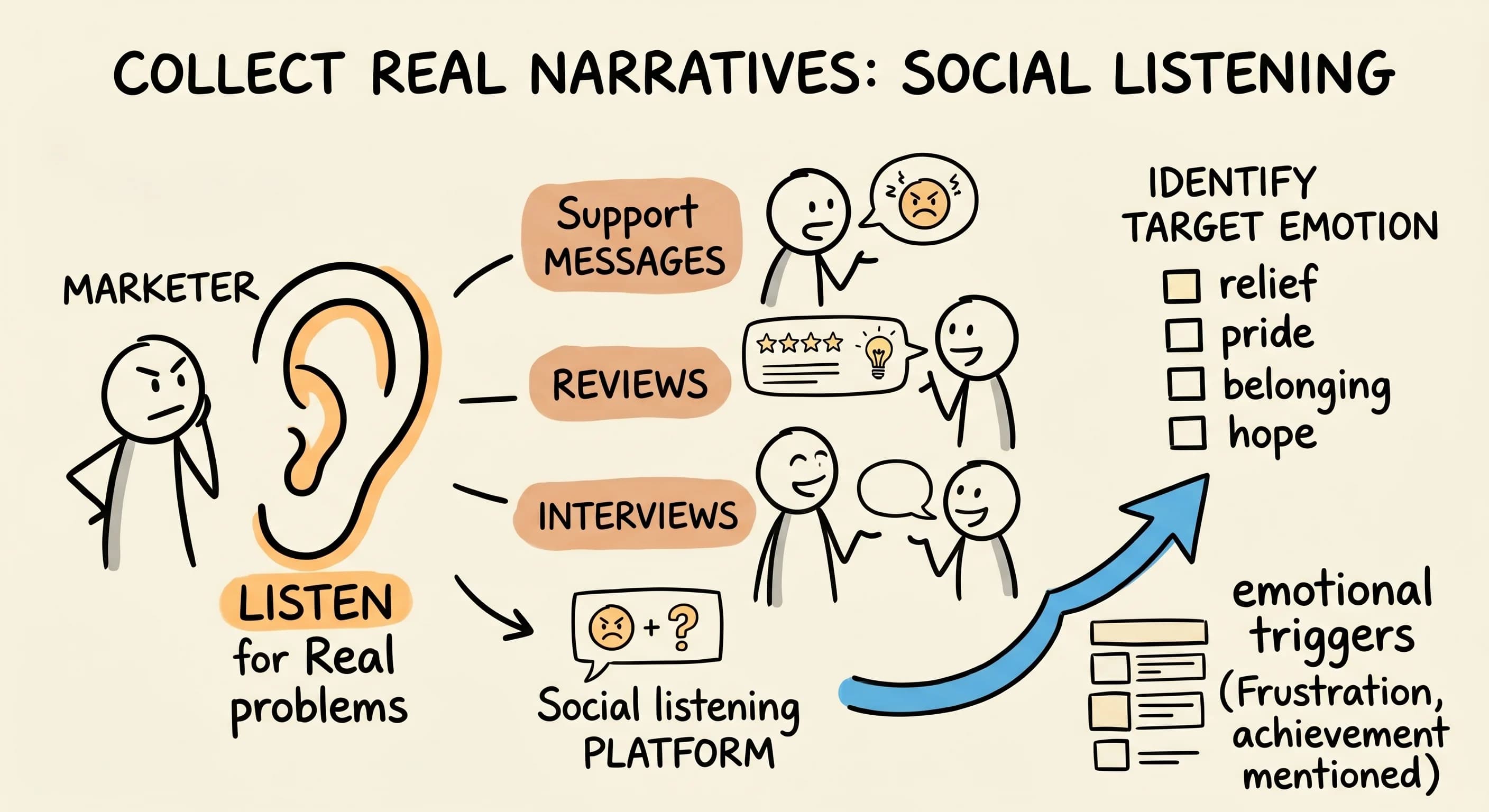
Here is something worth noting: before you even start identifying emotions, collect real narratives first. Talk to your customers. Read their support messages. Pull from their reviews. The emotional language you need is already out there waiting for you. Crafting emotion from thin air leads to content that feels forced and falls flat. Starting from real stories keeps everything grounded.
As one marketing leader put it: if you do not have a social listening platform or program for your brand, and you are not taking the time to understand how your consumers, your customers and prospective customers are talking about you and your specific vertical, how are you really able to provide them with something that is striking and resonates?
When emotions play a central role in how you frame your marketing content, it becomes relatable. It triggers recognition. Your audience thinks, that is exactly me. That emotional reaction is far more persuasive than any feature list.
Neuroscientist Paul Zak's research on narrative confirms why this works at a biological level. His studies found that emotionally engaging stories promote connection and influence behavior. Critically, it is the tension and vulnerability in a story that creates engagement, not the structural sophistication of it. Narratives that show a character's genuine struggle produce measurable physiological responses that correlate with real purchasing behavior.
Identify the Specific Emotion You Want to Evoke
Not all emotions serve every brand equally. The first step in any campaign is identifying which emotion sits at the heart of your value proposition. Relief? Pride? Belonging? Hope? Once you name that emotion, every piece of content, every headline, every image can be evaluated against one question: does this produce that feeling?
Emotional triggers are the recurring themes and situations that reliably produce your target feeling in the audience. They might be moments of frustration, aspiration, fear of missing out, or the satisfaction of achievement. Mapping these to your content gives you a repeatable system rather than a guessing game.
How to Create an Emotional Connection With Your Audience
Use Emotion to Build Trust and Credibility
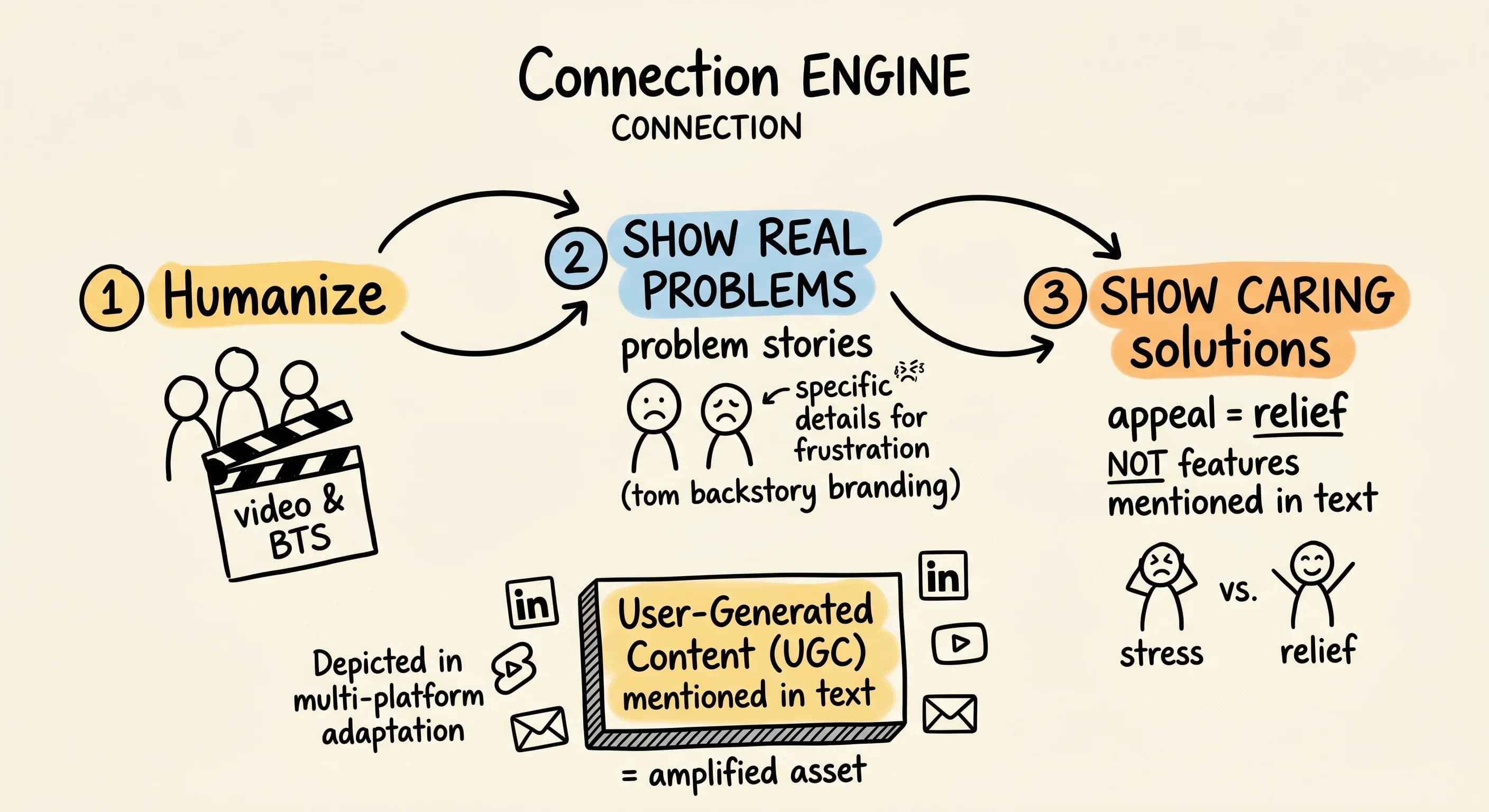
Trust and credibility are not built through credentials alone. They are built through consistent emotional resonance over time. To build trust with your audience across platforms, focus on three things that form the core of emotional storytelling in marketing.
First, show the people inside your company. Humanize your brand. Short-form video, behind-the-scenes content, and team spotlights create a genuine connection with a brand that paid advertising cannot replicate. When your audience sees the actual humans behind what you sell, trust builds fast.
Second, show your customers' real problems. Emotional advertising works when audiences see themselves in the struggle. Use storytelling in testimonials, case studies, and social content to evoke genuine feeling. The Digital Marketing Institute highlights this approach as profiling individual customers and their specific struggles before ever mentioning the product.
Third, show how you solve those problems. The emotional impact of a clear, caring solution is immense. This is your emotional appeal, not features, but relief. Focus on the before-and-after emotional states: stress versus relief, doubt versus confidence. That emotional journey is what audiences remember long after they forget any individual campaign detail.
For individual creators, this approach is particularly powerful because you do not need a production budget to execute it. A creator posting on Instagram or LinkedIn who shares a genuine customer frustration and walks through how they helped solve it is doing exactly this. The format is simple. The emotional core is everything.
Emotional Messaging Across Marketing Campaigns
For content creators operating across multi-platform environments, whether that is Instagram, LinkedIn, YouTube, or email marketing, your marketing materials must be adapted in format but consistent in feeling. Keep a single emotional core and adapt how you express it for each platform.
A LinkedIn post might highlight a customer's professional frustration and your solution in a 200-word text post. A YouTube short might capture a team member's genuine passion in 60 seconds. An email might tell a full customer story with vivid, specific details. Each piece should evoke something specific and strong, but they all pull from the same emotional thread.
User-generated content deserves a special mention here. When real customers share their emotional experience with your brand unprompted, it does more emotional work than any polished campaign. Encourage it, amplify it, and treat it as a core asset in your marketing efforts.
Backstory Branding advocates using small, vivid details rather than broad emotional labels. Instead of telling your audience something felt overwhelming, describe what someone actually saw, heard, or experienced in that moment. Those micro-details do more emotional work than any narrative framework ever will. Train yourself to ask: what moment best shows the problem? What moment best shows the relief? What specific detail captures how that felt? These are the messages that resonate.
Does Emotional Marketing Work in B2B?
How Emotion Works in B2B Marketing
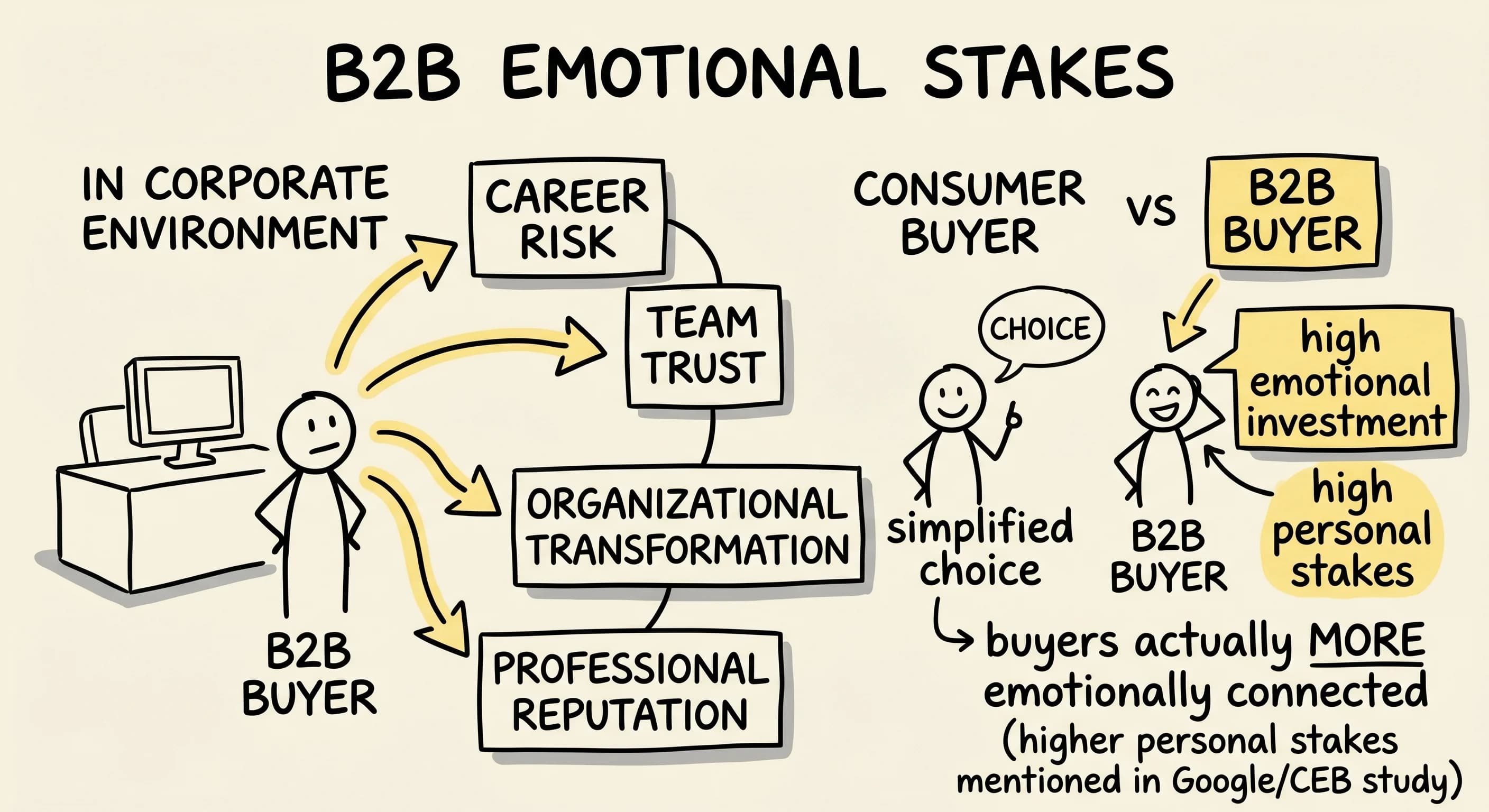
There is a persistent myth that b2b marketing should stay rational and professional, leaving emotion for consumer brands. The research does not support this. Studies by Google and CEB found that b2b buyers are actually more emotionally connected to their vendors than consumer buyers, because the personal stakes, career risk, team trust, and professional reputation are all on the line with every purchase.
Emotional investment in a b2b context looks different from a consumer campaign, but the principle is identical. Your buyers are human. They want to feel confident, supported, and understood. A campaign that speaks to the fear of making a costly mistake, or the pride of delivering a transformative result for their organisation, will outperform a feature comparison every time.
The same principles apply: understand the emotional level at which your buyers operate, identify the feelings that influence their choices, and build your messaging around those emotional realities rather than product attributes alone.
Teach People to Be Better Buyers
One of the most powerful marketing tips you can act on in any sector is helping your prospects become more confident, informed buyers. When you create content that genuinely teaches them how to evaluate their options, identify risks, and ask better questions, you establish credibility before a sales conversation ever happens.
This approach is not about hiding your product. It is about demonstrating that you understand their world deeply enough to help them navigate it. When brands build connections with their audiences through education rather than persuasion alone, the relationship that follows is the foundation of long-term loyalty and advocacy. That is what it means to create an emotional connection through genuine helpfulness.
Develop an Emotional Marketing Strategy That Converts
What a Working Emotional Marketing Strategy Looks Like
To develop an emotional marketing strategy that actually moves the needle, start here. Stop chasing immediate buyers with your marketing because they represent only around 5 percent of your market. Build an emotional connection through personal brand and meaningful stories, which research shows drives 61 percent higher brand differentiation. Plant memory seeds in your customers minds because emotions last longer than facts.
Your day-to-day efforts do not need a 12-step framework. Instead, ask: what emotion do our products and services address? Build every piece of content around that answer.
When your message consistently produces genuine emotional responses, purchasing decisions follow naturally. Brands that connect emotionally with their audiences maintain premium pricing, attract stronger word-of-mouth, and see loyalty that purely rational messaging never generates.
It is also worth adding one layer that makes emotional content genuinely persuasive rather than just emotionally interesting: pair the feeling with credibility. Research from the Product Marketing Alliance points out that effective storytelling balances pathos, logos, and ethos. Emotion gets people to lean in. Evidence gives them the confidence to act. A message that carries both is a message that converts.
Content marketing is one of the most effective vehicles for this kind of sustained emotional engagement. Unlike one-off paid placements, a well-considered content marketing approach builds emotional familiarity over time, which is precisely what converts a cold audience into a loyal one. A successful emotional marketing campaign does not live in a single ad or post. It lives in the accumulated weight of consistent, emotionally honest content across every channel.
Finally, do not treat story structure as the enemy. Treat it as optional. If a framework helps a stuck creator identify where the transformation moment is in their content, use it. If it causes paralysis, set it aside and go back to the basics: real people, real problems, real relief.
Here are a few practical points to bring this to life today. Audit your existing content and ask which pieces produce a clear emotional response and which ones simply inform. Replace one information-only piece with a customer story. Test one subject line in your next send built around an emotion rather than a feature. Review your approach quarterly to ensure your emotional core is still visible across all channels.
Start today: identify one core emotion your brand addresses, find one real customer story that illustrates it, and create one piece of content that lets that emotion lead. Resonate with your audience by speaking to how they feel, not just what they need to know. That is the entire strategy. Everything else builds from there.
Read more about Becoming a Content Creator
📚 Complete Guides
- How to Become a Content Creator: Complete Beginner's Guide
- Content Creator Platform Guide: Choose the Right Platform to Start Your Creator Journey
⚡ Tactics & Strategies
- 50% Retention Rate Optimization for YouTube Algorithm Success
- Age Bracket as Superpower Strategy for Older UGC Creators
- AI Workflow Integration for Content Reduction
- Audience Consistency Strategy to Avoid Algorithm Penalties
- Audience Poll on Instagram to Source Q&A Content in Advance of Recording
📄 Related Articles
- Street Interviews: The LinkedIn Strategy That Went Viral
- How to Record a Podcast on Your Phone: The Simple Voice Memo Workflow
- Walking Tour Content Strategy: How to Create Authentic Local Content
- Business Vlog Ideas: How to Find Your Niche While Satisfying Your Creative Passion
- Welcome Email: Examples and a Sequence That Converts
- Email Sender Reputation: How to Protect It
- Authentic Content: Why It Beats Polished Perfection
- How to Create Authentic Social Media Content That Boosts Engagement
Read more about Systems, Workflows & Operations for Content Creators

Alex Kirillov
One link. Every channel, rate, and piece of work brands need to evaluate you. Built for how creators actually get hired.
Claim your profile
Live creator, content, and marketing roles from real companies, with the pay, market, and context the raw job page never gives you.
Browse jobs