B2B Influencer Marketing: A No-Agency Starter Guide
Start your B2B influencer program this week without an agency. A practical step-by-step guide for LinkedIn marketers to find, reach out to, and test b2b influencers on a lean budget.
Details
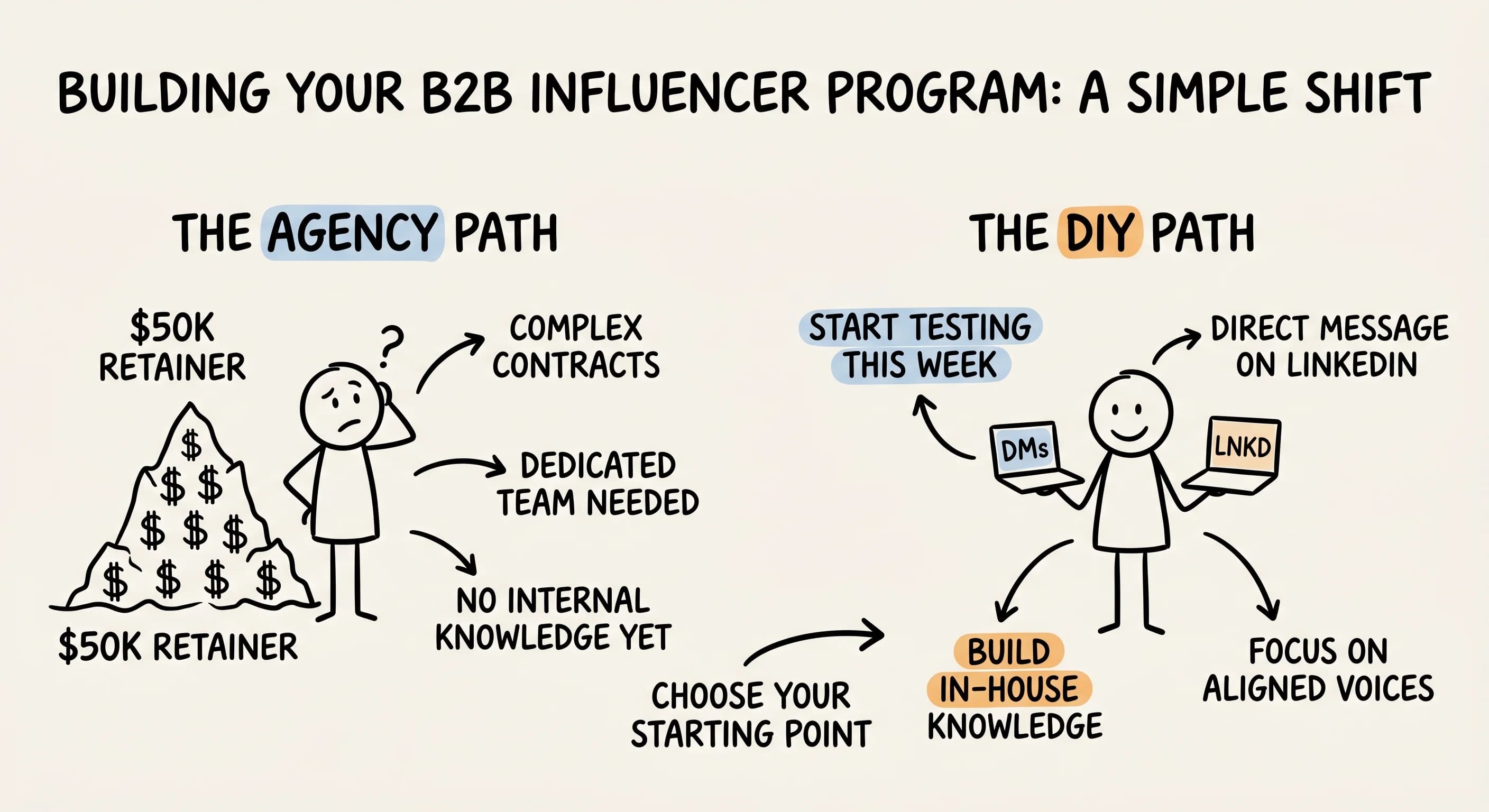
Most b2b marketers assume launching an influencer program requires a big budget, a dedicated team, or a contract with one of the top b2b influencer marketing agencies. You can start testing b2b influencer marketing this week with nothing more than a LinkedIn search and a direct message.
Here's how to do it right.
Does Influencer Marketing Work for B2B?
 Short answer: yes. But the marketing landscape for b2b brands looks very different from what most people picture when they think of influencer marketing. Forget b2c influencer campaigns built around unboxing videos and lifestyle posts. B2B buyers make decisions based on trust, expertise, and peer recommendations. That's exactly what a well-run b2b influencer marketing strategy delivers.
Subject matter experts who speak directly to your buyers' problems carry far more weight than celebrity endorsements. When a respected analyst or practitioner vouches for your approach, it builds brand awareness and credibility in ways that paid ads simply cannot replicate. This kind of thought leadership from aligned voices is what separates effective b2b influencer marketing campaigns from generic content pushes.
Influencer marketing is also worth it across budget sizes. A data-driven test with two or three right creators can generate measurable pipeline impact without the overhead of a full agency engagement.
Why B2B Influencer Marketing Doesn't Require an Agency to Start
B2b influencer marketing agencies offer real value at scale, but for marketers just beginning, they introduce unnecessary complexity. Before you can brief an agency, you need internal knowledge: what content resonates, which metrics matter, and what ROI looks like for your specific market.
The smarter move is to start small, build that knowledge in-house, and bring in outside support only once you know what you're optimizing for. Marketing teams that skip this step often struggle to hold an agency partner accountable because they don't yet have a benchmark for what good looks like.
B2B influencer specialist Nick Bennett put it plainly in a LinkedIn post that resonated with thousands of marketers: "You shouldn't need a $50K agency retainer to figure out B2B influencer marketing." His free B2B Creator Playbook GPT exists precisely because most brands trying to build with creators are stuck, not knowing how to identify the right voices, worried about ROI, and unable to find a strategy that doesn't feel awkward. That feeling is completely normal at the start.
And Alice de Courcy, a B2B marketing leader who shared her influencer strategy publicly on LinkedIn, echoes this. Her first recommendation? Start with a small but highly focused group of external influencers. These don't need to be people with hundreds of thousands of followers. Smaller, more aligned audiences will consistently outperform follower count.
The 3 R's of Influencer Marketing Applied to B2B
 The 3 R's, Reach, Relevance, and Resonance, are your foundation. When identifying the right influencer for a b2b influencer campaign, relevance and resonance matter far more than follower count. A LinkedIn creator with 4,000 engaged followers in your exact niche will outperform a generalist with 40,000 every time.
Multiple B2B influencer experts have documented this clearly: authority beats audience size in B2B, and smaller creators tend to drive higher conversions while larger creators are better suited for top-funnel awareness. Prioritize engagement rate over amplification when you're just starting out, and your early campaign data will actually mean something.
This same logic applies whether you are building influencer relationships on LinkedIn or experimenting with other platforms for more consumer-adjacent b2b companies. Platform matters less than precision.
What Is the Best Influencer Marketing Platform for B2B?
For many b2b brands starting out, LinkedIn remains the most practical channel for finding and working with creators. But as your program matures, you may want dedicated software to support it. An influencer marketing platform built for b2b can streamline discovery, contracting, and performance tracking in one place.
The best b2b platforms typically offer a vetted creator network so you are not starting from scratch with every search, along with end-to-end influencer management tools covering everything from outreach to reporting. When evaluating platforms or agencies, ask whether they offer end-to-end influencer campaign support or just discovery, because the answer will determine how much internal resource you still need to commit.
For small or early-stage programs, manual processes work fine. But understanding what platforms offer helps you plan your marketing budget accurately as you scale.
Step-by-Step Guide: How to Launch Your First B2B Influencer Campaign
 Step 1: Identify 1 to 3 B2B Influencers You Already Follow
Scroll your LinkedIn feed and note the creators you see consistently producing relevant content. These are your starting targets. You've already done passive vetting, you know their voice, their vertical, and their audience.
This isn't just a shortcut, it's actually the recommended approach. A no-cost framework for b2b work suggests manually researching LinkedIn and asking your community who they follow, then engaging a small group of relevant thought leaders rather than launching a full paid marketing program from day one. You're not cutting corners by starting here. You're starting smart.
Influencer discovery at this stage doesn't require expensive software. Your own feed, community Slack groups, and LinkedIn search filters are enough to surface a valuable influencer or two who already speaks to your audience.
Step 2: Reach Out Directly and Be Transparent
Send a simple, honest message. Tell them you're exploring b2b influencer marketing for the first time and want to build a real partnership, not a one-off transaction. Framing this as a long-term relationship makes working with a b2b influencer far more appealing than a single paid post.
Direct outreach on LinkedIn is normal and often preferred for early-stage programs. The key is crafting personalized messages that explain why you value their content, how you want to feature them, and what they gain from participating. Generic copy-paste messages won't cut it here.
One approach that works well before you even ask for anything: feature creators in content first. Think "Top voices to follow in your space" posts or short interview clips. When you lead with visibility and genuine respect for their work, the relationship starts from a place of trust rather than transaction.
Step 3: Set Clear but Lightweight Metrics
Even in early testing, define your metric priorities. Track engagement rate, content performance, and any downstream pipeline influence. You don't need a sophisticated platform yet, a simple spreadsheet works fine.
That said, give each creator a unique UTM link or custom landing page from day one. Even at the 1 to 3 creator level, this gives you real attribution data rather than guesswork. Tracking cost per lead or cost per demo request alongside engagement gives internal marketing stakeholders the proof points they need to support continued investment.
Performance-driven influencer guides consistently recommend tracking funnel metrics like leads, demo requests, and pipeline rather than vanity metrics like likes and impressions. Also worth doing before any campaign: assign each creator a specific role in your funnel. One creator focused on awareness, another on consideration, a customer advocate for conversion. This makes your small tests far more informative when it's time to scale.
Step 4: Tap Your Customer Base
Look inside your existing user base for enthusiastic advocates. Some b2b influencer campaigns have been launched with customers who simply wanted early product access in exchange for authentic content. These voices carry enormous credibility.
Customers who already speak positively about you can appear in co-marketing content: case studies, webinars, social posts, and user-generated content style clips. The value exchange doesn't need to be cash. Beta features or speaking opportunities often mean more to engaged customers than a one-time payment.
Do I Need a Contract With a Micro Influencer? Do Influencers Need an Agent?
For early b2b influencer testing, a simple written agreement covering deliverables, timelines, usage rights, and disclosure requirements is advisable even at the micro level. You don't need a lengthy legal document, but having expectations in writing protects both sides and sets a professional tone for the relationships you are building.
As for agents, direct influencer management is practical and lean at this stage. Influencer agencies become valuable once your strategy has proven ROI and needs to grow, not before.
That's not a knock on b2b influencer marketing agencies. TopRank Marketing and others make a compelling case for what agencies bring once you're ready: expertise in discovery, relationship management, measurement infrastructure, and scale. But if you engage an agency before you've run a single campaign, you won't be able to brief them effectively or hold them to meaningful standards. Build internal knowledge first, then decide whether a specialist team is the right fit.
How Do I Compare KPIs From One Agency to Another?
When evaluating b2b influencer marketing agencies, ask each one the same set of questions: How do you define success for a program like ours? What does a benchmark engagement rate look like in our vertical? How do you attribute pipeline to influencer activity? Ask them what their unique value is: access to unique influencers, proprietary data, or deep experience with SaaS and b2b leaders in specific verticals?
A strong agency partner will answer these questions with specifics, not generalities. If they can't explain how they run campaigns for b2b brands with clear measurement frameworks, that's a signal to keep looking.
Now You've Got Your Program in Place: How Do You Prove ROI?
The average ROI for influencer marketing varies widely by industry and execution, but for b2b buyers the most meaningful signals are pipeline contribution, not just reach. Here is what to track:
- Website Traffic: Has there been an upswing in website traffic around key influencer engagements? UTM parameters tied to each creator make this measurable.
- Lead Quality: Are inbound leads from influencer-driven traffic converting at a higher rate than other digital marketing channels?
- Pipeline Influence: Are deals citing influencer content as part of their journey? Short post-demo surveys can surface this.
- Brand Awareness: Use aided awareness surveys or share-of-voice tracking to measure whether your name is being mentioned more in relevant conversations.
- Email Marketing Response: If you feature influencer content in newsletters, track click and conversion rates separately to isolate its impact.
When you run a program with these tracking layers in place, you move from anecdotal wins to defensible business cases. That's what gets budget approved for the next cycle.
Can a Small Business Use Influencer Marketing? Which Industry Uses Influencers the Most?
Small businesses can absolutely run influencer marketing effectively, and in some ways have an advantage. A focused, personal approach often outperforms the spray-and-pray tactics larger brands rely on. You don't need scale to run a performance-driven influencer test. You need clarity on your audience and a genuine value proposition for the creators you approach.
As for which industry uses influencers the most, consumer goods and entertainment still dominate overall volume. But b2b sectors including SaaS, professional services, and technology are the fastest-growing segments. The question of whether influencer marketing is worth it on a small budget is really a question of focus. A small budget spent precisely, on the right creators for a defined audience, beats a large budget spent broadly every time.
Build a B2B Influencer Foundation First
The best influencer marketing strategy starts with curiosity, not contracts. Expert guidance consistently frames B2B influencer marketing as a test-and-learn channel: run small tests, measure everything you can, iterate quickly, and scale what works.
Here's a simple 4 to 6 week test loop you can start this week:
- Before reaching out: Define 1 to 2 key KPIs, like demo requests or newsletter signups
- For each creator: Set a small, testable campaign such as 2 LinkedIn posts or one webinar mention with unique tracking links
- After 4 to 6 weeks: Compare performance across creators, decide who to deepen the relationship with, and refine your approach
Want to build and scale your B2B influencer marketing strategy? Use LinkedIn to find your first partners, keep your analytics simple, and let real relationships drive your work forward. Scale comes after proof, and proof comes faster than you think when you start small and stay focused.
Read more about Audience Building & Growth for Content Creators
📚 Complete Guides
- How to Build an Audience as a Content Creator
- How to Find Your Target Audience (Start With One Person)
⚡ Tactics & Strategies
- 30 Daily Outbound Pitches for UGC Deal Generation
- 50% Retention Rate Optimization for YouTube Algorithm Success
- Age Bracket as Superpower Strategy for Older UGC Creators
- Audience Consistency Strategy to Avoid Algorithm Penalties
- Audience Psychology Over Algorithm Optimization, Focusing on Human Pain Points and Goals Instead of Platform Tactics
📄 Related Articles
- How Audience Reachability Score Transforms Instagram Creator Marketing Analytics
- How Many Followers Do You Need to Make Money? (Start at 500)
- Content Gap Analysis: A Step-by-Step Guide for Creators
- Creator Collectives: How They Land Bigger Brand Deals
- Personal Brand Identity: How One Signature Item Built Instant Recognition
- How to Pitch Brands as a Creator (and Land Deals)
- Content Pillars for Social Media: How to Choose Yours
- How to Increase Your LinkedIn Reach (Mentions + Fundamentals)
Read more LinkedIn Resources for Content Creators
📚 Complete Guides
⚡ Tactics & Strategies
- Finding and Supporting Small Creator Communities
- Platform-Specific Role Assignment- Separating Influencing from Content Creation by Channel
- Starting a B2B Influencer Program Direct Outreach to 1-3 Known Creators Without an Agency
- Street Interview Content Strategy for Viral LinkedIn Growth
- First Three Lines Hook Strategy for LinkedIn Posts

Alex Kirillov
Details
One link. Every channel, rate, and piece of work brands need to evaluate you. Built for how creators actually get hired.
Claim your profile
Live creator, content, and marketing roles from real companies, with the pay, market, and context the raw job page never gives you.
Browse jobs