

Contentstack
Contentstack is an Agentic Experience Platform combining a headless CMS, real-time data cloud, and AI agents to automate content workflows and deliver personalized digital experiences.
What is Contentstack? A Content Creator's Guide
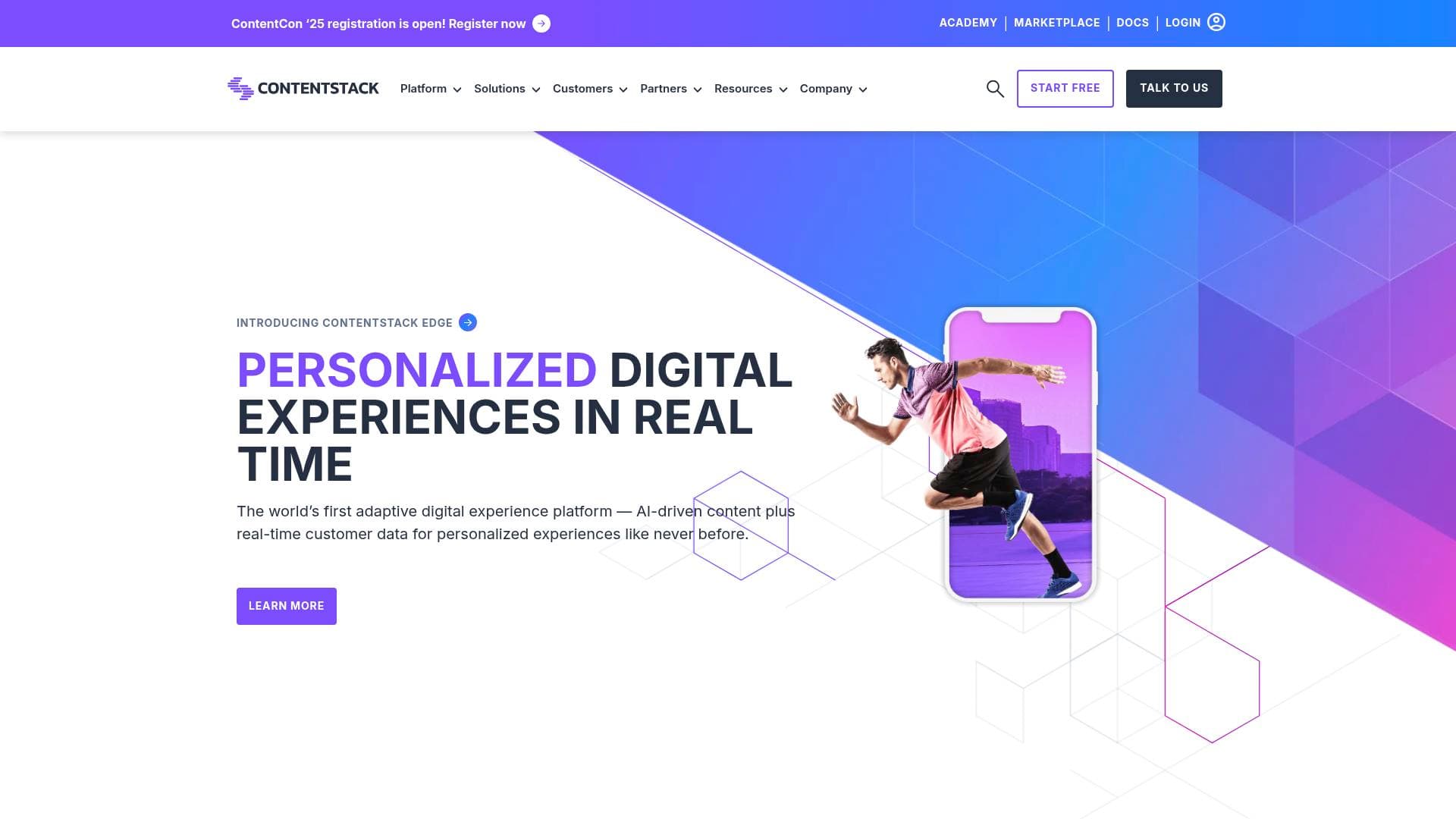
Contentstack is the industry's first Agentic Experience Platform (AXP), designed to help teams manage, personalize, and automate content delivery at scale. At its core, it solves a problem every serious content creator eventually faces: the gap between creating great content and getting it in front of the right audience, on the right channel, at the right time. The platform unifies three major components — a composable Content Cloud, a real-time Data Cloud, and an autonomous Agent OS — into a single system that handles everything from content management to AI-driven personalization. Built on an API-first, cloud-based headless CMS architecture, Contentstack separates content from the front-end presentation layer, giving creators and developers complete flexibility over how and where content appears. It supports omnichannel publishing, meaning content can flow to websites, apps, digital displays, and any other channel without rebuilding from scratch. Contentstack has been recognized as a Leader in The Forrester Wave for Content Management Systems (Q1 2025) and is the only pure headless provider to earn that designation, making it a standout choice for creators who need enterprise-grade infrastructure without the constraints of monolithic platforms.
Contentstack Features That Matter for Content Creators
-
API-First Headless CMS: Contentstack's headless CMS architecture decouples content from the front-end, so creators can publish once and distribute everywhere. This content creation workflow means a blog post, product description, or campaign asset can be reused across a website, mobile app, and digital signage without duplicating effort.
-
Agent OS (Agentic AI): The platform's Agent OS deploys intelligent agents that combine reasoning, brand context, and automation tools to handle repetitive CMS tasks. Creators can use agents to generate, translate, and personalize content instantly, freeing up an estimated 90% of time previously spent on CMS "janitorial work" so teams can focus on strategy and creative output.
-
Real-Time Personalization: Contentstack leverages first-party data and AI to deliver the right message in the right place at the right time. For content creators managing audience-driven platforms, this means content automatically adapts to individual visitors based on real-time behavioral signals rather than static segments.
-
Omnichannel Personalization: The platform includes a dedicated omnichannel personalization product that lets creators tailor experiences across every channel simultaneously. Audience analytics are built in, so creators can see how different content variants perform across touchpoints without switching between tools.
-
Real-Time Customer Data Platform (CDP): Following the acquisition of Lytics, Contentstack integrates a real-time CDP directly into the platform. All customer data is unified and ready for action across every channel and audience, giving creators a single source of truth for understanding who their audience is and what they respond to.
-
Visual Builder: Contentstack includes a Visual Builder that allows content teams to build and edit pages visually without requiring developer involvement for every change. The abstraction of content from the UI layer means marketing teams can focus on writing quality content rather than designing pages, as noted by users in documented case studies.
-
Live Preview: The Live Preview feature lets creators see exactly how content will look before publishing, with support for both REST and GraphQL implementations. Changes appear in real time, reducing the back-and-forth between content editors and developers during production cycles.
-
Automation Hub: Contentstack's Automation Hub connects the CMS to cloud tools and platforms with clicks rather than code. Creators can automate workflows like content publishing triggers, asset management, translation pipelines, and cross-stack synchronization without writing custom integrations.
-
Taxonomy and Content Organization: The platform includes a robust taxonomy system for organizing content with scalable, hierarchical structures. Teams managing large content libraries across multiple brands or regions can maintain governance and consistency without losing flexibility.
-
Front-End Hosting (Launch): Contentstack Launch provides fully integrated, MACH-compliant front-end hosting that works alongside the CMS. It supports frameworks including Next.js, Nuxt, Gatsby, Angular, Remix, and React, making it a complete content creation and delivery solution for technically capable creator teams.
-
Brand Kit: The Brand Kit feature stores voice profiles and a knowledge vault, giving content teams a centralized repository of brand guidelines that AI agents can reference when generating or personalizing content. This ensures brand consistency across all AI-assisted content production.
Which Content Creators Should Use Contentstack?
Contentstack is best suited for content creators who operate at scale or who need their content infrastructure to grow with them. It is particularly powerful for teams that publish across multiple channels, manage large content libraries, or want to leverage AI to automate repetitive content tasks. While the platform has a free trial option, its full feature set is oriented toward creators and teams who need enterprise-grade reliability.
Primary creator types:
- Bloggers and digital publishers managing high-volume content across multiple sites or regions
- Video creators and streamers who need to publish supporting content, show notes, and metadata across web and app simultaneously
- Newsletter writers looking to repurpose long-form content across multiple formats and channels
- Podcast creators who manage episode pages, transcripts, and promotional content across platforms
- Social media managers handling omnichannel content distribution with personalization requirements
- Content teams at media companies (similar to LadBible Group, a documented Contentstack user) scaling content publishing operations
Experience level: Contentstack offers an Academy with structured learning paths including a Developer Kickstart program with six hands-on coding modules. There is also a Contentstack Developer Certification program. The platform is best suited for intermediate to advanced creators who are comfortable with or have access to developer support for initial setup.
Team size: While solo creators can explore the platform via free Explorer accounts, Contentstack is most powerful for small-to-medium content teams where writers, editors, and developers collaborate on content operations.
Specific use cases for content creators:
- Publishing a single piece of content to a website, mobile app, and digital display simultaneously
- Using AI agents to auto-generate SEO titles and meta descriptions for content entries
- Setting up automated translation workflows for multilingual content
- Running A/B tests on content variants to optimize audience engagement
- Personalizing homepage content based on visitor location or behavior
- Managing a content release calendar with scheduled publishing and release management tools
- Organizing a large asset library with taxonomy, folder permissions, and version control
- Automating content publishing triggers when new assets are uploaded or entries are updated
Getting Started with Contentstack
- Create a free account: Contentstack offers free Explorer accounts, allowing creators to explore the platform before committing to a paid plan. Sign up at contentstack.com/try-for-free.
- Set up your stack: A "stack" is Contentstack's term for a content repository. Use the platform's guided setup or the CLI to seed a new stack with pre-built content models.
- Explore the Developer Kickstart: The Contentstack Academy offers a Developer Kickstart learning path with six coding modules covering CLI setup, Next.js integration, Live Preview, Visual Builder data modeling, and the JSON Rich Text Editor.
- Connect your front end: Use one of the available SDKs (JavaScript, TypeScript, Python, Java, .NET, iOS, Android, and more) or the GraphQL/REST APIs to connect your website or app to the CMS.
- Enable personalization and automation: Once content is flowing, activate the Personalize product and Automation Hub to start delivering tailored experiences and automating repetitive workflow tasks.
Contentstack FAQ for Content Creators
Is there a free version of Contentstack? Contentstack offers free Explorer accounts that allow creators to explore the platform's capabilities. A free trial is also available at contentstack.com/try-for-free, giving teams hands-on access before committing to a paid plan.
What frameworks does Contentstack support for front-end development? Contentstack Launch supports Next.js, Nuxt, Gatsby, Angular, Remix, React, and Vue, among other frameworks. The platform also provides SDKs for JavaScript, TypeScript, Python, Java, .NET, iOS (Swift), Android, Ruby, Dart, and React Native.
Does Contentstack support multilingual content? Yes, the platform includes robust multilingual content support with localization features, language management, and automated translation workflows that can connect to services like Smartling, XTM, Phrase, and AWS Translate through the Automation Hub.
What AI capabilities does Contentstack include? Contentstack's Agent OS enables AI-powered content generation, translation, and personalization. The platform also includes a Brand Kit with voice profiles so AI agents can generate content that stays on-brand. Additionally, the Automation Hub includes connectors for ChatGPT, Azure ChatGPT, Google Gemini, Google Vertex, Anthropic, and AWS Bedrock.
Can Contentstack integrate with e-commerce platforms? Yes, Contentstack has marketplace integrations with Shopify, commercetools, SAP Commerce Cloud, Salesforce Commerce, and BigCommerce, making it a strong choice for creators who produce content for e-commerce brands.
What analytics does Contentstack provide? The platform includes built-in analytics covering CMS activity, Automation Hub usage, Launch performance, Personalize results, and Brand Kit engagement. The real-time CDP (powered by Lytics) also provides audience analytics, behavioral scoring, and lookalike modeling.
How does Contentstack handle content versioning? Contentstack supports full entry versioning, allowing creators to name versions, compare versions, restore old versions, and track changes over time. Asset versioning is also available, with the ability to restore previous asset versions at any point.
The Verdict: Is Contentstack Worth It for Content Creators?
Contentstack is a powerful platform for content creators who have outgrown traditional CMS tools and need a more flexible, scalable infrastructure. Its headless architecture means content is not locked into any single front-end, making it ideal for creators who publish across multiple channels or plan to expand their distribution in the future. The addition of Agent OS and real-time personalization puts it ahead of standard CMS platforms for teams that want AI to handle the operational side of content management.
The main limitation is the learning curve. Contentstack is not a plug-and-play blogging tool. Initial setup benefits from developer involvement, and the full feature set is best utilized by teams rather than solo creators working without technical support. However, the free Explorer accounts, comprehensive Academy learning paths, and extensive documentation lower the barrier to entry significantly.
For content teams managing high-volume publishing, omnichannel distribution, or audience personalization, Contentstack delivers a genuinely differentiated platform. The recognition as a Forrester Wave Leader and the documented results from brands like Burberry (80% faster content publishing) and Land O'Lakes (38% conversion rate improvement) suggest the platform delivers real performance gains for teams willing to invest in the setup.
Details
One link. Every channel, rate, and piece of work brands need to evaluate you. Built for how creators actually get hired.
Claim your profile
Live creator, content, and marketing roles from real companies, with the pay, market, and context the raw job page never gives you.
Browse jobs

 Post Bridge