How Long Should a Newsletter Be? Longer Than You Think
Think your email newsletter has to be short? Content creator Anne runs a 1,500-word newsletter that outperforms shorter sends. Here's the formatting strategy behind it.
Details
Everyone tells you to keep your email newsletter short. "No one reads long emails," they say. "Keep it concise or lose your subscriber." But what if that conventional wisdom is actually costing you deeper connections and better engagement?
Content creator Anne built a thriving newsletter by doing the exact opposite, and her results prove that length isn't the enemy. Poor writing and dense formatting are.
So How Long Should a Newsletter Be?
If you want a number: most email newsletters land between 200 and 500 words, and many guides put the recommended length at around 20 lines of text, or a two to three minute read. Promotional emails work best short, often under 200 words with one clear CTA. But a value-packed weekly newsletter can run far longer. Anne's runs about 1,500 words and still wins on engagement.
The real answer to how long a newsletter should be isn't a fixed word count. It is this: as long as every line earns the next, and short enough in feel that readers never notice the length. Format, not word count, is what decides whether your email newsletter feels long.
The Real Problem With Long Email Newsletter Content
Readers don't abandon your email because it's long. They leave because it feels long. There's a critical difference between those two things.
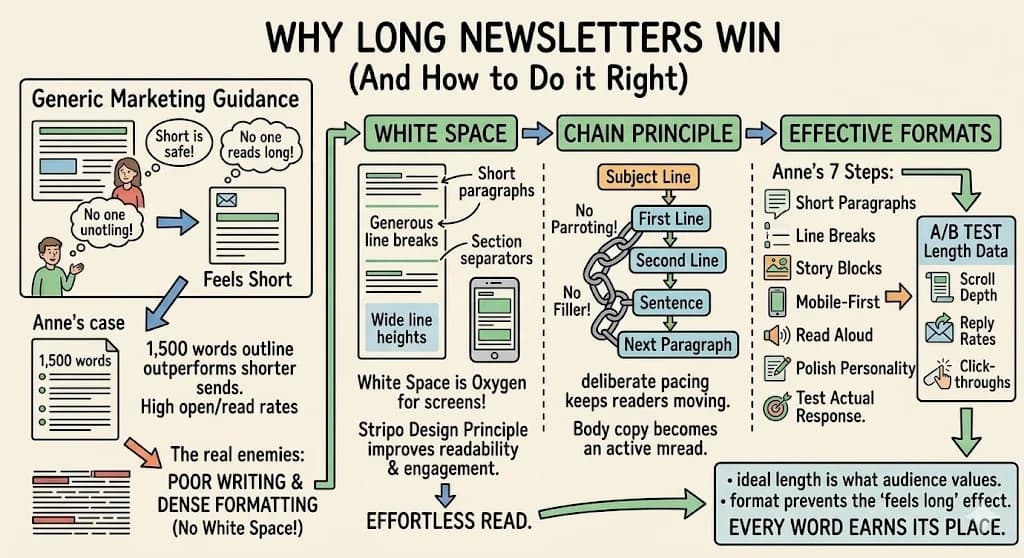
Anne's e-newsletter runs approximately 1,500 words, far beyond what most email marketing guides recommend. Yet her open rates and read-through rates outperform shorter sends. Her secret? Structure.
 By using frequent line breaks, generous white space, and intentional formatting, she makes 1,500 words feel effortless. White space is oxygen on a screen. It creates momentum, invites the eye forward, and removes the psychological weight of a dense inbox message. Email design specialists at Stripo explicitly treat white space as a design principle that improves readability and can lift engagement. A poorly formatted 300-word email can genuinely feel heavier than a beautifully structured 1,500-word newsletter.
There's also a practical consideration worth knowing: Gmail clips emails that exceed certain file size thresholds. So if you're going long, keep your HTML lean and your formatting clean. A technically long email that gets truncated before the footer defeats the whole purpose.
The Chain Principle: How to Create an Email That Pulls Readers Through
 Anne applies one powerful rule to every newsletter she writes: each element must earn the next.
- The subject line earns the open
- The first line earns the second
- Every sentence earns the paragraph that follows
This chain principle transforms body copy from a passive block of text into an active reading experience. If any sentence merely repeats what came before it, it gets cut. No parroting. No filler. Every word pulls its weight.
This isn't just a philosophy, it's a copywriting discipline layered on top of a layout strategy. Newsletter design guidance consistently points to strong openings, clear sectioning, and deliberate pacing as the mechanics that keep readers moving through longer content. The chain principle is what makes all of that work together.
This approach answers a question a lot of content creators wrestle with: what is the ideal length of an email newsletter? The honest answer is, long enough to deliver real value, short enough in feel to maintain momentum.
Newsletter Formats That Work: Structure Over Word Count
 Forget rigid rules like the 60/40 rule or the 30/30/50 rule. What matters most is whether your newsletter format serves your reader. Beefree's guidance on text-heavy emails is particularly useful here, specifically recommending padding, controlled max width, section breaks, and line height as the tools that make dense copy readable rather than overwhelming.
Here's how to apply Anne's framework to your own newsletter:
- Use short paragraphs -- two to three sentences maximum
- Add line breaks generously -- treat every paragraph like a breath
- Break longer content into story blocks -- use subheads or visual separators so readers experience multiple small wins rather than one long scroll
- Use a single-column, mobile-first layout -- multi-column designs are harder to read on phones, and most of your subscribers are reading on one
- Read your draft aloud -- where you stumble, your subscriber will too
- Polish for personality -- add humor and distinctive word choices in a final pass
- Test longer formats -- don't default to concise without testing actual audience response
Tools like Mailchimp make it straightforward to A/B test newsletter length, so let your data guide format decisions rather than assumptions. Scroll depth, reply rates, and click-throughs will tell you far more than any generic best-practice guide.
Stop Defaulting to Short -- Test What Your Audience Actually Wants
 You've probably heard the stat that people spend just 51 seconds, on average, with an email newsletter after opening it. That number gets used as evidence that short is always better. But it's worth asking what those 51 seconds look like in a well-structured, white-space-forward newsletter versus a dense wall of text. The experience is completely different.
Mailchimp's long-form content guidance frames engagement as a function of structure and pacing rather than length alone. That aligns directly with what Anne found in practice. The format is what makes length a non-issue.
The ideal length for your email newsletter isn't determined by generic email marketing advice. It's determined by your specific audience and the value you consistently deliver to them. A narrow width, short paragraphs, and deliberate spacing all work together to prevent the "feels long" effect that actually drives subscribers away.
If your body copy earns attention line by line, your subscriber will follow you all the way to the footer, no matter how long the journey is.
Break the convention. Write the longer newsletter. Just make every word earn its place.
Read more about Becoming a Content Creator
📚 Complete Guides
- How to Become a Content Creator: Complete Beginner's Guide
- Content Creator Platform Guide: Choose the Right Platform to Start Your Creator Journey
⚡ Tactics & Strategies
- 50% Retention Rate Optimization for YouTube Algorithm Success
- Age Bracket as Superpower Strategy for Older UGC Creators
- AI Workflow Integration for Content Reduction
- Audience Consistency Strategy to Avoid Algorithm Penalties
- Audience Poll on Instagram to Source Q&A Content in Advance of Recording
📄 Related Articles
- Newsletter Sponsorship: Design Sections Sponsors Want
- How to Create a Lead Magnet That Converts: The Research Report Playbook
- How to Train ChatGPT on Your Brand Voice
- Google Alerts Marketing: How to Land High-Profile Guests with Strategic Timing
- How to Use the Instagram Question Sticker to Source Podcast Questions
- Influencer Ads: Turn Organic Content Into Winning Ads
- Facebook Group Research: How to Use Social Media Comment Sections to Uncover Content Gold
- How to Get More Reach on Instagram: The Email List Timing Trick
Read more about Monetization & Business Models for Content Creators
📚 Complete Guides
- Content Creator Monetization: Proven Revenue Streams
- Content Creator Income Streams: 7 Ways to Build Financial Stability
⚡ Tactics & Strategies
- 30 Daily Outbound Pitches for UGC Deal Generation
- Affiliate Code Negotiation Using Membership Audience Influence
- Age Bracket as Superpower Strategy for Older UGC Creators
- B2B Merchandise Bulk Sales to Industry Professionals- Packaging Products as Client Gifts for Lawyers and Service Providers
- Becoming Your Own Sponsor by Plugging Your Offer Within Episodes
🧮 Calculators
Read more about Systems, Workflows & Operations for Content Creators

Alex Kirillov
Details
One link. Every channel, rate, and piece of work brands need to evaluate you. Built for how creators actually get hired.
Claim your profile
Live creator, content, and marketing roles from real companies, with the pay, market, and context the raw job page never gives you.
Browse jobs