Podcast Formats: Solo vs Interview (and How to Choose)
Should you do solo or interview podcast episodes? Learn how to use both formats strategically to build authority, grow your audience, and convert listeners into clients.
Details
The Most Common Podcast Formats
Before you choose, it helps to know the full range of formats used in podcasting. The most common types of podcasts are:
- Solo (monologue): one host speaking directly to the listener.
- Interview: a host and a guest in conversation, the classic podcast format.
- Co-hosted (conversational): two or more hosts riffing together.
- Panel or roundtable: a host plus several guests discussing a topic.
- Narrative or storytelling: scripted, produced shows, the format behind true crime, documentary, and audio drama podcasts.
- Q&A: episodes built around listener questions.
Most creators mix a few of these, but the two formats that decide a show's growth and authority are solo and interview episodes, so this guide focuses there.
Solo vs. Interview: The Two Formats That Decide Your Growth
Every podcaster faces the same strategic question: What kind of episodes should you be creating? The answer isn't one or the other. It's both, used intentionally. Understanding the difference between interview podcasts and solo podcasts is one of the most powerful frameworks you can apply to your show's growth strategy.
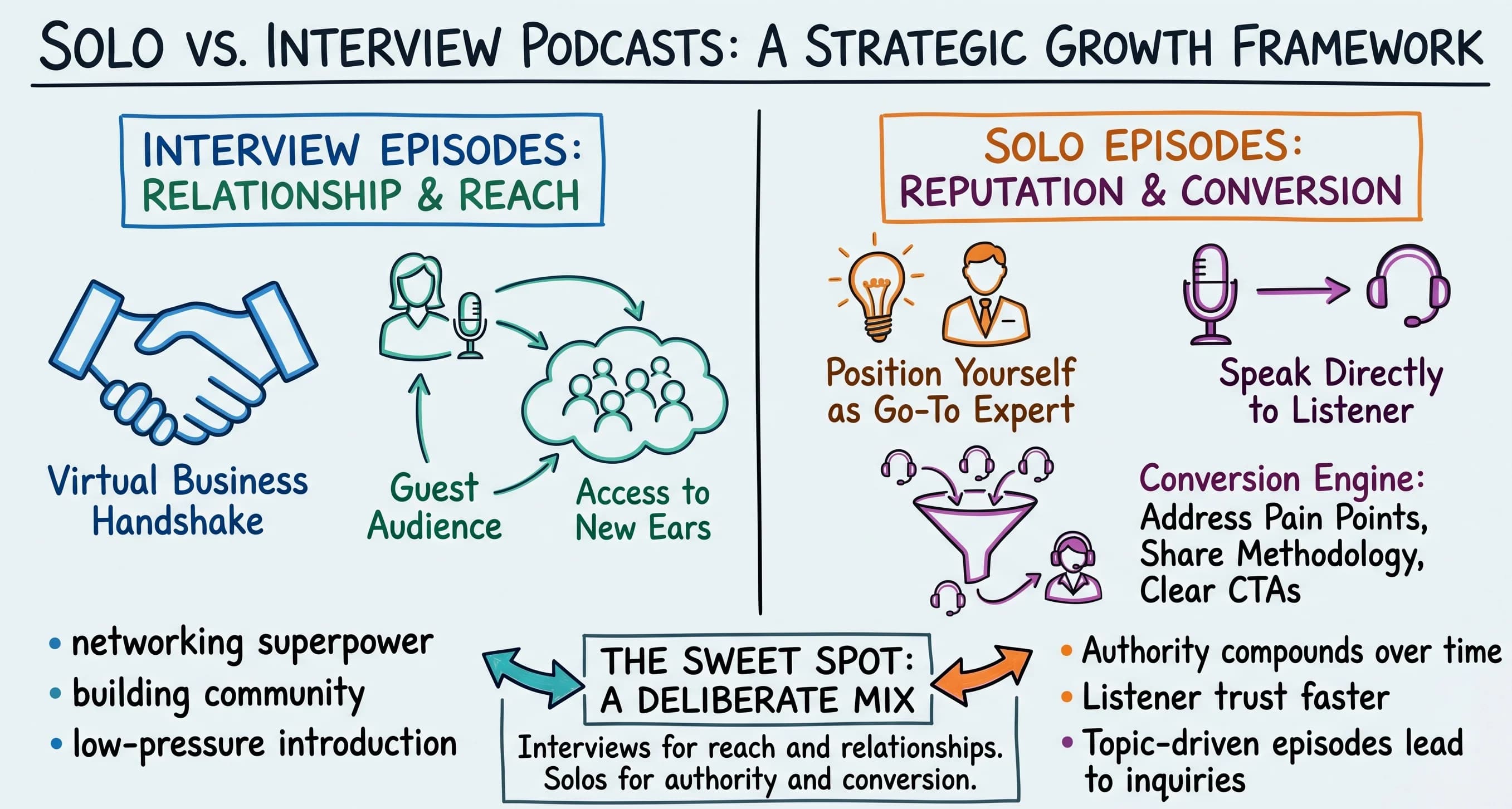
Interview Episodes: Your Best Virtual Business Handshake
 Think of the interview format as your networking superpower. Every time you invite a guest onto your podcast, you're doing more than recording a conversation. You're building a relationship. Interview episodes serve as a virtual business handshake, giving you direct access to influential voices and expanding your professional ecosystem.
For new podcasters especially, the guest episode is a low-pressure way to connect with people you genuinely admire or want in your circle. The mic becomes your introduction. Your guest benefits from a marketing platform, but you gain something equally valuable: a meaningful relationship and exposure to an overlapping audience.
Podcast coaches and experienced creators consistently describe interviews as ideal for networking, building community, and accessing other people's audiences. Having other thought leaders and industry insiders on your show can be genuinely good for business, not just in theory, but in practice.
Strategically, interview podcasts fuel audience growth by tapping into your guest's existing listener base. When guests share the episode, your show reaches new ears organically. This is exactly why choosing the right podcast format for each goal matters so much.
Solo Episodes: Where You Build Authority and Convert Listeners
 If interview episodes build relationships, solo podcasts build reputation. Say that again: interviews build relationships, solo episodes build reputation. A solo episode positions you as the go-to expert in your space. When you speak directly to your listener without a guest, you demonstrate depth of knowledge, share your unique perspective, and naturally position your offer.
Podcast coach Tim Wohlberg of Podcast Performance Coach puts it plainly: solo podcasts are one of the most effective ways to establish yourself as the go-to expert in your space because the listener feels like you're speaking directly to them. That directness builds trust faster than almost anything else.
For podcasters focused on conversion, turning listeners into clients, the solo podcast format isn't optional. Topic-driven solo episodes let you address your audience's pain points head-on, walk them through your methodology, and clearly articulate how they can work with you. This is where authority compounds over time.
Tom and Tracy Hazzard, who've studied this across hundreds of shows, found that topic-driven solo episodes are frequently the ones that lead directly to client inquiries. Solo episodes are your conversion engine. Weave in clear calls to action that feel natural, not salesy, and you've got content that works long after it publishes.
Real Creators Who've Applied This Strategy
This isn't just theory. Individual podcasters have documented exactly how this plays out.
Business coach Tara Reid made a deliberate shift with her own show. She started out guest-heavy, then intentionally flipped her approach, making solo episodes the foundation and guest episodes the strategic add-ons she sprinkles in. Her reasoning was straightforward: solo episodes gave her the space to share personal stories, teach her own frameworks, and build a deeper connection with listeners. Guest episodes added variety and reach, but she stopped letting them fill her entire schedule by default.
Her format breakdown is practical and replicable: solo episodes run 5 to 15 minutes, short and actionable. Guest episodes run around 30 minutes for more depth. That structure keeps her voice front and center while still benefiting from guests' reach.
Tom and Tracy Hazzard describe a staged approach that a lot of successful podcasters land on naturally. In the early episodes of a show, going guest-heavy makes sense. You're growing visibility, building social proof, and tapping into established audiences. After roughly 50 episodes, the shift toward more solo and topic-driven content tends to correlate with deeper listener connection and, crucially, more client conversations.
Their suggested mix for a mature show running on both tracks: four topic-driven solo episodes plus four guest episodes per month. That ratio keeps growth happening while ensuring you're producing the kind of content that actually leads to clients.
Finding the Balance Between Solo and Guest Episodes
 The sweet spot is a deliberate mix of both podcast formats. Here's how to apply this framework in a way that actually works for your show:
- Use interview episodes to connect with guests already inside your target ecosystem whose audience overlaps with yours. Think of it as relationship capital you're building with every recording.
- Use solo podcasts to demonstrate expertise, speak directly to listener challenges, and position your services. Don't just share information; share your opinion and your frameworks.
- Rotate formats intentionally. Interviews for reach and relationships, solos for authority and conversion.
- In every solo episode, include a clear next step for listeners who want to go deeper with you. A strategy call, a program, an email list, whatever fits your business.
- Watch your data. Engagement and downloads across different episode types will show you what's resonating and what's driving actual results.
One insight worth noting: listeners don't want you to be a conduit to the guest. They want to know what you think. Solo episodes are where you stop deferring to others and start owning your point of view. That's what builds the kind of trust that converts.
Choosing the Right Podcast Format for Your Goals
Whether you're launching your first podcast episode or optimizing an established show, the format question is really a strategy question. Interview guests expand your world. Solo episodes deepen your credibility.
If you're in the early stages, lean into interviews. Build your network, grow your reach, and let your guest relationships open doors. As your show matures and your focus shifts toward authority and client conversion, let solo episodes take more space in your content calendar.
The most successful podcasters don't choose one format. They use both with purpose. Start by auditing your current episode mix and ask yourself honestly: am I building enough relationships and enough reputation? That balance is where podcast growth truly accelerates.
Read more about Becoming a Content Creator
📚 Complete Guides
- How to Become a Content Creator: Complete Beginner's Guide
- Content Creator Platform Guide: Choose the Right Platform to Start Your Creator Journey
⚡ Tactics & Strategies
- 50% Retention Rate Optimization for YouTube Algorithm Success
- Age Bracket as Superpower Strategy for Older UGC Creators
- AI Workflow Integration for Content Reduction
- Audience Consistency Strategy to Avoid Algorithm Penalties
- Audience Poll on Instagram to Source Q&A Content in Advance of Recording
📄 Related Articles
- Swipe File: How to Build One With Gmail Labels
- The LinkedIn Hook: Templates and Types to Stop the Scroll
- The P2P Revolution: How Peer to Peer Community Building Is Transforming Influencer Marketing Strategies
- Personal Brand Values: How to Define Them and Filter Every Post
- Influencer Contract Template: What to Include (and Why)
- Voice of the Customer: A Creator's Guide to Magnetic Messaging
- Content Creator Burnout: Signs, Prevention, and the Mindset That Fixes It
- Influencer Authenticity: How Honest Product Reviews Drive Real Influence
Read more about Systems, Workflows & Operations for Content Creators

Alex Kirillov
Details
One link. Every channel, rate, and piece of work brands need to evaluate you. Built for how creators actually get hired.
Claim your profile
Live creator, content, and marketing roles from real companies, with the pay, market, and context the raw job page never gives you.
Browse jobs