
Founder-Led Marketing: How to Scale It Past 7 Figures
Stuck at one face, one voice, one founder? Learn the multi-evangelist brand strategy that scales content creator brands past 7 figures on Instagram and podcasts.
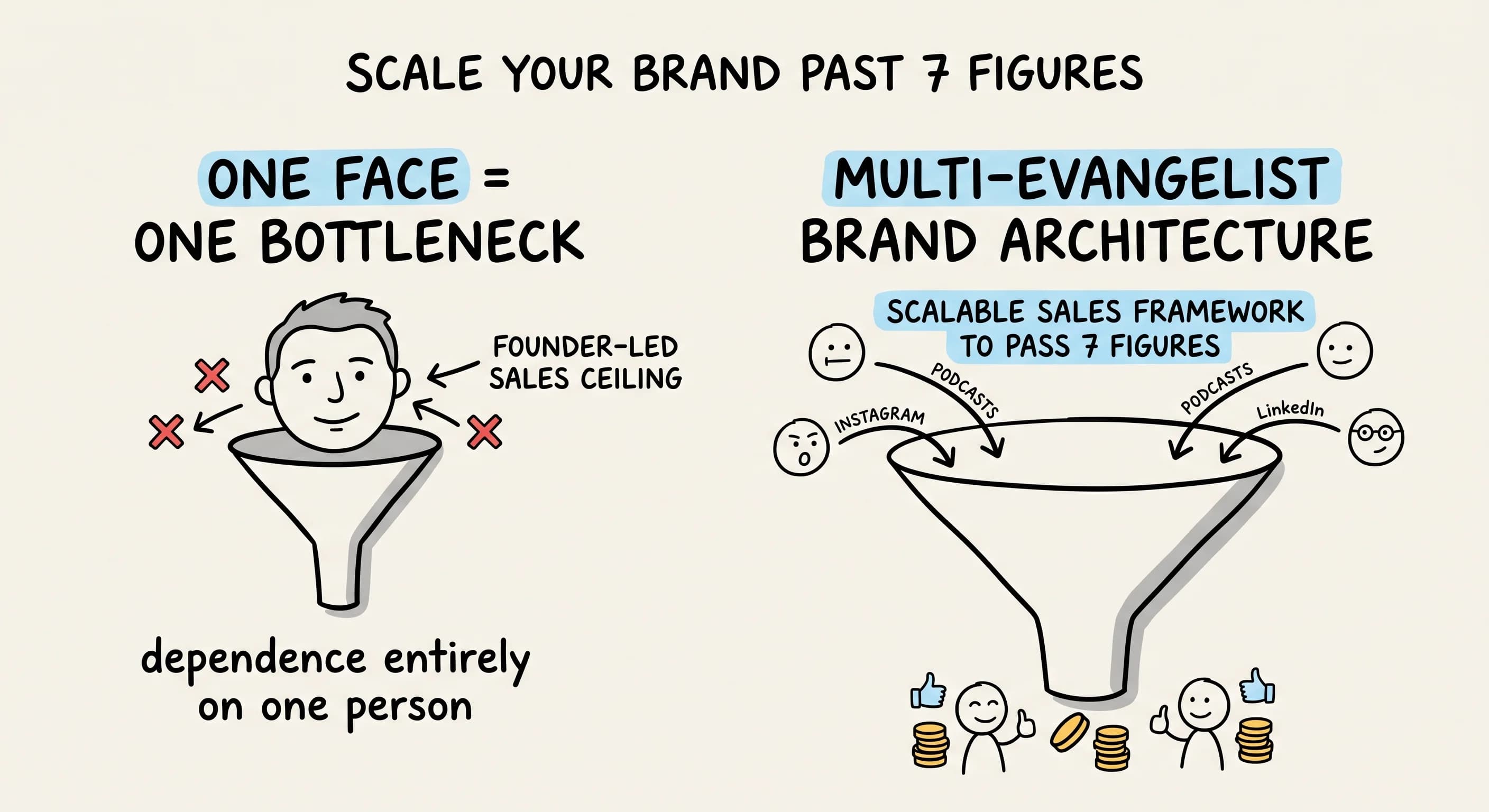
Founder-led marketing is the practice of putting the founder's own voice, face, and point of view at the center of how a company grows. Instead of a faceless brand pushing polished ads, the founder shares insights, opinions, and behind-the-scenes lessons directly with an audience. And honestly, it works: people trust people, so founder-led marketing builds trust faster than any logo can.
Most founders start here for a reason. A founder posting on LinkedIn, building in public, and showing up as a thought leader is the cheapest, highest-trust marketing a young company has. But there's a catch. If every bit of that trust lives inside one person's personal brand, the same founder-led marketing that got you off the ground quietly becomes your biggest bottleneck the moment you try to scale past 7 figures.
This guide covers both halves of the story: why founder-led marketing works so well, and how to scale it beyond a single founder using a multi-evangelist brand architecture. It's one of the most powerful scalable frameworks available to founders and content creators building on LinkedIn, Instagram, and podcasts today.
Why Founder-Led Marketing Works
The whole premise of founder-led marketing rests on one truth: people buy from people, not from faceless brands. A founder's personal brand carries an authenticity a corporate account can't fake, and that authenticity is exactly what builds trust with a skeptical audience.
This matters more now than ever. In an era where AI can generate an endless stream of generic, faceless content, audiences are tuning that AI content out. A real founder sharing a real opinion is the one thing AI can't replicate at scale, which is why founder-led content stands out precisely when everyone else sounds the same. The more AI-generated noise fills the feed, the more a genuine founder voice cuts through it.
That's why founder-led marketing has become a default play for B2B and SaaS startups. The founder shows up on LinkedIn, shares hard-won insights, builds in public, and becomes a recognized thought leader in the category. Each LinkedIn post, each podcast appearance, each build-in-public update compounds into a personal brand that makes the whole company more credible. Done consistently, founder-led content strategies turn one person's expertise into the company's biggest marketing asset.
Growth Beyond the Founder: How Do I Scale ME?
 CEOs and founding operators ask this exact question. The answer starts with recognizing that founder-led sales and marketing systems that depend entirely on one person create a ceiling. Growth requires distributing both your voice and your customer acquisition efforts across a team of evangelists.
Think about your best clients. What problem does each segment need to solve? What unique perspective can you offer based on your experience? Use those answers to build a go-to-market strategy and systematic brand positioning that doesn't live inside one person's head.
Your instinct is to stay central. But that creates key-man risk. A multi-evangelist model solves this by building systems that carry brand equity across multiple characters, each authentic to a distinct audience. The question then becomes: where must you make changes to create increasing and predictable profits within your business?
Why Founder-Led Marketing Alone Doesn't Scale
The limit of founder-led marketing isn't the idea, it's the single point of failure. When all the trust routes through one personal brand, the founder becomes the ceiling, the bottleneck, and the key-man risk all at once. The fix isn't to abandon founder-led marketing; it's to multiply it.
Think about ESPN. Their strategy doesn't hinge on one face. Stephen A. Smith owns one audience segment. Pat McAfee commands another. Each evangelist builds their own following while remaining connected to the umbrella brand. That's scalable brand marketing in action.
Look at what Barstool Sports built. Dave Portnoy is visible, but he's not the only face. When one personality hits turbulence, the brand keeps moving because the equity is distributed. That's the organizational insight most operators miss.
A Step-by-Step Guide to Evangelist Brand Architecture
 This isn't about hiring influencers randomly. It's a deliberate, strategic approach rooted in processes that successful media brands use to grow. Here's how to implement it.
1. Map your audience segments first. Before you hire or partner with anyone, identify the distinct groups within your broader audience. A B2B service business might serve entry-level operators, scaling businesses, and enterprise clients. Three segments, three different messages, three different evangelists. Understand their problems before you assign a voice to each one.
2. Find or develop your evangelists. These can be employees, partners, or aligned creators. Each person should authentically speak to one segment. Give them a consistent format within your content ecosystem. Morning Brew did this by building verticals like Marketing Brew, each fronted by writers who became the face for a specific audience. Readers started following specific bylines. That's the dynamic you're building toward.
3. Position each character deliberately. Your message should evolve per evangelist. One character's LinkedIn presence might speak to early-stage operators. Another's podcast segment might target established high-value B2B clients. The brand umbrella holds them together while each builds a niche following. HubSpot's podcast network is a strong example, with multiple hosts acting as micro-evangelists while HubSpot stays present in naming and cross-promotion throughout.
4. Let the founder step into key moments. You don't disappear, and your founder-led marketing doesn't stop. You become the voice for the brand's biggest ideas: the founder still posts on LinkedIn, still builds in public, still shows up as the thought leader for launches and category-defining moments. Day-to-day, your evangelists carry the message forward and expand your reach organically, while the founder's personal brand anchors the whole system.
Are More Prospects Booking Calls But Fewer Converting?
If you're seeing more calls booked but your conversion rate is dropping, that's a signal worth examining. It often means your messaging has drifted from your actual service offerings or your pricing no longer matches how ideal customers perceive your value. A referral program can stabilize this by bringing in warmer leads who are ready to buy and already understand your offer.
A key performance indicator to track here is the ratio of booked calls to closed deals. Lowering customer acquisition costs while improving that conversion number is how you drive predictable revenue growth without increasing your outreach volume. Refine your intake process, align your content with your core offer, and use case studies to build trust before the call even starts. Ask yourself honestly: do I have a repeatable sales process, or am I reinventing the wheel each time?
Building Systems for Scalable Growth
 Building a system that works is what separates a brand that scales from one that stalls. Founder-led content, thought leadership on LinkedIn, a strong referral network, and consistent outreach working together create an engine that doesn't depend on any one person's energy. In a market flooded with AI-generated posts, this network of authentic human voices is what keeps a company recognizable, and it ensures momentum is maintained even as the company grows beyond the founder.
What industry trends are you seeing? Which formats drive the most engagement? What elements are worth keeping because they carry brand recognition? Does the current brand accurately reflect the company's positioning today? These questions help you refine your content strategy over time rather than rebuilding from scratch.
A practical optimization tactic is to repurpose your best-performing content across formats. Upload original content to your podcast, then post clips to Instagram, and initiate a newsletter digest that means building a second touchpoint with subscribers who prefer email. Your CRM can track which format brings in leads who are closest to a decision. This approach also helps you establish clear roles for each evangelist across channels.
A founder's best move is to run a content pod experiment. Spin up a focused effort around one audience segment, pair one strategist with one or two potential evangelists, and run four to six episodes or posts before making big decisions. Low risk, real data. Think about what comes next before you scale the pod further.
Scaling founder-led marketing beyond the single founder means building something bigger than any one person. It means investing in people, processes, and brand positioning that produce increasing and predictable profits per month and beyond. For a business targeting $1M and above, that distribution of voice is not optional. Keep the founder's personal brand doing what it does best, then start with one additional evangelist mapped to your most underserved audience segment. Build the character, not just the content schedule. That's how you turn founder-led marketing into something that lasts longer than the founder's own calendar.
Read more about Becoming a Content Creator
📚 Complete Guides
- How to Become a Content Creator: Complete Beginner's Guide
- Content Creator Platform Guide: Choose the Right Platform to Start Your Creator Journey
⚡ Tactics & Strategies
- 50% Retention Rate Optimization for YouTube Algorithm Success
- Age Bracket as Superpower Strategy for Older UGC Creators
- AI Workflow Integration for Content Reduction
- Audience Consistency Strategy to Avoid Algorithm Penalties
- Audience Poll on Instagram to Source Q&A Content in Advance of Recording
📄 Related Articles
- Content Repurposing: Turn One Post Into Many (and ROI)
- How to Reach a Wider Audience: The NAPs Strategy for Niche Creators
- How to Come Up With Content Ideas (and Never Run Out)
- Newsletter Best Practices: Treat It Like a Product
- Psychographic Segmentation: A Data-Driven Guide for Newsletters
- Podcast Promotion: Grow Your Show With Swap Deals
- Brand Partnerships: How Creators Win Them and Keep Them
- Social Media Competitor Analysis: How to Decode Their Strategy
Read more about Audience Building & Growth for Content Creators
📚 Complete Guides
- How to Build an Audience as a Content Creator
- How to Find Your Target Audience (Start With One Person)
⚡ Tactics & Strategies
- 30 Daily Outbound Pitches for UGC Deal Generation
- 50% Retention Rate Optimization for YouTube Algorithm Success
- Age Bracket as Superpower Strategy for Older UGC Creators
- Audience Consistency Strategy to Avoid Algorithm Penalties
- Audience Psychology Over Algorithm Optimization, Focusing on Human Pain Points and Goals Instead of Platform Tactics

Alex Kirillov
One link. Every channel, rate, and piece of work brands need to evaluate you. Built for how creators actually get hired.
Claim your profile
Live creator, content, and marketing roles from real companies, with the pay, market, and context the raw job page never gives you.
Browse jobs