Newsletter Best Practices: Treat It Like a Product
Stop treating your email newsletter like a broadcast channel. Learn the product mindset that builds loyal subscribers, improves retention, and grows your email list organically.
Details
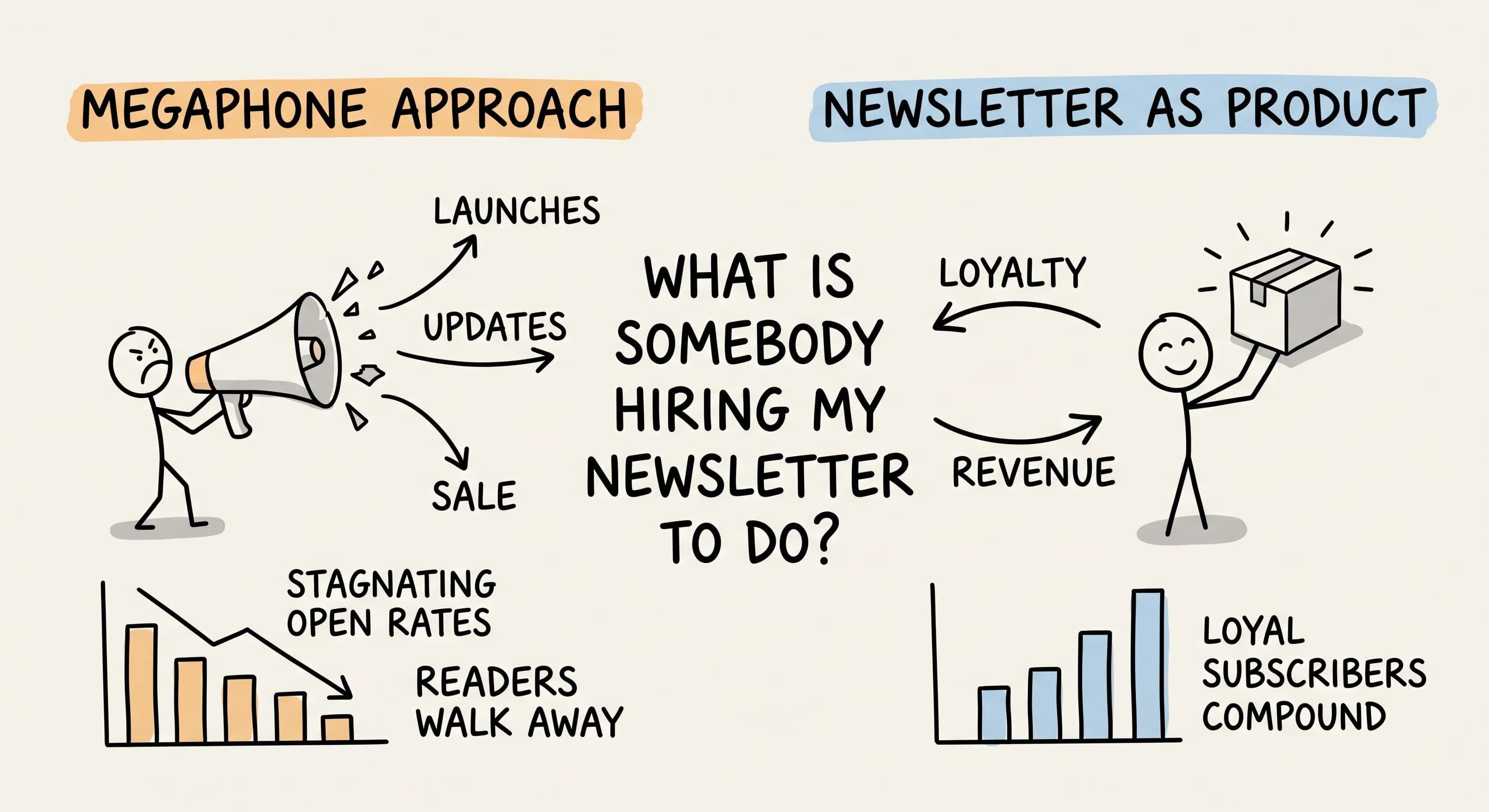
Most content creators treat their email newsletter like a megaphone, a place to announce launches, share updates, and nudge readers toward a sale. But that approach is exactly why open rates stagnate and readers walk away without a second thought. There is a better framework, and it starts with one powerful question: What is somebody hiring my newsletter to do?
Before diving into tactics, you must answer one critical question: what is the primary financial goal of this newsletter? Is the mission to keep current customers coming back, improve customer retention, or drive direct revenue? Are you ready to elevate your email marketing game and turn a simple update into your most powerful revenue driver? Defining that goal first shapes every decision that follows. A truly great newsletter is not built on clever writing alone; it is built on a clear purpose that guides subscribers from the moment they sign up.
What Is Email Marketing and Why Does It Matter for Newsletter Creators
Email marketing is the practice of sending targeted messages directly to a list of people you have permission to contact. Unlike social media posts that surface algorithmically, a newsletter lands in a space the reader controls. That directness is why email marketing consistently outperforms other channels for engagement and revenue, and why understanding how it works is foundational before anything else.
When newsletter readers opt in, they are choosing to hear from you specifically. Subscribers who have opted in this way are genuinely interested in what you have to say, not passive scrollers. That distinction matters enormously when you are trying to build trust and keep your list healthy over the long term.
The average open rate for email newsletters sits between 20% and 40% depending on industry and list quality, far above what most social media posts achieve. That performance gap is why so many creators ask: do email newsletters really help increase sales? The short answer is yes, when the newsletter has a clear job to do. Monitoring the performance of your email campaigns over time is the only reliable way to know whether that job is being done well.
Ready for more great email content? The sections below walk through every layer of strategy, from defining purpose to growing your audience and protecting long-term retention.
Treat Your Newsletter Like a Product, Not a Marketing Tool
 Every newsletter has a job. Think of it the way consumers think about products. You hire a product because it solves a specific problem or scratches a persistent itch. If your newsletter does not have a clear purpose baked into each issue, new readers will open once, shrug, and disappear forever.
This mindset shift separates thriving newsletters from ones that flatline. When you treat each issue as a product delivery, something your readers derive valuable insights from, you stop being just another marketer in their inbox and start becoming a trusted resource they actively protect from the unsubscribe button.
Nicolas Cole, who has built multiple paid newsletters into full-time income streams, puts it directly: 80% of launching a newsletter is offer creation. Not the writing. Not the subject line. The offer itself, meaning the specific, tangible job your newsletter does for a specific reader. If you cannot name an objective outcome readers get from each issue, the newsletter will underperform no matter how strong your writing is.
How do you create a newsletter that not only captures attention but also effectively supports your business goals? It starts by deciding what problem you solve before you write a single word. That decision is the heart of your newsletter, and everything else grows from it.
How to Define Your Newsletter's Job-to-Be-Done
Ask the Hard Question First
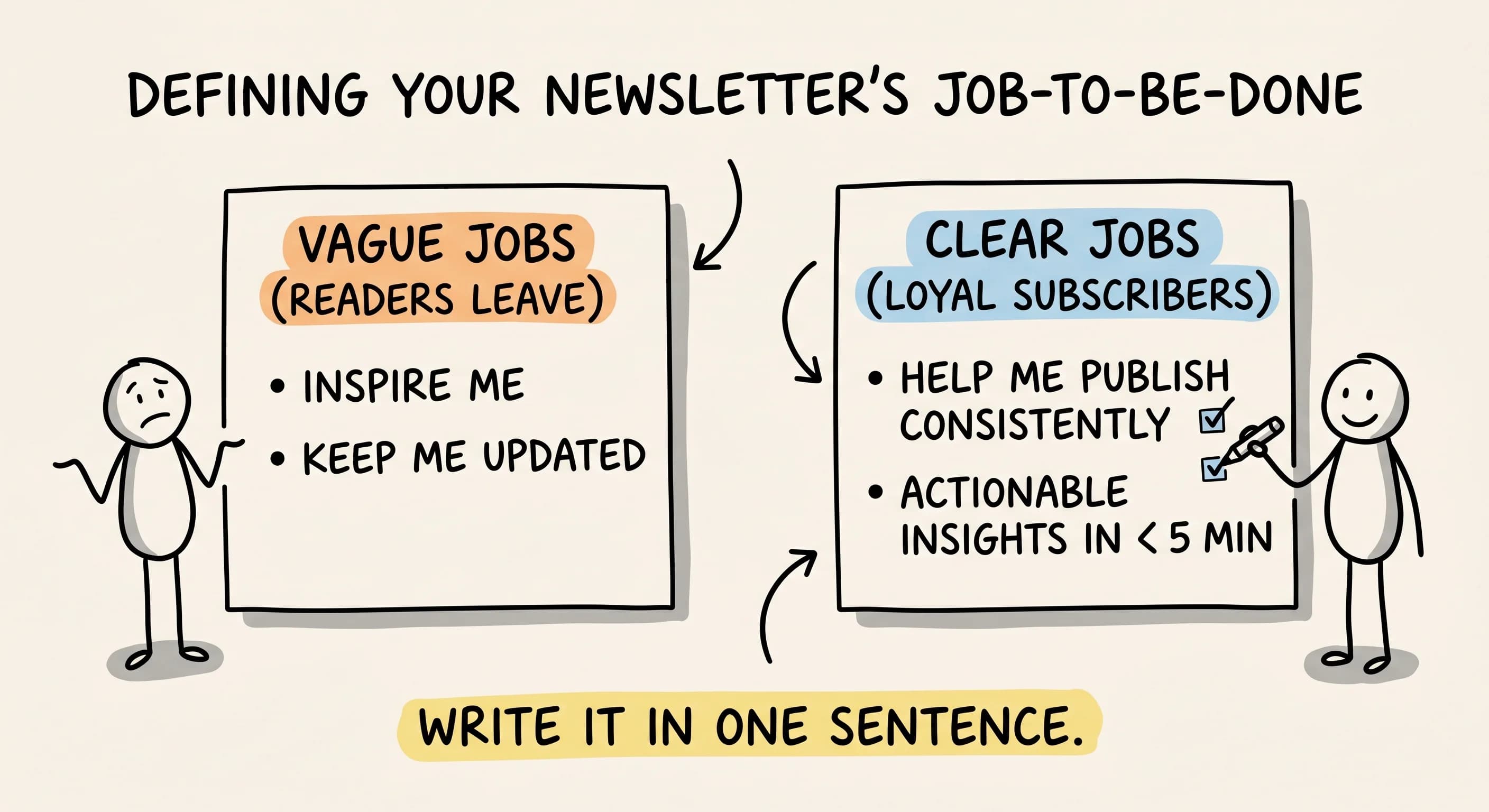
Before you optimize your subject line, tweak your conversion rates, or plan your next email campaign, get brutally honest: why does your newsletter exist? What specific problem does it solve? Loyal subscribers do not stick around for vague inspiration. They stay because your newsletter content reliably delivers something they cannot easily get elsewhere.
Write your answer in one sentence. If you cannot, your newsletter strategy needs reframing before anything else. A useful test: can you imagine 50 different issues all clearly doing the same job in slightly different ways? If not, your job definition is either too narrow or too fuzzy.
The clearest jobs tend to sound like this: "Help me publish consistently using a repeatable system" or "Give me actionable insights on a niche topic in under five minutes." Vague versions sound like "inspire me" or "keep me updated." Readers do not stay for vague. They stay for content that solves a problem and delivers insights they can act on immediately.
Keep it simple: what challenge did your reader face, and how did your product or service help them overcome it? That framing also doubles as a template for case study content inside your newsletter.
Align Every Issue With That Purpose
Once you define the job, every send must deliver on it. Think of each email send as a product release. Good newsletter ideas come from deeply understanding what makes subscribers feel heard, helped, or ahead of the curve. Whether you give them curated insights, tactical how-tos, or early access to ideas still forming, consistency with purpose is what allows you to build trust over time.
The 3/2/1 newsletter format works precisely because its structure signals a clear promise readers can count on. That predictability is a product feature, not just an aesthetic choice.
Newsletter advisor Dan Oshinsky of Inbox Collective recommends a straightforward approach if you are unsure what your job actually is: email ten of your current readers and ask what they love about receiving it. If several say the same thing, that is your job. That is what they hired you to do. Build everything around it.
How to Get People to Subscribe to Your Newsletter
 How can you get people to sign up for your newsletter? Make the job your newsletter does undeniably obvious on your sign-up page. State the problem you solve. Show social proof from readers who found that solution. This is one of the most effective ways to attract potential subscribers without paid acquisition.
Readers need to see a clear reason to sign up before they hand over their email addresses. Make it easy by reducing friction: one field, one button, one clear promise about what they will receive and how often. For instance, a subject line like "Writing Emails? Here is what actually gets them opened" on a sample issue previewed on your sign-up page can dramatically lift conversions.
One practical addition: treat your sign-up page like a product landing page, not a form. List what readers walk away with after each issue. Use language that anchors value to something concrete: time saved, a skill sharpened, a decision made easier. That is what turns a passive opt-in into an engaged subscriber from day one.
Offering a free newsletter preview issue also helps. Let potential readers see the format and depth upfront. When they can evaluate your newsletter before committing, they are far more likely to become active subscribers over the long term. Encourage readers to share each issue with a colleague using a short referral nudge at the bottom, and use your existing subscribers to attract new ones without spending anything on advertising.
What Kind of Newsletter Content Encourages Subscribers to Stay
To keep subscribers engaged, your content must consistently resonate with the people reading it. What makes a good newsletter is not production value or length. It is relevance. Each issue should feel like it was written specifically for the person opening it.
Valuable content takes many forms: a curated roundup that saves readers hours of research, a behind-the-scenes perspective from your CEO or leadership team that shares a unique point of view, or a quick tutorial that sharpens a skill. Does your CEO or CMO have a unique perspective that is perfect to share with your newsletter list? That kind of voice-driven content makes your entire newsletter feel distinct in a crowded inbox.
To make subscribers feel like insiders, offer exclusive content unavailable anywhere else. That might be early data, a private community link, or a thought piece still forming. When you offer exclusive content tied to a genuine insight, you make your newsletter worth protecting.
Want to boost engagement further? Include a direct question at the end of each issue and encourage subscribers to reply. Replies signal to inbox providers that your newsletter is wanted, which helps deliverability. They also tell you, with specificity, what resonates best with your audience. Never overwhelm readers with too many calls to action in a single issue; one clear prompt performs better than three competing ones.
How to Grow and Protect Your Email List
Growing your newsletter audience is not just about gathering email addresses. It is about acquiring the right readers. A list of 500 engaged newsletter subscribers will outperform a list of 5,000 who barely open your emails. Quality compounds faster than quantity.
To keep your email marketing feeling like a natural continuation of a relationship rather than a broadcast, build a short welcome sequence that sets expectations. Guide new subscribers by telling them what the newsletter covers, how often they will receive it, and what resource or exclusive offer they get for joining. That sequence does more to keep open rates healthy than almost any other single tactic.
Encourage subscribers to forward issues to one person they think would benefit. Word-of-mouth referrals bring in readers who are already pre-sold on your job-to-be-done because a trusted contact vouched for it. Sharing your newsletter this way costs nothing and consistently brings in readers who match your target audience.
Do not overlook re-engagement. What do you do about all the inactive readers on your list? Send a dedicated re-engagement campaign. Ask whether they still want to receive your upcoming newsletter and give them a simple way to confirm. This keeps your list clean and your open rate healthy. If you want loyal subscribers who are genuinely interested, a smaller, cleaner list always wins.
How Often Should You Send Your Newsletter
How often should you send email newsletters? The honest answer is: as often as you can deliver on your job-to-be-done without letting quality slip. For most solo creators, that means weekly or bi-weekly. How often will you send your newsletter, and how feasible is it to maintain this schedule over months and years? Consistency matters more than frequency. A reliable fortnightly issue builds more trust than an erratic weekly one.
When is the best time to send your newsletter? Testing matters here. The time that performs well for one list may be different for another. Run a simple split test across two send times over four issues and let your own data decide. Keep your email send schedule consistent once you find what works, because readers rely on that rhythm.
Optimize Around Retention, Not Just Reach
 Open rate matters, but retention tells the real story. Content that consistently fulfills its hired job creates compounding loyalty. Subscribers who love what they receive refer others organically, growing your newsletter without paid campaigns.
Dan Oshinsky's benchmark for a healthy newsletter is an unsubscribe rate below 0.25% per send. If you are above that, the newsletter probably is not consistently fulfilling its job. That is not a deliverability problem or a subject line problem. It is a product-fit problem.
To keep your subscribers engaged and your newsletter performing well, think in seasons. After every 8 to 12 issues, review your metrics and any replies you have received. Ask whether each issue delivered on the job you defined. If something has shifted, your audience has evolved or you have noticed a pattern in what gets the most replies, adjust. Treat it like a product iteration, not a failure.
Make your message land by keeping it focused. A newsletter that drives real business results is one where every paragraph serves the reader's core need. Cut anything that does not serve that goal, no matter how interesting it seems in isolation.
Collect Feedback Like a Product Team
Collect product feedback, not just marketing metrics. Add a simple prompt at the end of your emails: "Was this useful? Reply and let me know what would make it more valuable." Those replies tell you more about newsletter health than your open rate ever will. A prompt like this also guides subscribers back into a conversation, reinforcing the relationship that makes your newsletter durable. This is one of the clearest ways to keep your subscribers happy and your content improving issue after issue.
If you want to monetize your newsletter, that feedback loop is even more important. Knowing exactly what readers value makes it easier to design an exclusive offer, a paid tier, or a sponsored placement that resonates with your audience rather than feeling intrusive. Make readers feel that any commercial element is a natural extension of the value they already receive.
Will you be launching a new newsletter to existing subscribers? Frame it as a natural evolution of what they already hired you to do, not as a separate product they need to be sold on. Keep your email consistent with the voice and promise that made them subscribe in the first place, and use your newsletter to strengthen the relationship rather than simply to sell.
Newsletter Best Practices That Boost Every Send
Once your newsletter has a clear job, these email newsletter best practices make each issue perform better:
- Write a subject line worth opening: keep it short, specific, and curiosity-driven. Your subject line and preview text decide your open rate before anyone reads a word.
- Use one clear CTA: give each newsletter a single call to action, one thing you want the reader to do, rather than five competing links.
- Design for mobile: most subscribers read on their phones, so use short paragraphs, a clean template, and alt text on every image.
- Send at a consistent time: pick a send time and stick to it so your newsletter becomes a habit.
- Segment your email list: send more relevant content by grouping subscribers by interest or behavior. Relevance is the best practice that protects your open rates.
- Make unsubscribing easy: a clean list of engaged readers beats a big, unresponsive one every time.
Follow these best practices on top of a strong product mindset and your newsletter does its job while looking effortless.
The One Thing That Makes a Newsletter Durable
Stop treating every email as a marketing touchpoint. The newsletters that compound over time, the ones that keep your audience coming back, grow through word of mouth, and eventually become real business assets, all share one thing: readers can feel exactly what they hired them to do, every single time subscribers open them.
A newsletter is not measured by list size alone. It is measured by how reliably it delivers on its promise and how consistently it makes readers glad they opened. Now that you are armed with newsletter best practices, what will you send next? Ready to supercharge your email content? Start by writing one sentence that defines the job your newsletter does. Every issue after that becomes easier.
Answer the job-to-be-done question clearly, deliver on it consistently, and your newsletter stops being something readers tolerate and starts being something they would genuinely miss.
Read more about Becoming a Content Creator
📚 Complete Guides
- How to Become a Content Creator: Complete Beginner's Guide
- Content Creator Platform Guide: Choose the Right Platform to Start Your Creator Journey
⚡ Tactics & Strategies
- 50% Retention Rate Optimization for YouTube Algorithm Success
- Age Bracket as Superpower Strategy for Older UGC Creators
- AI Workflow Integration for Content Reduction
- Audience Consistency Strategy to Avoid Algorithm Penalties
- Audience Poll on Instagram to Source Q&A Content in Advance of Recording
📄 Related Articles
- How to Sell Wholesale as a Content Creator
- How to Become a Successful Instagram Content Creator: Complete Growth Guide
- How to Become a YouTuber: A Comprehensive Guide for YouTube Creators
- Curated Newsletter: How to Make Yours Feel Prestigious
- Media Kit Examples: How to Create One That Lands Brand Deals
- Buyer Persona Examples (and How to Create One With AI)
- Blog Content Strategy: The Question-Based Method
- Viral Hooks: How to Write Openers That Get Millions of Views
Read more about Audience Building & Growth for Content Creators
📚 Complete Guides
- How to Build an Audience as a Content Creator
- How to Find Your Target Audience (Start With One Person)
⚡ Tactics & Strategies
- 30 Daily Outbound Pitches for UGC Deal Generation
- 50% Retention Rate Optimization for YouTube Algorithm Success
- Age Bracket as Superpower Strategy for Older UGC Creators
- Audience Consistency Strategy to Avoid Algorithm Penalties
- Audience Psychology Over Algorithm Optimization, Focusing on Human Pain Points and Goals Instead of Platform Tactics
Read more about Monetization & Business Models for Content Creators
📚 Complete Guides
- Content Creator Monetization: Proven Revenue Streams
- Content Creator Income Streams: 7 Ways to Build Financial Stability
⚡ Tactics & Strategies
- 30 Daily Outbound Pitches for UGC Deal Generation
- Affiliate Code Negotiation Using Membership Audience Influence
- Age Bracket as Superpower Strategy for Older UGC Creators
- B2B Merchandise Bulk Sales to Industry Professionals- Packaging Products as Client Gifts for Lawyers and Service Providers
- Becoming Your Own Sponsor by Plugging Your Offer Within Episodes
🧮 Calculators
Read more about Systems, Workflows & Operations for Content Creators

Alex Kirillov
Details
One link. Every channel, rate, and piece of work brands need to evaluate you. Built for how creators actually get hired.
Claim your profile
Live creator, content, and marketing roles from real companies, with the pay, market, and context the raw job page never gives you.
Browse jobs