How to Structure Your Business So It Doesnt Depend on You: The SCORE Framework
Learn how to structure your business so it doesnt depend on you using the SCORE framework covering strategy, culture, operations, structure, and efficiency.
Details
How to Structure Your Business So It Doesnt Depend on You: The SCORE Framework Every Entrepreneur Needs
Imagine stepping away from your business for a full week and coming back to find everything exactly as you left it. Revenue still coming in. Your team still executing. Operations still humming. For most entrepreneurs and content creators, that feels like a fantasy. But it does not have to be.
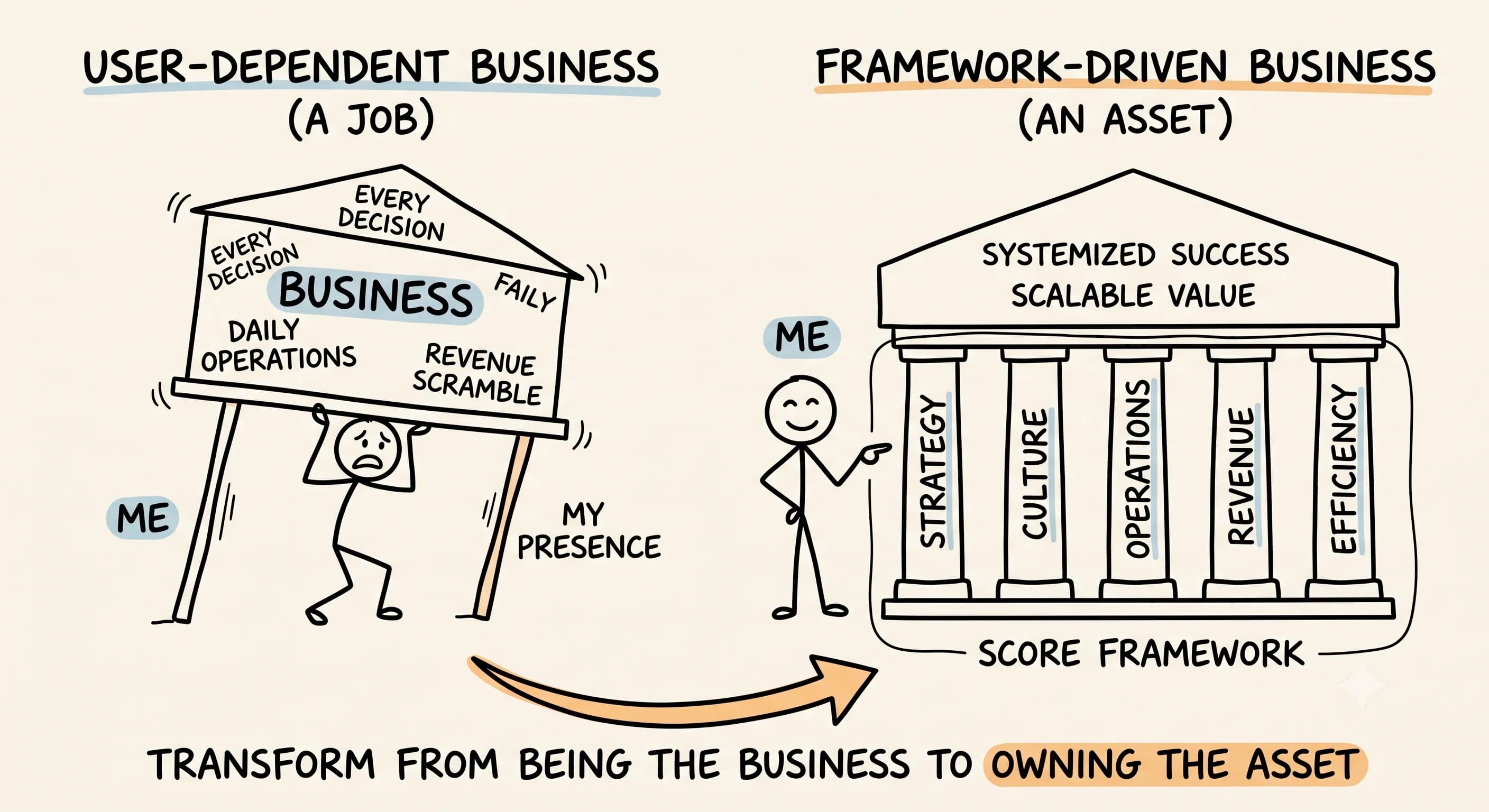
If your business cannot function without you physically present, you do not own a business. You own a job. That distinction matters enormously when you are trying to build a business that creates lasting value and eventually gives you the freedom you started this whole journey to find.
Every business owner deserves to ask: would you know whether cash flow remains healthy if you stepped back for a month? Could your team make decisions without you? If the honest answer is no, your business might be more dependent on you than you realize. The path forward starts with five pillars. Together, they form the SCORE framework.
Build a Business on Strategy First: The Foundation of Everything
 Strategy is not just a business plan or a set of quarterly goals. It starts with your mindset.
As a business owner, you need to be flexible enough to look at problems from multiple angles. There are always several ways to solve any challenge, and the entrepreneur who stays rigid in their thinking is the one who gets stuck. Strategy begins with recognizing that your way is not always the only way.
Your strategy covers three things: your vision for where the business is going, the values driving your decisions, and the positioning that makes you different in your market. For content creators specifically, this means getting clear on your niche, your audience, and the unique perspective you bring. What problems do you solve? What do you stand for? How do the content decisions you make today serve your long-term goals?
When strategy is clear, every decision downstream becomes easier. You stop chasing every trend and start making intentional business decisions aligned with where you are actually trying to go. That clarity is what separates creators who are building something from creators who are just staying busy.
Start here before anything else. Without a clear strategy, everything you build on top of it is guesswork. This applies whether you are a startup finding your footing or an established brand looking to grow.
Build a Business Culture That Amplifies Your Vision
 Culture is where your business begins to grow beyond just you.
Building the right culture means surrounding yourself with people who resonate with your strategy and your atmosphere. Not people who simply execute tasks. People who genuinely believe in what you are building and approach their work with the same values you hold.
You have probably experienced what happens when that alignment is missing. A video editor who does not understand your brand voice will produce technically fine work that feels completely off. A social media manager who does not connect with your mission will post content that falls flat with your audience. The skills can be there, and the results still disappoint, because the cultural fit is not.
When you hire employees or bring on contractors, cultural alignment is not a bonus. It is a requirement.
Culture also extends to the audience and community you cultivate. The people who follow you, engage with your content, and eventually become paying customers are part of your culture ecosystem too. Nurture that relationship intentionally, and your business becomes far more resilient, because your audience is invested in your success, not just your content.
Define your culture deliberately. Do not let it form by accident.
Business Operations: Create SOPs and Systems That Remove You From the Equation
This is where businesses either break free or stay trapped.
Standardizing your operations through Standard Operating Procedures is one of the most powerful things you can do to keep your business running smoothly without you. An SOP is simply a documented process that explains how a task gets done, step by step, so that anyone with the right skills can execute it consistently.
Think about every repetitive task in your business right now: editing workflows, publishing schedules, client onboarding, email responses, invoice processing, content repurposing. Every single one of those should have a documented process. Pair that documentation with automation tools, and you have created a business infrastructure that does not depend on any one person, including you.
Small business owners who do not document their processes often become the bottleneck without realizing it. Effective delegation only works when the process is documented. Most creators struggle to hand off work because the entire workflow lives in their head. When that happens, no one else can execute it reliably. You will end up re-doing things or over-explaining constantly, which defeats the purpose of delegating in the first place.
Solopreneurs who have replaced delegation with automation face a similar risk. A fully automated business might operate without a human team member, yet it can still depend on the owner to monitor, troubleshoot, and update every system. Automation reduces manual work, but it does not automatically create a self-sustaining business. Someone still needs to own the decisions.
Tools like a CRM for managing client relationships or project management software for tracking team tasks are foundational here. They create a shared source of truth that lets your team make decisions without needing to check in with you constantly. When your team feels empowered to make calls within their role, the whole business moves faster.
The 3 P's of business success reinforce exactly this point. People, Process, and Product work together as a unit. Solid processes transform capable people into a high-performing team. Without the process layer, your people cannot perform to their potential.
Start small. Document the tasks you do most often, then work outward from there.
Business Structure: Choose the Right Legal Foundation
Before you can truly run without constant involvement, your business needs the right legal and structural foundation underneath it.
Business formation is not just paperwork. Choosing the right business entity protects your business assets, separates personal and business finances, and affects how you conduct business, file taxes, and are perceived publicly. Sole proprietors carry unlimited personal liability. LLCs offer protection while keeping administration manageable. The best business structure for your situation depends on your industry, your goals, and how you want to scale.
Do different industries favor different structures? Yes. A local business providing services might operate well as an LLC, while a startup seeking investment may need a corporation. The Small Business Administration offers guidance on business formation options and filing requirements worth reviewing when you are deciding.
Once you have chosen your structure, register your business name, obtain any required business license for your jurisdiction, and open a separate business bank account. Keeping your financials clean from day one makes financial reporting straightforward and prevents headaches later. Mixing personal and business income is one of the most common and costly mistakes small business owners make.
Your business structure also affects branding and public perception. Clients and partners often take a formally structured business more seriously than an informal arrangement. A registered business entity signals that you are operating professionally and are here for the long term.
Can you change your business structure later if your needs evolve? Yes. Many businesses start as sole proprietors and transition to LLCs or corporations as business grows. Business development and growth often make restructuring necessary. Plan for that possibility from the start.
Structure Your Revenue Streams for Predictable Cash Flow
 Revenue is the core of your business operations, and this is where your marketing and sales systems live.
Structuring your revenue well determines whether your business has healthy cash flow or exhausting feast-and-famine cycles. Diversifying your revenue streams protects you when one channel underperforms. For content creators, that might look like combining ad revenue, brand partnerships, digital products, membership communities, coaching programs, and affiliate income. Each stream serves a different segment of your audience.
But having multiple streams is only half the equation. Each stream needs a clear marketing and sales process attached to it. How are new people discovering your offer? How are you nurturing them toward a purchase? How are you retaining existing customers over time?
How does healthy cash flow create business freedom? When your business income arrives predictably and you are not scrambling to cover expenses, you can invest in better tools, better people, and better business practices. You can also afford to step back, because the business does not depend on your daily presence to stay financially stable.
A business worth evaluating financially is one with structured, documented revenue systems. A business generating revenue through repeatable sales processes is worth significantly more than one generating the same amount because the owner shows up every single day and holds it all together personally.
Systems create value. Owner dependency destroys it. Map out each revenue stream, then document how each one works from first touch to sale to retention.
Business Efficiency: Execute All Four Pillars With Precision
Efficiency is the discipline that brings all four pillars to life.
It is not about doing more. It is about executing better. Efficiency is the ongoing practice of reviewing your strategy, culture, operations, and revenue systems to find where friction exists and eliminating it. Are business decisions getting made quickly and at the right level? Are your automated systems actually reducing workload? Is your team clear on priorities?
Eighty percent of your results come from twenty percent of your business activities. Efficiency means identifying that high-impact twenty percent and protecting it from everything else. This is the practical application of the 70 30 rule in business, where the majority of your focus belongs on activities that move the needle most.
Efficiency also means working less on the wrong things. Small business owners who are still in the weeds of every task are not building an asset, they are running a treadmill. Stepping back and working less on execution while focusing more on oversight is a sign of a mature, well-structured business.
Review each of the four pillars regularly. Ask where things are slowing down, where confusion exists, and where energy is being wasted. Then fix those things one at a time.
The SCORE Framework Is Your Roadmap to a Business That Runs Without You
When you build a business using the SCORE framework, you are not just building a company. You are building an asset. One with a defined strategy, a thriving culture, systemized operations, diversified revenue, and the efficiency to execute on all of it.
What does business owner freedom really mean? It means your business can operate without your daily input. It means you are building something a resilient business that does not require you to be present for every business decision. It means you can depend on your business without your business depending on you.
You can start today. Pick the weakest pillar right now and address it directly. If everything grinds to a halt the moment you step away, the answer is almost always in Operations. If you are stuck doing everything yourself, it is probably in Culture. If your income feels unpredictable, it is in Revenue. If your legal foundation is unclear, revisit your business structure.
Start with strategy. Build your culture. Systemize your operations. Secure your structure. Execute with efficiency.
Your business does not have to depend on you. With SCORE, it will not.
What is one task in your business you would love to delegate this quarter?
Read more about Systems, Workflows & Operations for Content Creators
📚 Complete Guides
⚡ Tactics & Strategies
- 30 Daily Outbound Pitches for UGC Deal Generation
- 50% Retention Rate Optimization for YouTube Algorithm Success
- AI Workflow Integration for Content Reduction
- Audience Consistency Strategy to Avoid Algorithm Penalties
- Audience Poll on Instagram to Source Q&A Content in Advance of Recording
📄 Related Articles
- Content Creator Burnout: Signs, Prevention, and the Mindset That Fixes It
- Influencer Authenticity: How Honest Product Reviews Drive Real Influence
- TikTok Creator Search Insights: How to Find Content Gaps That Guarantee Views
- The AI Content Creation Workflow: Turn 37 Seconds Into 1,200 Words
- The AI Content Workflow That Cuts Production Time by 70%
- Influencer Campaign Report: How Smart Reporting Systems Build Stronger Brand Relationships
- How to Get Traffic From Pinterest: Pins That Compound for Years
- Street Interviews: The LinkedIn Strategy That Went Viral

Alex Kirillov
Details
One link. Every channel, rate, and piece of work brands need to evaluate you. Built for how creators actually get hired.
Claim your profile
Live creator, content, and marketing roles from real companies, with the pay, market, and context the raw job page never gives you.
Browse jobs